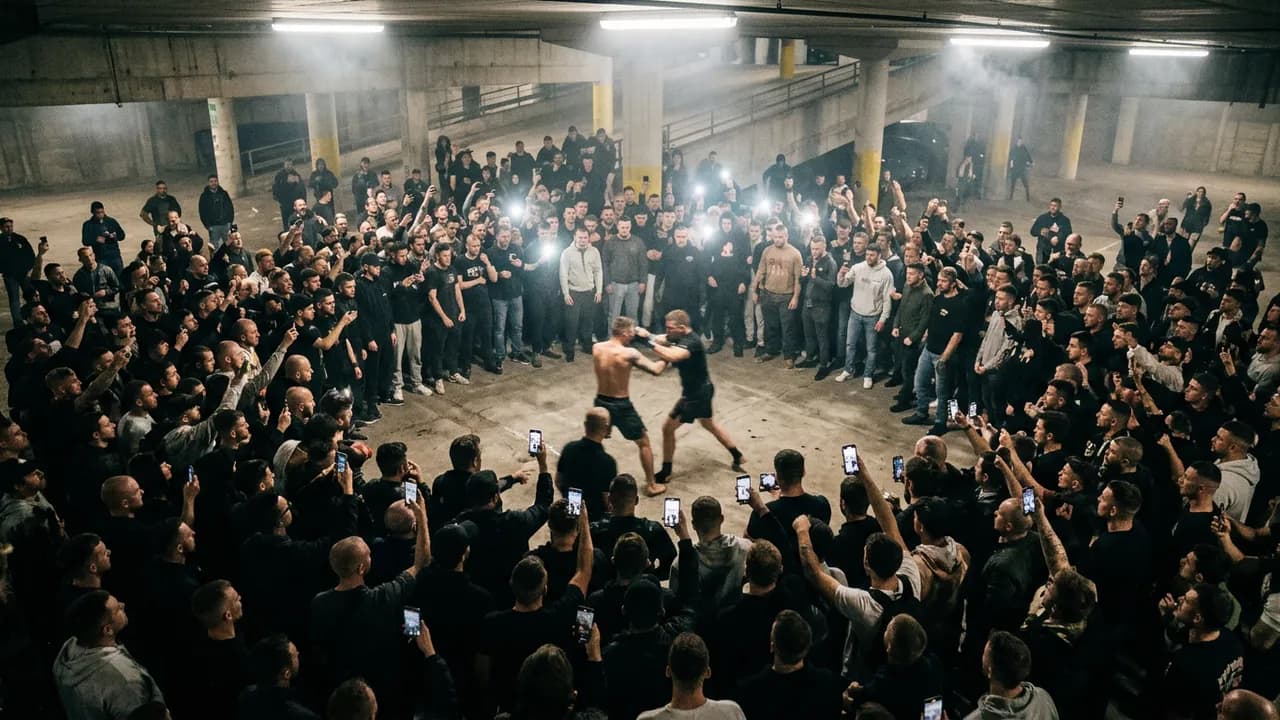
The connection between European football hooliganism and underground fighting is not metaphorical. It is structural. The organizations, the networks, the fighter recruitment pipelines, the culture of honor-through-violence that defines Europe's underground fight scene -- all of it grew directly from the organized hooligan firms that have operated around European football clubs for more than half a century.
To understand underground fighting in Europe is to understand hooliganism. The two are not merely related. In many cases, they are the same people, operating in the same networks, following the same codes, and fighting for the same reasons they always fought: territory, reputation, and the primal satisfaction of proving you are harder than the man standing across from you.
This is the story of how the organized violence around European football stadiums evolved into the continent's underground fight scene -- and why the two worlds remain inseparable.
The Firms: Where European Fight Culture Begins
European football hooliganism is not spontaneous. It is organized. The hooligan "firm" -- a semi-structured group of fighters affiliated with a particular football club -- has been a feature of European sporting culture since at least the 1960s, when English clubs like Millwall, West Ham, and Chelsea developed organized groups of supporters who attended matches with the explicit intention of fighting rival firms.
The firms operated on a hierarchy. Leaders, often called "top boys" in British terminology, organized and directed violence. Rank-and-file members carried out the fighting. The firms had rules -- unwritten but understood -- about who you fought, when, and how. Fighting civilians or uninvolved bystanders was generally considered unacceptable. Fighting rival firm members was expected. The violence was targeted, consensual in the sense that both sides sought it out, and governed by a code that, while informal, was remarkably consistent across countries and decades.
This organizational structure -- hierarchical, rules-based, built around reputation and testing -- is the direct ancestor of Europe's underground fight organizations. The firms were, in essence, fight clubs that happened to be organized around football.
The British Template
England established the template. From the 1960s through the 1980s, firms like the Inter City Firm (West Ham), the Headhunters (Chelsea), the Bushwackers (Millwall), and the Zulu Warriors (Birmingham City) made English football synonymous with organized violence. The firms were sophisticated operations. They used walkie-talkies and, later, mobile phones to coordinate ambushes. They traveled by train to away matches specifically to fight. They maintained internal hierarchies based on fighting ability and loyalty.
The British government's crackdown on hooliganism in the late 1980s and 1990s -- triggered by the Heysel disaster in 1985, the Hillsborough disaster in 1989, and escalating public concern -- drove the firms underground but did not eliminate them. CCTV cameras, football banning orders, and dedicated policing units made it harder to fight at or near stadiums. The firms responded by arranging "meets" -- pre-organized fights between rival firms in locations away from the grounds, away from cameras, and away from police.
These arranged meets were the prototype for what would become Europe's underground fight scene. Two groups, equal in number, meeting at an agreed location to fight. No civilians involved. No property destroyed. Just organized violence between consenting participants. The format was portable, scalable, and remarkably difficult for authorities to prevent.
Expansion Across the Continent
The firm model spread across Europe. Scandinavia, Eastern Europe, the Netherlands, Germany, France, Italy, and the Balkans all developed their own hooligan cultures, each with local variations but all sharing the essential structure: organized groups of young men, affiliated with football clubs, fighting rival groups according to informal but understood rules.
In Scandinavia, the firm culture took root in Sweden, Denmark, and Norway in the 1980s and 1990s. Swedish firms associated with clubs like AIK, Djurgarden, Hammarby, and IFK Gothenburg developed reputations for violence that rivaled anything in England. The Swedish scene was notable for its level of organization and its connections to both far-right politics and organized crime -- connections that would later manifest directly in the country's underground fight scene.
In Russia and Eastern Europe, hooliganism developed later but with extraordinary intensity. Russian firms associated with clubs like Spartak Moscow, CSKA Moscow, and Zenit St. Petersburg became some of the most violent in the world by the 2000s. The Russian hooligan scene placed enormous emphasis on fighting ability, with firms recruiting from boxing gyms, kickboxing schools, and martial arts dojos. This emphasis on combat skill, rather than mere willingness to brawl, laid the groundwork for Russia's emergence as a center of organized underground fighting in the 2010s.
From Firm Meets to Fight Clubs: The Evolution
The transition from hooligan firm meets to organized underground fight clubs was not a single event but a gradual evolution driven by several converging factors.
The Arranged Meet Format
By the 2000s, arranged meets between hooligan firms had developed into something that closely resembled organized fight events. The typical format involved two firms agreeing -- through intermediaries, phone calls, or later, social media -- to meet at a specific location at a specific time. The location was chosen for its remoteness: forest clearings, industrial estates, abandoned buildings, rural roads. Each side brought an equal number of fighters. The fight was conducted under rudimentary rules: no weapons, no continuing against a downed opponent, and a general understanding that the fight ended when one side was clearly beaten.
Viewers who had no connection to football hooliganism became fascinated by the spectacle of organized group fights.
These meets were filmed. Initially, the footage was shared privately among firm members as proof of victory or evidence of a rival firm's cowardice. As mobile phone cameras improved and social media platforms emerged, the footage began to circulate more widely. By the early 2010s, arranged meet footage was a distinct genre of online content, with compilation videos accumulating millions of views on YouTube and other platforms.
The footage created demand. Viewers who had no connection to football hooliganism became fascinated by the spectacle of organized group fights. That demand created a market. And that market created the economic incentive for someone to formalize the format, add production value, and turn hooligan meets into a commercial entertainment product.
The Key Transition: Individual Combat
The critical innovation that transformed hooligan culture into an underground fight scene was the shift from group fighting to individual combat. Firm meets were mass brawls -- ten versus ten, twenty versus twenty, sometimes more. They were chaotic, difficult to film effectively, and legally indistinguishable from riots. The entertainment value, while real, was limited by the chaos of the format.
Individual fights -- one man against one man, filmed with proper cameras, in a controlled space -- were more watchable, more dramatic, and more marketable. They allowed for the development of fighter personalities, rivalries, and narratives. They were also legally simpler: two men agreeing to fight was easier to defend than twenty men brawling on an industrial estate.
The transition happened organically. Firms began settling disputes through champion fights -- the best fighter from each firm facing the best fighter from the rival firm. These champion fights were filmed with increasing production quality. The fighters developed reputations. Audiences grew. And eventually, someone recognized that you did not need the football pretense at all. You could simply organize fights between willing combatants, film them, and put them on the internet.
King of the Streets: The Definitive Expression
The organization that most fully realized the transition from hooligan culture to commercial underground fighting is King of the Streets (KOTS), founded in Gothenburg, Sweden, in 2013 by an anonymous collective known as "Hype Crew."
The Founders
The Hype Crew's background was unmistakable. Its members came from Swedish hooligan firms, organized crime, and the combat sports gym scene -- three worlds that overlap extensively in Scandinavian underground culture. The collective's anonymity was not a marketing gimmick. It was a necessity. KOTS operates outside the law, and its founders face genuine legal risk if identified.
The connection to hooliganism was built into KOTS's DNA. The organization's fighter recruitment drew heavily from firm networks across Europe. Fighters arrived at KOTS events through connections to hooligan groups in Sweden, Denmark, Germany, Poland, England, and beyond. The culture of the events -- the emphasis on toughness, the disdain for protective equipment, the codes of respect between combatants -- was directly imported from hooligan firm culture.
The Format
KOTS's format stripped fighting to its most elemental: bare hands, concrete surface, no rounds, no time limit, no judges, no decisions. A fight ended only when one man was knocked out, submitted, or quit. Headbutts, elbows, knee strikes, and techniques banned by every sanctioned combat sport were permitted. The only restrictions were those the fighters agreed to before stepping onto the concrete.
This format was the logical endpoint of hooligan fight culture. Firm meets had always valued raw toughness over technical skill. KOTS formalized that value system into a competition format that was as close to actual street fighting as could be organized without descending into complete chaos.
The concrete surface was particularly significant. In sanctioned combat sports, the fighting surface -- canvas, mat, or cage -- is designed to reduce injury from falls and takedowns. KOTS's concrete floor made takedowns dangerous, grappling risky, and knockdowns potentially catastrophic. It was a deliberate choice that reflected the hooligan ethos: the fight should be real, the consequences should be real, and the surface should be the same surface you would fight on in the street.
The Documentary and Cultural Impact
The 2024 documentary "KING OF THE STREETS" provided the most detailed public account of the organization's roots in hooligan culture. The film traced the connections between KOTS, Swedish football firms, and the broader European underground fight scene, revealing an organizational ecosystem that was simultaneously more sophisticated and more dangerous than casual viewers had assumed.
03 / Up next / The Copycat Movement: KOTS Spawns a Continent-Wide Scene
The documentary also explored KOTS's connections to far-right extremism and organized crime -- themes that the Swedish film "The Cage" had previously dramatized in fictional form. These connections are not incidental. The European hooligan firms from which KOTS draws its fighters and its culture have long been intertwined with far-right political movements, particularly in Sweden, Germany, Poland, and Russia. The fighting scene is not separate from these political dynamics; it exists within them.
The Copycat Movement: KOTS Spawns a Continent-Wide Scene
KOTS's success on YouTube -- its channel surpassed one million subscribers and individual videos regularly exceeded a million views -- spawned copycat organizations across Europe. The "no rules" fighting format that KOTS popularized became a template that could be replicated by anyone with a camera, a concrete floor, and willing fighters.
FPVS (France)
On the French Riviera, two twenty-year-old men named Leon and Victor launched FPVS, a no-rules fighting organization that explicitly adopted the KOTS format: concrete surface, bare hands, no rules. FPVS recruited through Telegram, drawing fighters from the young working-class male demographic -- construction workers, restaurant servers, men aged 18-25 with combat sports interest and limited economic prospects.
FPVS was technically unaffiliated with KOTS, but it was spiritually a direct descendant. The format, the aesthetic, the recruitment methods, and the cultural values were identical. The primary difference was geography. FPVS proved that the KOTS model was portable -- it could be transplanted to any European country with a population of young men willing to fight on concrete.
UUF (Denmark)
In Denmark, Ultimate Underground Fights (UUF) emerged as part of the same broader movement. Operating in abandoned warehouses, industrial halls, and vacant lots across Denmark, UUF adopted the no-gloves, no-rules format and communicated through encrypted messaging to avoid police detection. The organization flew in international fighters and attracted up to 100 spectators per event.
A Danish podcast, "Undergrunden: Den danske fightclub," exposed UUF's operations and revealed its participants to be largely ordinary people -- mechanics, office workers, fathers -- who were drawn to the scene for the same reasons that hooligan firm members had always been drawn to organized violence: the test, the rush, and the community of people willing to share the experience.
Holmgang (Germany)
The most extreme expression of the European movement was Holmgang, a German-based organization that staged fights with medieval weapons -- swords, axes, and other bladed implements -- with minimal protective equipment. Named after the historical Norse dueling practice, Holmgang represented the point where the underground fight scene's obsession with authenticity crossed into territory that most observers considered genuinely insane.
Holmgang participants wore T-shirts and light protection while absorbing full-power strikes from sharpened steel. The risk of severe laceration, disfigurement, or death was explicit and accepted. The organization operated entirely outside the law, and its existence demonstrated that there was no floor to how far the European underground fight scene was willing to go.
The Cultural Code: Understanding Why They Fight
To understand the connection between hooliganism and underground fighting, it is necessary to understand the cultural code that governs both worlds.
Honor and Reputation
In hooligan culture, reputation is everything. A firm's standing is determined by its record in arranged meets. An individual's standing within the firm is determined by his willingness to fight and his performance when he does. Cowardice -- failing to show up for a meet, running during a fight, refusing a challenge -- is the ultimate disgrace. Bravery -- standing and fighting against superior numbers, continuing despite injury, showing up when others do not -- is the highest virtue.
This value system transfers directly to underground fighting. Fighters in organizations like KOTS, FPVS, and UUF are not primarily motivated by money. Most earn nothing. They fight for the same thing their hooligan predecessors fought for: the respect of their peers and the knowledge that they tested themselves and did not flinch.
The In-Group Bond
Hooligan firms and underground fight organizations both function as communities built around shared risk. The experience of fighting -- of accepting the possibility of serious injury, of trusting that your opponent will respect the code, of standing beside men who are willing to do the same -- creates bonds that are difficult to replicate in civilian life.
05 / Up next / The Code of Conduct
For many participants, the fight organization fills a social need that has nothing to do with violence per se. It provides belonging, purpose, hierarchy, and a clear standard of evaluation. In a world where traditional markers of masculine identity -- physical labor, military service, community standing -- have eroded, the fight organization offers a space where those markers still apply.
The Code of Conduct
Despite the violence, both hooligan culture and underground fighting operate under codes of conduct that their participants take seriously. In KOTS, fighters shake hands before and after bouts. In arranged firm meets, attacking a downed opponent is considered dishonorable. In virtually every European underground fight organization, fighting civilians, involving bystanders, or using weapons when fists have been agreed upon is viewed as a transgression that invites expulsion and disgrace.
These codes are not always followed. The reality of underground fighting is messier than its ideals. But the existence of the codes -- and the social consequences for violating them -- demonstrates that European underground fighting is not mindless violence. It is organized, governed, and culturally coherent, even if the governance is informal and the coherence is invisible to outsiders.
The Dark Side: Far-Right Politics and Organized Crime
The connection between European hooliganism, underground fighting, and far-right extremism is well-documented and cannot be ignored.
Swedish hooligan firms associated with clubs like AIK and Hammarby have historical connections to far-right organizations. KOTS's anonymous founders have been linked to networks that include both organized crime and political extremism. In Germany, the hooligan-to-underground-fighting pipeline passes through communities where far-right ideology is prevalent. In Russia, the overlap between football hooliganism, organized crime, and ultranationalist politics is extensive and well-documented.
This does not mean that every underground fighter in Europe is a far-right extremist or an organized criminal. Many fighters are drawn to the scene purely for the fighting and have no interest in politics or criminal activity. But the organizational infrastructure -- the networks through which fighters are recruited, events are organized, and locations are secured -- frequently passes through communities where extremism and crime are present.
The 2024 Swedish film "The Cage" explored this intersection through fiction, depicting a young fighter drawn into an underground fighting world intertwined with organized crime and far-right ideology. The film's reception suggested that the European public is increasingly aware of these connections, even if the underground fighting community itself is reluctant to address them directly.
The Current Landscape: Football Hooligans and Fighting in 2026
In 2026, the relationship between European football hooliganism and underground fighting remains as strong as ever, even as both worlds evolve.
The hooligan firms continue to operate, though with increasing sophistication in avoiding detection. Arranged meets still take place across Europe, though they are now planned through encrypted messaging apps rather than phone calls. The fighters who emerge from the firm scene continue to populate underground fight organizations, bringing their skills, their codes, and their networks with them.
The underground fight organizations have, in many cases, outgrown their hooligan origins. KOTS's audience includes millions of YouTube viewers who have no connection to Swedish football. Top Dog FC attracts fighters from professional boxing and kickboxing backgrounds alongside former hooligans. Strelka has always drawn from the general population rather than specifically from hooligan culture. The scene is diversifying.
But the foundation remains. The organizational DNA of European underground fighting is hooligan DNA. The culture of honor-through-combat that pervades the scene is hooligan culture. The networks that connect fighters across borders are, in many cases, the same networks that connect firms across borders. The European underground fight scene was built by football hooligans, and even as it evolves beyond its origins, those origins remain visible in its structure, its values, and its participants.
The question for the future is whether the underground fight scene can fully separate itself from the most destructive elements of hooligan culture -- the far-right politics, the organized crime connections, the indifference to fighter safety -- while preserving the elements that make it compelling: the authenticity, the courage, the community, and the raw, unfiltered commitment to testing yourself against another human being.
That question has not yet been answered. But as long as young men in Europe are willing to fight on concrete for nothing but reputation, the answer will continue to be written in bruised knuckles and split lips on warehouse floors from Gothenburg to the French Riviera.