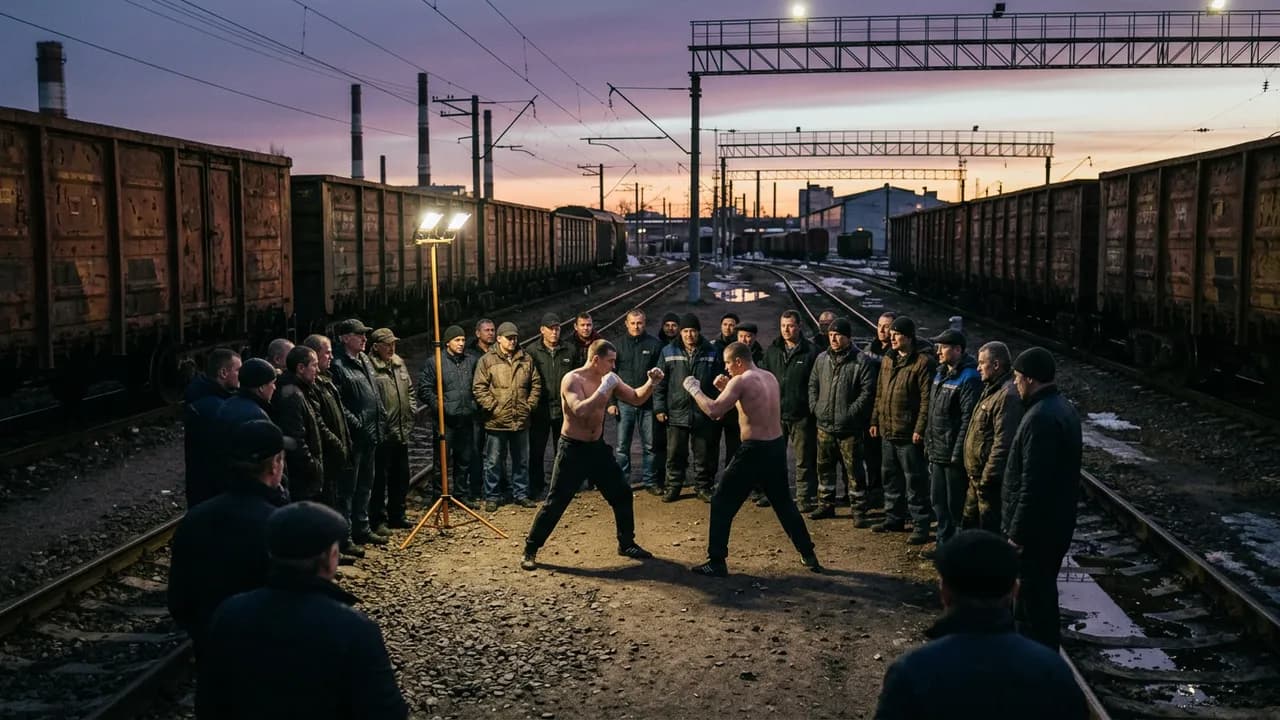
St. Petersburg is Russia's cultural capital. It is home to the Hermitage Museum, the Mariinsky Theatre, and some of the most magnificent architecture in Europe. It is also where a man named Greg, freshly unemployed from Fedor Emelianenko's entourage, decided to stage an MMA fight in a sand ring as a publicity stunt -- and accidentally created the biggest fight club in the world.
Strelka was born in St. Petersburg in 2011. Fifteen years later, it has grown into a decentralized empire spanning nearly 50 Russian cities and the CIS nations, with over 10,000 active participants, a virtual roster exceeding 40,000 fighters worldwide, and a YouTube presence of more than 2.45 million subscribers and 1.5 billion views. Only the UFC generates more combat sports viewership on the platform.
St. Petersburg did not just produce Strelka. It produced the template for how modern fight clubs operate at scale -- amateur, decentralized, and built on the understanding that the internet can turn a sand ring in a vacant lot into a global brand.
The Founding Story
The origin of Strelka reads like a screenplay that a studio executive would reject as too implausible. In 2011, a figure known as Greg -- who had previously worked for legendary MMA fighter Fedor Emelianenko -- found himself out of a job. He had an idea to open a sporting goods store in St. Petersburg and wanted to generate publicity with an attention-grabbing event. His solution: organize a bare knuckle MMA fight outdoors, film it, and use the footage to drive traffic to his business.
The first event was held in an outdoor space in St. Petersburg. The ring was improvised -- a circle drawn in sand, with ropes or barriers to mark the boundaries. Two cameras recorded the action. Two pairs of gloves were passed from one fighter to the next. The rules were minimal: no rounds, no time limits, fight until one person surrenders or cannot continue. The setup cost almost nothing. The footage was uploaded to YouTube.
The sporting goods store never materialized. But the fight club did. The videos resonated immediately with Russian audiences, and the response was strong enough that Greg and his collaborators decided to stage another event, and then another. Strelka was born -- not from a grand vision of building the world's largest fight club, but from a failed retail marketing plan.
The Sand Ring
The sand ring is Strelka's most distinctive feature, and it was established from the very first event in St. Petersburg. Unlike King of the Streets, which fights on concrete, or Streetbeefs, which uses grass or dirt, Strelka fills its improvised ring with sand.
The sand serves multiple purposes. It provides cushioning for fighters who are taken down or knocked out, significantly reducing the risk of head injuries from impact with the fighting surface. It gives the events a visual identity that is immediately recognizable -- the sight of two fighters circling each other on sand, outdoors, with a crowd pressed in around the ring, is unmistakably Strelka. And it reinforces the amateur, improvised aesthetic that has always been central to the organization's appeal. The sand ring says: this is not a professional event. This is a fight.
In St. Petersburg, the original sand ring events were held outdoors in parks, vacant lots, and open spaces around the city. The outdoor setting was both practical -- no venue rental costs -- and atmospheric. Fights took place under open skies, in whatever weather St. Petersburg's notoriously unpredictable climate delivered. Rain, wind, cold -- none of it stopped the events. The conditions added to the rawness of the spectacle and reinforced the message that Strelka was not for the faint-hearted.
The Democratic Fight Club
Strelka's founding principle -- established in St. Petersburg and maintained as the organization scaled -- is radical openness. Anyone can fight. There are no tryouts, no qualifications, no professional credentials required. A truck driver can face a sushi chef. A dockworker can fight a college student. A first-timer with no training can step into the sand ring against someone with years of martial arts experience.
This democratic approach is what separates Strelka from virtually every other fighting organization in the world. Professional promotions screen and select their fighters. Even other underground organizations like Top Dog curate their rosters. Strelka takes all comers. The only requirement is the willingness to fight.
03 / Up next / Football Hooliganism and Fighting Culture
In St. Petersburg, this meant that Strelka events drew from the full spectrum of the city's population. Working-class men from the city's industrial districts fought alongside white-collar professionals looking for an adrenaline rush. Football hooligans tested their skills against martial arts practitioners. Immigrants, students, veterans, and anyone else who showed up was welcome to step between the ropes.
The result was a kind of sporting event that feels more like a village festival than a professional fight card. The atmosphere at a St. Petersburg Strelka event is communal, chaotic, and electric. Fighters are cheered and consoled in equal measure. Wins are celebrated but losses are not stigmatized. The crowd understands that stepping into the sand ring at all is an act of courage, regardless of the outcome.
Football Hooliganism and Fighting Culture
St. Petersburg's fighting culture did not emerge from nothing. It was nourished by decades of football hooliganism that made the city -- and Russia more broadly -- infamous among European football communities.
Russian football firms -- organized groups of supporters associated with clubs like Zenit St. Petersburg -- developed sophisticated fighting cultures that blended athletic training, martial arts, and street combat. Unlike the stereotypical image of drunken hooligans brawling outside stadiums, Russian firms trained seriously. They maintained fitness regimes, practiced fighting techniques, and organized structured confrontations with rival firms that resembled planned military engagements more than spontaneous violence.
This hooligan culture created a large population of young men in St. Petersburg who were physically fit, experienced fighters, and hungry for structured competition. When Strelka arrived, it offered exactly what they were looking for: a legitimate arena for combat that did not require the risks of street confrontation. During the 2018 FIFA World Cup in Russia, international media profiled this phenomenon extensively, with the South China Morning Post noting that while Russian hooligans were conspicuously absent from World Cup venues, organizations like Strelka had channeled their aggressive energies into something more constructive.
The relationship between football culture and fighting culture in St. Petersburg remains tight. Many Strelka fighters come from the hooligan world. Many spectators are active supporters of Zenit and other clubs. The events draw on the same tribal loyalties, the same codes of respect and toughness, and the same appetite for physical competition that define football firm culture.
Strelka's Expansion from St. Petersburg
St. Petersburg was the launchpad, but Strelka did not stay contained to a single city. The organization's decentralized model -- which allows independent organizers to stage events under the Strelka banner using a standardized format -- enabled rapid expansion across Russia and the CIS nations.
By the mid-2010s, Strelka events were being held in nearly 50 cities across Russia. Each local chapter operated with significant autonomy, adapting to local conditions while maintaining the core format: sand ring, no rounds, fight to finish, amateurs only. The YouTube channel served as the unifying platform, aggregating content from events across the country and presenting it to a growing global audience.
The creator registered the Strelka trademark in the United States, signaling ambitions that extended beyond the Russian domestic market. Partnerships with international promotion companies, including the American firm TronMMA, brought Strelka's format to new territories and new audiences. The organization's website, tronmma.com, now serves as a registration portal for fighters around the world.
But St. Petersburg remains the spiritual home. The city's sand rings were the original proving grounds, and its fighters were the first to establish the norms and culture that define Strelka events worldwide. When fighters from other cities step into a Strelka ring, they are participating in a tradition that began in St. Petersburg's parks and vacant lots.
The Strelka Experience in St. Petersburg
Attending a Strelka event in St. Petersburg is an experience unlike anything in mainstream combat sports. The events are typically held outdoors, weather permitting, in open spaces that could be a park, a vacant lot, or a cleared area near an industrial site. The sand ring is set up in the center, surrounded by whatever barriers are available. Spectators crowd in close -- there are no assigned seats, no VIP sections, no production lighting rigs.
The fights themselves are raw and unpredictable. Without weight classes, the physical mismatches can be dramatic. A 200-pound martial artist might face a 160-pound first-timer who has never thrown a punch in anger. Sometimes the bigger, more experienced fighter dominates. Sometimes the underdog delivers a shocking upset. The absence of rounds means that fights can end in seconds or grind on for minutes, with both fighters exhausted and covered in sand.
06 / Up next / St. Petersburg's Place in the Russian Fighting Hierarchy
Between fights, the atmosphere is social. Fighters who have just competed stand on the sidelines watching others, offering encouragement or commentary. Beer is consumed. Stories are told. The sense of community is genuine -- these are not spectators watching athletes perform. These are participants in a shared experience, bound by the willingness to fight or to watch fighting at the closest possible range.
St. Petersburg's Place in the Russian Fighting Hierarchy
In the broader Russian fighting landscape, St. Petersburg occupies a specific position. If Moscow is the professional capital -- home to Top Dog, its CSKA Arena events, and its polished pay-per-view productions -- St. Petersburg is the grassroots capital. The city's fighting culture values accessibility over exclusivity, participation over spectating, and authenticity over production value.
This is not a hierarchy of quality. It is a hierarchy of approach. Top Dog and Strelka serve different audiences and different purposes, and both have found massive success. But the difference in ethos is real. Top Dog curates. Strelka includes. Top Dog engineers spectacle. Strelka embraces chaos. Top Dog fills arenas. Strelka fills sand rings.
For fans of underground fighting, St. Petersburg represents the purest expression of the fight club ideal -- a place where anyone can fight, where the ring is made of sand, where the rules are minimal, and where the only thing that matters is your willingness to step in. The city that produced Strelka did not just create a fight club. It created a template that has been replicated around the world, from parking lots in American suburbs to industrial sites in European cities. St. Petersburg's sand ring is where it all began.
Related Reading
- Strelka -- Full organizational profile
- Top Dog Fighting Championship -- Moscow's professional bare knuckle promotion
- Underground Fighting in Moscow -- St. Petersburg's counterpart in the Russian fighting scene
- King of the Streets (KOTS) -- The Swedish promotion influenced by Russian fighting culture