Quick Facts
| Detail | Info |
|---|---|
| Founded | 2011 |
| Location | St. Petersburg, Russia (events across Russia and CIS) |
| Format | Amateur MMA in a sand ring; no rounds, fight to finish |
| Participants | 10,000+ (Russia/CIS); 40,000+ (global roster) |
| YouTube Subscribers | 2.45 million+ |
| YouTube Views | 1.5 billion+ |
| Website | tronmma.com |
| Social Media | YouTube: STRELKA - Street Fight Championship |
Overview
Strelka is the biggest fight club in the world. That is not marketing hyperbole or internet exaggeration -- it is a statement supported by numbers that dwarf every other underground fighting organization on the planet. With more than 10,000 participants across Russia and the CIS nations, a virtual roster exceeding 40,000 fighters from around the globe, and a YouTube presence that ranks second only to the UFC in combat sports viewership, Strelka has achieved a scale that its founders could not have imagined when they staged their first events in St. Petersburg in 2011.
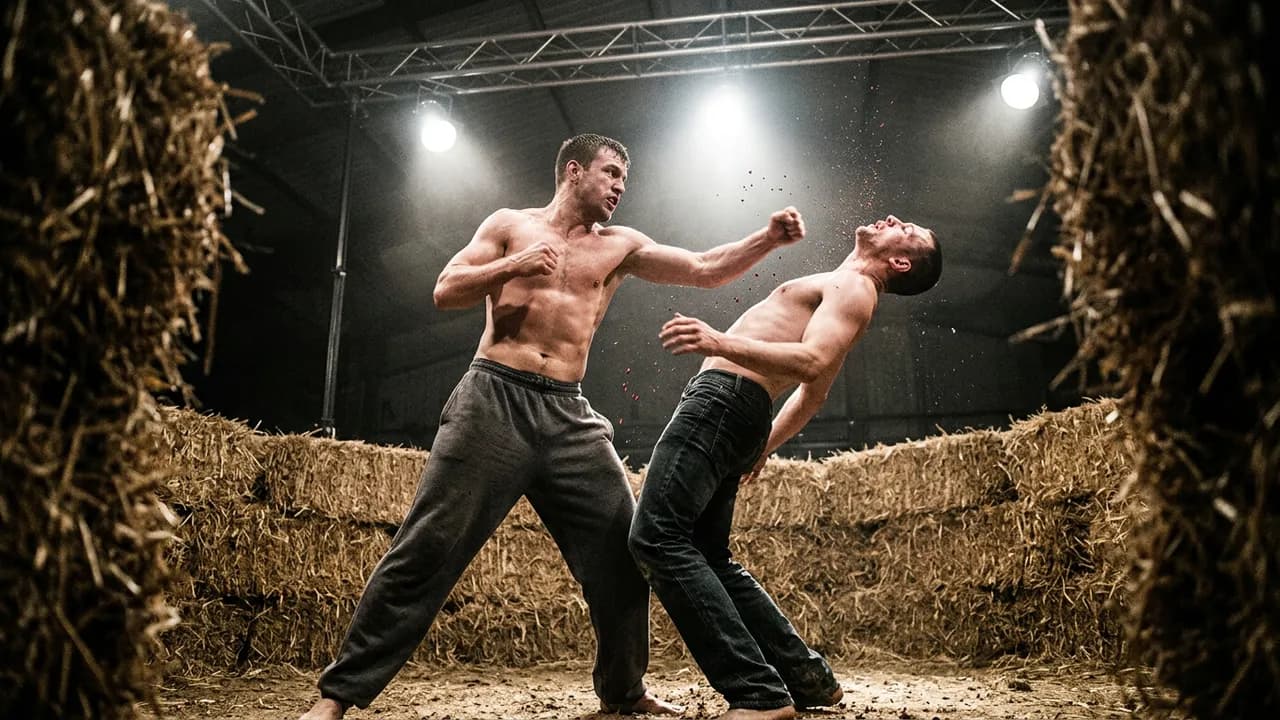
The concept is elegant in its simplicity. An outdoor sand ring. No rounds. No time limits. Amateurs only. Two fighters enter, and they fight until one surrenders, is knocked out, or can no longer continue. It is raw, democratic, and open to anyone willing to step between the ropes, regardless of age, background, or training. A truck driver from Bryansk can fight a sushi chef from Kislovodsk. A longshoreman from St. Petersburg can face a hawker from Sochi. In Strelka's sand ring, the only credential that matters is the willingness to fight.
History
Strelka was founded in 2011 in St. Petersburg, Russia's cultural capital and second-largest city. The name "Strelka" translates roughly to "arrow" or "meeting point" in Russian -- a fitting name for an organization built around the concept of two people coming together to settle matters with their fists.
The early Strelka events were modest affairs, held outdoors in parks, vacant lots, and other open spaces around St. Petersburg. The format was inspired by Russia's long tradition of informal fighting -- from the historical wall-to-wall fistfights of Russian villages to the modern hooligan culture surrounding football clubs. But where those traditions were disorganized and spontaneous, Strelka brought a level of structure that made events repeatable, filmable, and ultimately scalable.
The founders recognized early on that video would be the key to growth. Strelka fights were filmed from the beginning and uploaded to YouTube, where the combination of genuine combat, unpredictable outcomes, and diverse participants proved irresistible to audiences. The channel grew steadily, crossing one million subscribers and then continuing to climb toward its current total of over 2.45 million.
The creator registered the Strelka trademark in the United States, a move that signaled ambitions beyond the Russian domestic market. By the mid-2010s, Strelka had expanded from its St. Petersburg base to cities across Russia and the CIS nations, establishing a decentralized network of events unified by a common format and brand.
The organization achieved peak cultural relevance during the 2018 FIFA World Cup in Russia, when international media attention turned to the country's hooligan and fighting subcultures. Coverage in outlets like the South China Morning Post profiled Strelka as a constructive channel for the aggressive energies of Russia's fighting community -- a place where hooligans could earn respect through skill rather than street violence.
Format
The Sand Ring
The sand ring is Strelka's most distinctive visual element and its most important safety feature. Unlike KOTS, which fights on concrete, or Streetbeefs, which uses grass or dirt, Strelka's improvised ring is filled with sand instead of canvas. This provides significantly more cushioning than a hard surface, reducing the risk of serious head injuries from takedowns and knockdowns while still maintaining the raw, outdoor aesthetic that defines the organization.
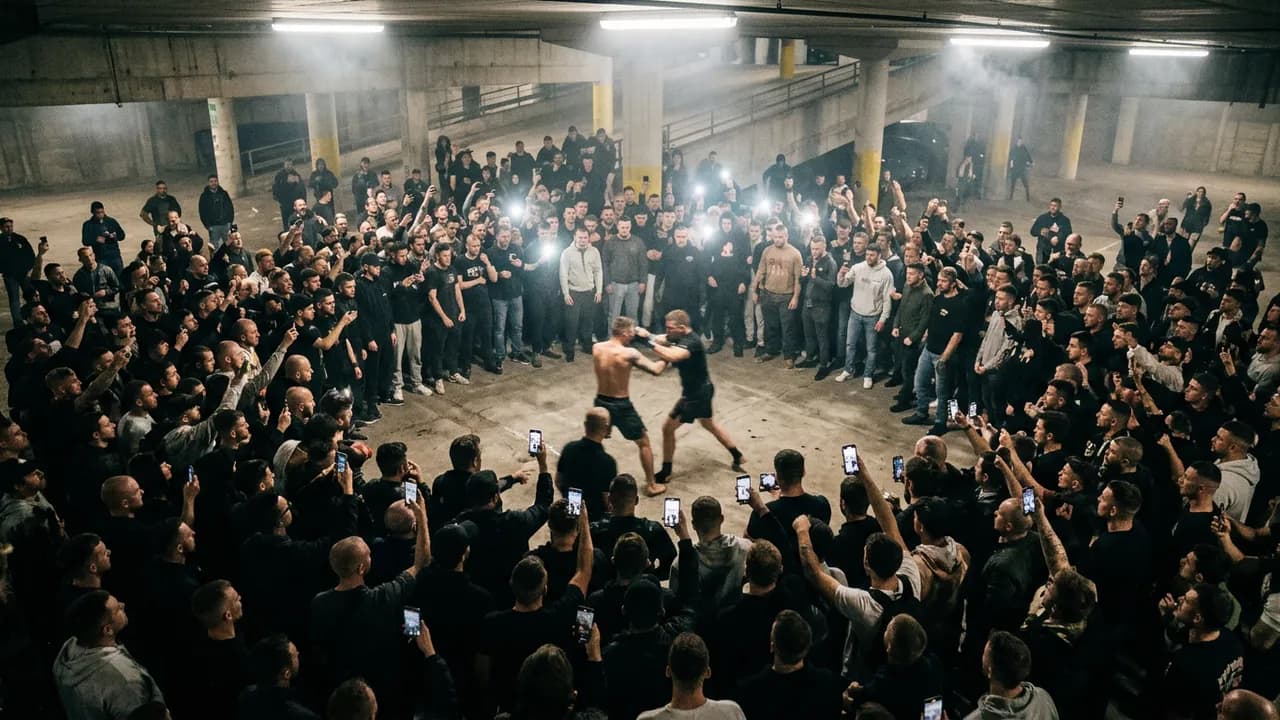
The ring itself is a simple circle marked out in an open-air location. There are no ropes, no cage, and no elevated platform. Fighters compete at ground level, surrounded by spectators who crowd close to the action.
Rules
Strelka operates under modified MMA rules that are more permissive than sanctioned amateur MMA but significantly more restrictive than no-rules organizations like KOTS:
- No rounds: Each fight is a single continuous bout with no time limit.
- No elbows to the head: Elbow strikes targeting the head are prohibited.
- No knees to the head: Knee strikes to the head are also banned.
- Fight to finish: A fight ends only when one fighter surrenders (verbally or by tap), is knocked out, or is unable to continue. Referee stoppage is also possible.
- MMA-style combat: Striking, grappling, takedowns, and submissions are all permitted within the restrictions above.
Amateurs Only
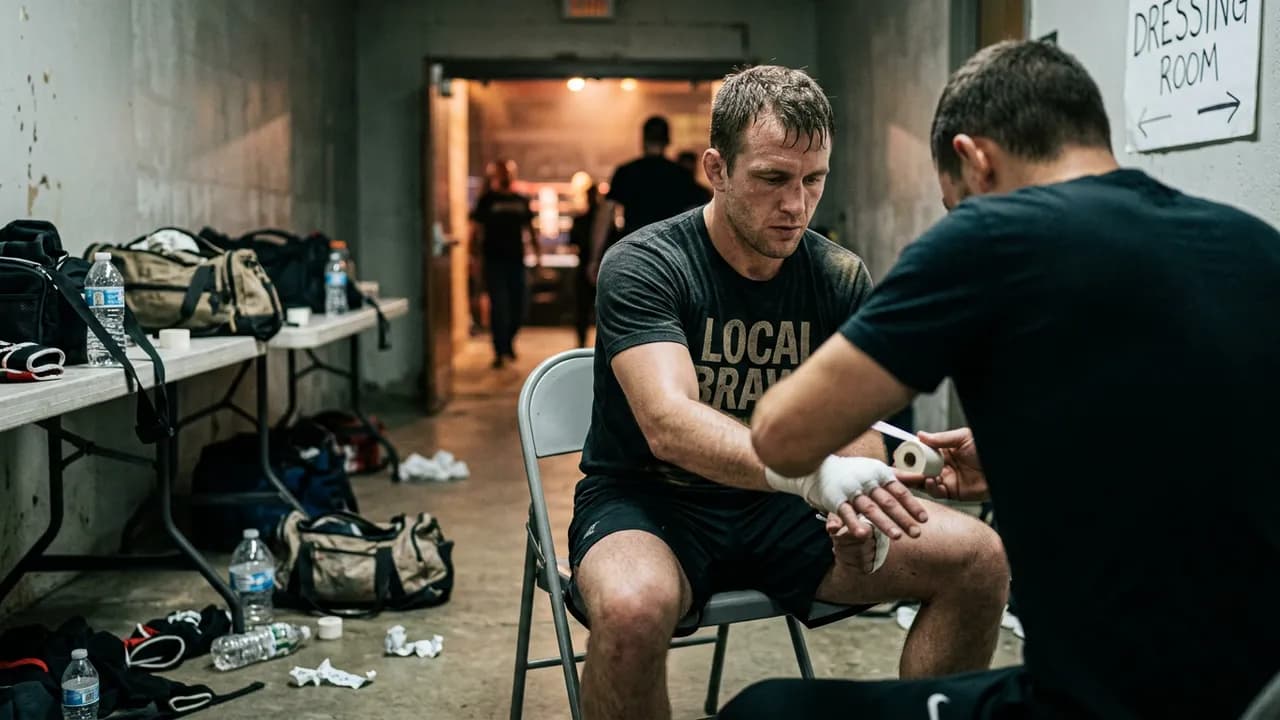
One of Strelka's founding principles is that it is an amateur organization. There are no professional fighters on Strelka cards. Participants are everyday people -- truck drivers, cooks, laborers, students, office workers -- who sign up for the experience and the adrenaline. Most fight for free, with no financial compensation beyond the occasional prize for tournament winners.
04 / Up next / Scale
This amateur ethos is central to Strelka's appeal. The fighters are relatable. They do not have six-pack abs, sponsorship deals, or walkout songs. They are ordinary people doing something extraordinary, and audiences respond to that authenticity in ways that polished professional promotions cannot replicate.
Scale
The numbers behind Strelka are staggering:
- 10,000+ participants have competed in Strelka events across Russia and the CIS nations since 2011.
- 40,000+ fighters are registered on the virtual roster through the tronmma.com platform.
- 2.45 million YouTube subscribers make Strelka one of the largest combat sports channels on the platform.
- 1.5 billion+ YouTube views across all content, placing the channel second in combat sports viewership behind only the UFC.
- Events have been held in dozens of cities across Russia, from Moscow and St. Petersburg to regional centers in Siberia, the Caucasus, and the Russian Far East.
- International expansion has brought Strelka events to other CIS nations and even to Italy, with a STRELKA ITALY branch operating under the organizational umbrella.
This scale is achieved through a decentralized model. Strelka does not need to transport fighters, rent arenas, or maintain a centralized infrastructure. Local organizers in each city handle logistics, recruit participants, and run events under the Strelka brand. The result is a franchise-like network that can operate simultaneously in multiple locations with minimal central overhead.
YouTube Presence
Strelka's YouTube channel, "STRELKA - Street Fight Championship," is the second most-viewed combat sports channel on the platform after the UFC. This is a remarkable achievement for an amateur organization operating without the marketing budgets, television deals, or celebrity fighters that drive viewership for established promotions.
The channel's success is driven by several factors:
- Volume: With thousands of fights filmed over more than a decade, the library of content is enormous.
- Authenticity: The fights are real, unscripted, and feature genuine emotions. There are no predetermined outcomes.
- Accessibility: All content is uploaded for free, removing barriers to viewership.
- Diversity: The range of fighters -- different body types, skill levels, backgrounds, and fighting styles -- means that every fight is unique and unpredictable.
- Algorithm-friendly content: Combat sports content performs well with YouTube's recommendation algorithm, and Strelka's high-volume upload schedule keeps the channel constantly in circulation.
The channel's 2.45 million subscribers represent a global audience, with significant viewership in Russia, the CIS nations, Western Europe, and increasingly the United States and Latin America.
Notable Fighters
Andrei Petrantsov
The most famous Strelka fighter never set out to become a combat sports star. Andrei Petrantsov, a truck driver from Bryansk, stepped into the Strelka sand ring as a nobody and walked out as a viral sensation. His knockout -- a single devastating punch that put his opponent to sleep instantly -- was viewed over 24 million times on YouTube, making it one of the most-watched amateur fight moments in internet history.
Petrantsov's story encapsulates everything that makes Strelka compelling. He was not a trained fighter. He was not sponsored. He was a working-class man from a provincial Russian city who decided to test himself in the ring. The fact that he delivered one of the sport's most spectacular knockouts is a testament to the unpredictability that makes amateur fighting so captivating.
The Everyman Fighters
Strelka's roster reads like a cross-section of Russian society: sushi chefs from Kislovodsk, longshoremen from St. Petersburg, hawkers from Sochi, students from Moscow, and factory workers from the Urals. Many of these fighters never compete more than once or twice, but their individual stories -- why they signed up, how they prepared, what the experience meant to them -- form the narrative backbone of the Strelka phenomenon.
Some fighters have parlayed their Strelka exposure into modest careers in sanctioned amateur MMA or other combat sports, though the organization remains primarily a one-off experience rather than a talent pipeline.
How to Join
Signing up to fight at Strelka is deliberately simple:
- Create an account at tronmma.com, the organization's official registration platform.
- Submit a fight video to [email protected] demonstrating your willingness and basic ability to fight.
- Get matched: If accepted, you will be matched with an opponent of similar size and placed on an upcoming event card.
There are no age restrictions, no experience requirements, and no membership fees. The registration is free, and fighters are not compensated for their participation.
08 / Up next / How to Watch
For those who prefer a more spontaneous approach, Strelka events are known for allowing audience members to volunteer to fight. Spectators who show up to watch can end up stepping into the sand ring if they are willing and an opponent is available. This open-door policy reinforces the democratic, anyone-can-fight ethos that defines the organization.
Registration for the championship events is available through tronmma.com/championships.
How to Watch
Strelka content is available across multiple platforms:
- YouTube: The primary platform. The "STRELKA - Street Fight Championship" channel hosts thousands of free fights. Watch on YouTube -- subscribe for new fight uploads.
- TronMMA: The tronmma.com website provides event information, fighter profiles, and links to content.
- Social Media: Strelka maintains presences across multiple social media platforms with fight clips and event announcements.
All content is free to view. Unlike some organizations that charge for pay-per-view or subscription access, Strelka's model relies on advertising revenue and the sheer volume of content to generate returns.
Strelka vs. Other Organizations
Strelka vs. KOTS
The most significant differences are safety and structure. Strelka uses a sand ring; KOTS fights on concrete. Strelka prohibits elbows and knees to the head; KOTS has essentially no prohibited techniques. Strelka operates legally within Russia's amateur MMA framework with medical personnel required at events; KOTS operates illegally in most jurisdictions. Strelka is an amateur organization by design; KOTS attracts hooligans and streetfighters motivated by violence. The two organizations occupy very different positions on the underground fighting spectrum.
Strelka vs. Streetbeefs
Both organizations share a democratic, open-to-all philosophy and an emphasis on YouTube content. The key differences are geographic (Russia vs. United States), surface (sand vs. grass/dirt), and format (MMA-style fight-to-finish vs. multiple disciplines with rounds). Streetbeefs also has a stronger social mission, emphasizing conflict resolution and gun violence prevention, while Strelka is more purely focused on providing an amateur fighting platform.
Strelka vs. Top Dog FC
Both are Russian organizations, but they occupy different tiers. Top Dog FC is a bare-knuckle boxing promotion with a more professional presentation, weight classes, multi-round fights, and events held in arenas. Strelka is a grassroots amateur operation held outdoors in sand rings. Top Dog pays its fighters; Strelka does not. Top Dog features primarily experienced fighters; Strelka welcomes complete novices. They coexist within the Russian combat sports ecosystem but serve different audiences and purposes.
Strelka vs. UFC
The comparison is often made because of Strelka's YouTube viewership numbers, but the two organizations are fundamentally different. The UFC is a professional, globally sanctioned MMA promotion with multi-million-dollar fighter contracts, television deals, and strict athletic commission oversight. Strelka is an amateur, unsanctioned, grassroots operation. The only meaningful similarity is that both involve MMA-style combat and both have massive YouTube audiences.
FAQ
Is Strelka legal?
Yes. Despite its grassroots appearance, Strelka operates legally within Russia's regulatory framework. Every fight night must be coordinated in advance, and a medical worker must be present at the venue. These are the primary requirements for holding an amateur MMA event in Russia, and Strelka complies with them.
Do Strelka fighters get paid?
Most fighters compete for free. The rush of adrenaline and the experience itself are the primary motivations. Some elite fighters in championship brackets may receive prizes, and a few have figured out how to monetize their Strelka fame through social media and sponsorships, but the vast majority of participants receive no financial compensation.
How dangerous is Strelka?
Strelka carries inherent risks, as does any combat sport. However, the organization's use of a sand ring (rather than concrete or hard surfaces), the prohibition on elbows and knees to the head, the requirement for on-site medical personnel, and the presence of referees who can stop fights all serve to mitigate the most extreme dangers. Strelka is significantly safer than no-rules organizations like KOTS but carries more risk than fully sanctioned amateur MMA.
Can anyone fight at Strelka?
Yes. There are no age restrictions, experience requirements, or membership fees. Anyone willing to register through tronmma.com and submit a fight video can apply to compete. Spectators at events can even volunteer to fight on the spot if an opponent is available.
What does "Strelka" mean?
The word "strelka" translates roughly to "arrow" or "meeting point" in Russian. In Russian street slang, it also refers to an arranged meeting or showdown -- a fitting name for an organization built around arranged fights.
Is Strelka the same as Top Dog FC?
No. While both are Russian combat sports organizations, they are distinct entities. Top Dog FC is a bare-knuckle boxing promotion with a professional structure, weight classes, and multi-round fights. Strelka is an amateur, open-to-all MMA organization fighting in sand rings with no rounds.
How many fights has Strelka hosted?
With over 10,000 participants across more than a decade of operations, Strelka has hosted thousands of individual fights. The exact total is difficult to determine due to the decentralized nature of the organization, but the YouTube channel alone contains thousands of filmed bouts.