Quick Facts
| Detail | Info |
|---|---|
| Name | Holmgang (Modern) |
| Origin | Hamburg, Germany |
| Spread | Across Europe |
| Format | Full-contact fighting with medieval weapons (swords, axes) |
| Safety Gear | Minimal -- vital area protection only; fighters often wear T-shirts |
| Weapons | Custom-made bladed weapons (swords, battle axes), reportedly half-weight or less |
| Named After | Historical Norse dueling practice (outlawed in Iceland 1006, Norway 1014) |
| Legal Status | Illegal / Unregulated |
| Risk Level | Extreme -- potential for deep lacerations, permanent injury, or death |
Overview
There are underground fight clubs that push the boundaries of what most people consider acceptable risk. And then there is Holmgang -- a movement that exists in a category entirely its own, one where participants swing real swords and battle axes at each other with full power while wearing little more than T-shirts.
Originating in Hamburg, Germany, and spreading across Europe, modern Holmgang represents the most extreme edge of the underground fighting spectrum. This is not Historical European Martial Arts (HEMA) with its protective equipment and controlled sparring. This is not stage combat or choreographed reenactment. Participants fight with custom-made bladed weapons, accepting the reality that a missed parry or a slip of timing could result in a blade cutting deep into muscle, severing tendons, or worse. In the world of underground fighting, where organizations like King of the Streets are considered extreme for their bare-knuckle, no-rules format on concrete, Holmgang occupies a tier of danger that most combat sport participants would consider incomprehensible.
The movement takes its name from the holmgang, an ancient Norse dueling practice that served as a legally recognized method of dispute resolution in Viking-age Scandinavia. The historical holmgang was outlawed in Iceland in 1006 and in Norway in 1014, but over a thousand years later, a small community of enthusiasts has resurrected its spirit -- stripping away the legal framework and cultural context of the original practice while preserving its most dangerous element: the willingness to face a blade wielded with intent.
History and Origins
The Ancient Holmgang
To understand the modern movement, one must first understand its namesake. The holmgang (literally "island-going" or "holm-going") was a formal dueling practice in early medieval Scandinavia. The name likely derives from the custom of combatants fighting on a small island, or holm, to prevent either party from fleeing.
In Norse society, the holmgang served as a legally sanctioned method for settling disputes. Any man, regardless of social status, could challenge another to holmgang over matters of honor, property, debt, or legal disagreements. The practice was codified with specific rules: combatants would stand on a cloak or hide spread on the ground, taking turns striking with their weapons. The duel ended when first blood was drawn, when one combatant was unable to continue, or when one was forced off the designated fighting area.
However, the system was invariably abused. Berserkers -- fearsome Norse warriors known for their battle-frenzied fighting style -- exploited holmgang as a form of legalized robbery, using their superior combat skills to challenge weaker men for their land, property, or women. This systematic abuse eventually led to the practice being outlawed: Iceland banned holmgang in 1006, following the infamous duel between Gunnlaugr Ormstunga and Hrafn Onundarson, and Norway followed suit in 1014.
The Modern Revival
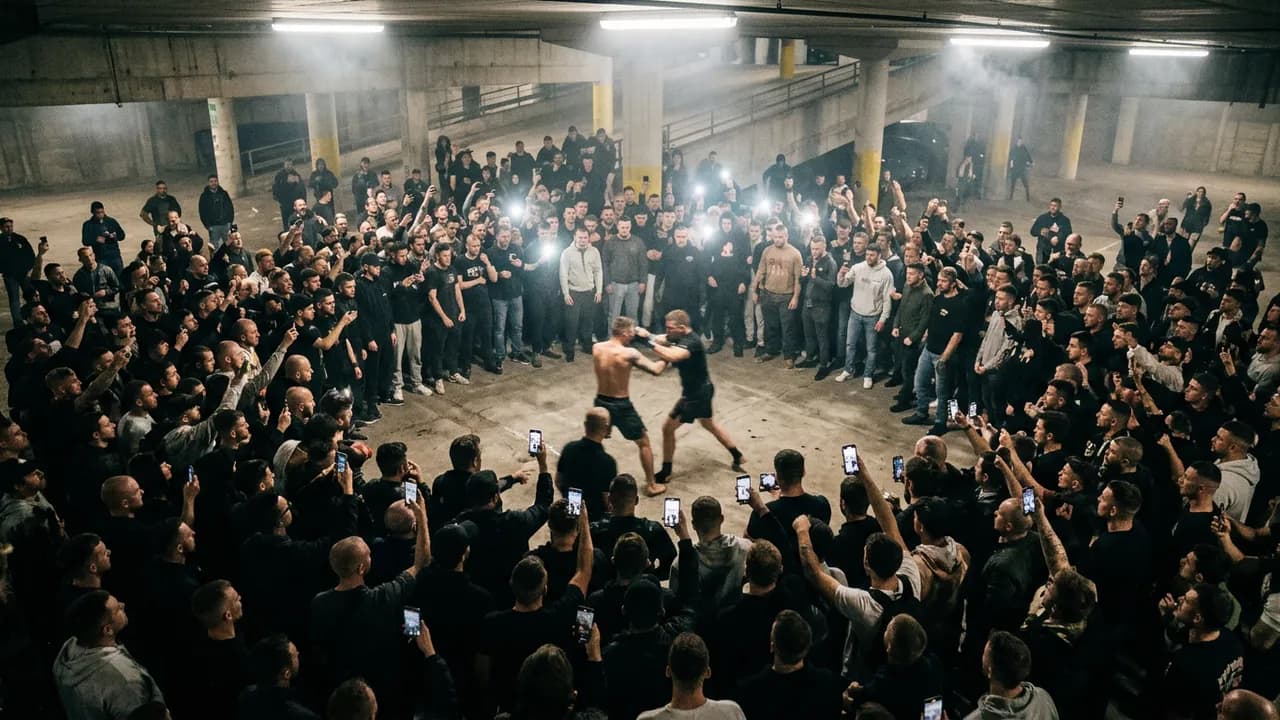
More than a millennium after the original practice was outlawed, Holmgang resurfaced in Hamburg, Germany, as an underground weapons sparring group that rejected the safety-first philosophy of mainstream HEMA and martial arts organizations. The Hamburg group gained notoriety through videos posted to platforms like BitChute and Odysee -- channels chosen specifically because mainstream platforms like YouTube would remove such content.
The videos showed something that sent shockwaves through the martial arts community: two people fighting with what appeared to be real bladed weapons, wearing minimal protective equipment, and landing strikes with visible force. Forum discussions on martial arts communities like Bullshido documented and debated the practice, with reactions ranging from horrified fascination to outright condemnation.
From Hamburg, the practice spread to other locations across Europe, carried by a network of enthusiasts connected through underground martial arts circles, reenactment communities, and word-of-mouth. The decentralized nature of the movement makes it difficult to track with precision, but reports and video evidence suggest Holmgang-style fighting has established footholds in multiple European countries.
Format and Combat Rules
Weapons
Modern Holmgang practitioners fight with custom-made bladed weapons. Based on available video evidence and forum discussions, the weapons include:
- Swords: Longswords and arming swords modeled after medieval European designs. Reports indicate the blades are custom-made and may be at half weight or less compared to historical originals, but they retain functional edges capable of cutting.
- Battle Axes: Single-handed and great axes have been documented in Holmgang sparring sessions. One notable documented bout featured an axe versus a greatsword matchup.
- Other Medieval Arms: The format is not restricted to specific weapon types; participants have been observed using various period-appropriate weapons.
The critical distinction between Holmgang and HEMA is that Holmgang weapons are sharp or semi-sharp. While HEMA practitioners use blunted feders, nylon wasters, or carefully dulled steel trainers, Holmgang fighters accept the possibility -- and reality -- of being cut by their opponent's blade.
Safety Gear (or Lack Thereof)
The most controversial aspect of modern Holmgang is the near-absence of protective equipment. In documented bouts:
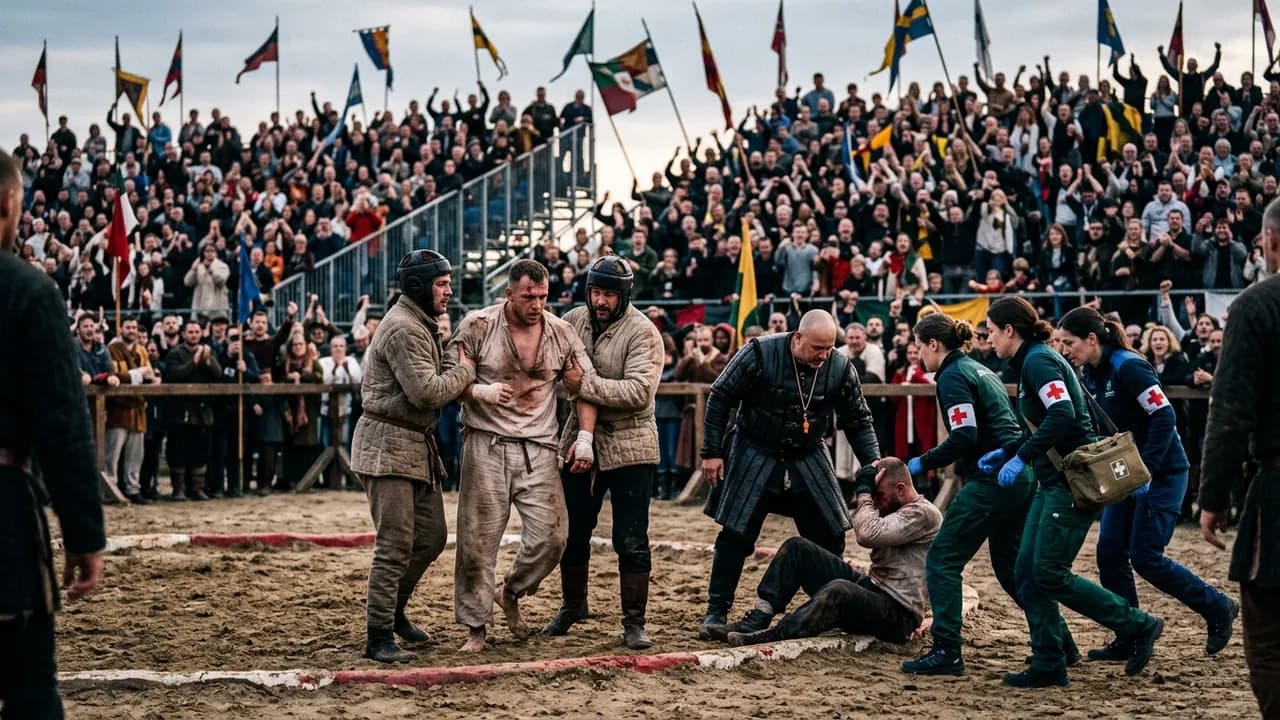
- Fighters have been observed wearing ordinary T-shirts as their primary torso covering.
- Vital areas receive some protection, though the extent varies and falls far short of what any safety-conscious martial arts organization would mandate.
- Medics are reportedly present at organized sessions to treat injuries.
- Helmets or head protection may be worn, though this is inconsistent.
This stands in stark contrast to HEMA, where practitioners wear specialized fencing jackets, steel or hard-shell helmets with throat guards, heavy gloves, forearm and shin protection, and sometimes full plate steel gauntlets. The gap between Holmgang's approach and accepted safety standards in weapons-based martial arts is enormous.
Combat Style
Bouts are primarily one-on-one encounters. The fighting is described as realistic in its approach, with participants trained to handle the psychological pressure of facing sharp steel -- learning not to panic at the sight of blood and understanding how blade binding and engagement differ fundamentally when the edges are real.
04 / Up next / How to Watch
Full-power strikes have been documented. Participants swing with intent, and the results are predictable: cuts that penetrate into muscle tissue are reported as common occurrences. Proponents argue these wounds heal quickly and that the experience provides a level of martial understanding that no amount of controlled sparring with blunted weapons can replicate.
How to Watch
Holmgang content is extremely difficult to find on mainstream platforms due to its graphic nature and the platform policies it violates:
- Odysee: Videos titled "Fight Club with Sharp Swords - Holmgang Hamburg" have appeared on the decentralized platform.
- BitChute: Archived footage including sword-versus-axe matchups has been documented on BitChute.
- Coub: Short clips, including full-contact axe fighting footage, have appeared on the clip-sharing platform.
- Forum Archives: Martial arts forums like Bullshido contain discussions and linked media from Holmgang sessions dating back several years.
There are no known pay-per-view events, streaming deals, or official channels. Content has been removed from YouTube due to policy violations, but some footage can still be found by searching "Holmgang Hamburg" on YouTube and alternative platforms. The movement operates entirely underground, with content distributed through alternative media platforms and private channels.
The Controversy
Martial Arts Community Response
The reaction from the broader martial arts and HEMA communities has been overwhelmingly critical. Practitioners of Historical European Martial Arts -- a discipline that prides itself on rigorously studying historical fighting techniques while maintaining modern safety standards -- view Holmgang as recklessly dangerous and fundamentally counterproductive.
Critics argue that fighting with sharp weapons and minimal protection does not produce better swordfighters; it produces injured ones. The stress of facing a real blade, they contend, leads to flinching, tentative technique, and survival instincts that override the disciplined mechanics that make historical swordsmanship effective. Proponents counter that this stress is precisely the point -- that facing genuine danger provides an authenticity and martial reality that padded sparring can never approximate.
Legal Implications
Modern Holmgang is illegal under the laws of virtually every European country where it is practiced. Assault with a deadly weapon, grievous bodily harm, and reckless endangerment are among the potential criminal charges that participants and organizers could face. The underground nature of the movement -- its reliance on alternative media platforms, private communications, and undisclosed locations -- reflects the participants' awareness of their legal exposure.
Medical Risks
The medical risks of Holmgang cannot be overstated. Even with half-weight blades and some vital area protection, a full-power sword strike can:
- Sever tendons and ligaments, causing permanent disability
- Cut into major blood vessels, creating life-threatening hemorrhaging
- Penetrate the abdominal cavity or chest wall
- Cause traumatic amputations of fingers or extremities
- Inflict skull fractures or brain injuries
The presence of medics at organized sessions provides some mitigation, but emergency medical response in an underground, undisclosed location is inherently limited compared to a hospital or sanctioned sporting venue.
Connection to Historical Fighting Traditions
Germany's Mensur Tradition
Germany has its own deeply rooted tradition of sharp-blade dueling that predates and parallels the modern Holmgang movement. Mensur, the academic fencing tradition practiced by German student fraternities (Studentenverbindungen), has involved sharp-sword dueling since the 17th century. Participants fight with sharpened Schlaeger (dueling swords), and facial scars from Mensur bouts -- known as Schmisse -- were historically worn as marks of honor and social status.
Mensur was banned during the Nazi era in 1933, but underground dueling continued through the war years, with secret societies conducting over 100 duels during the conflict. After the ban was lifted in the early 1950s, the tradition revived, and approximately 400 student fraternities continue the practice today.
While Mensur and modern Holmgang share the element of fighting with sharp steel, they differ fundamentally in structure, social context, and safety protocols. Mensur is conducted under strict rules with specific target areas, protective gear for the eyes and throat, and experienced seconds who intervene. Modern Holmgang strips away most of these protections.
Broader European Weapons Combat
Modern Holmgang exists within a larger landscape of weapons-based combat sports, including:
- HEMA (Historical European Martial Arts): The regulated, safety-conscious study and practice of historical European fighting techniques.
- Armored Combat / Buhurt: Full-contact fighting in plate armor with blunted weapons, governed by organizations like the International Medieval Combat Federation.
- Calcio Storico: Florence's ancient, violent sport, which while not weapons-based, shares Holmgang's embrace of historical brutality and minimal safety equipment.
Holmgang sits at the furthest extreme of this spectrum -- the point where martial arts practice crosses into territory that most practitioners and legal systems consider unacceptable.
Related Organizations
- King of the Streets (KOTS): Europe's most notorious no-rules fighting organization, sharing Holmgang's underground ethos but limited to unarmed combat.
- UUF (Ultimate Underground Fights): Denmark's KOTS-affiliated fight club, operating in the same European underground fighting ecosystem.
- Calcio Storico: Florence's ancient sport, another example of historical combat traditions that embrace extreme physicality.
- Strelka: Russia's mass participation fight club, representing a less extreme but similarly unregulated approach to combat sports.
For a broader look at the legal risks of underground fighting across Europe, see our guides to underground fighting legality in the UK and the USA.
FAQ
Is modern Holmgang legal?
No. Fighting with sharp or semi-sharp weapons with minimal protective equipment constitutes assault with a deadly weapon under the criminal codes of every European country where it is practiced. Participants and organizers face potential criminal prosecution.
Is Holmgang the same as HEMA?
No. HEMA (Historical European Martial Arts) is a regulated discipline that studies historical fighting techniques using protective equipment and safety protocols. HEMA organizations use blunted training weapons and mandate comprehensive protective gear. Modern Holmgang uses sharp or semi-sharp weapons with minimal protection, placing it far outside the standards of any recognized HEMA organization.
How dangerous is Holmgang compared to other underground fighting?
Holmgang is arguably the most dangerous form of underground fighting in existence. While organizations like KOTS involve bare-knuckle, no-rules fighting on concrete, Holmgang introduces bladed weapons capable of inflicting deep lacerations, severing tendons, or causing life-threatening hemorrhaging. The potential for permanent disability or death is significantly higher than in any unarmed underground fighting format.
Where did modern Holmgang originate?
The modern movement originated in Hamburg, Germany, and has spread to other locations across Europe through underground martial arts networks and word-of-mouth.
Can I participate in Holmgang?
Given the extreme danger and criminal illegality of the practice, participation cannot be recommended under any circumstances. Individuals interested in historical weapons combat should seek out legitimate HEMA clubs, which offer rigorous training in historical techniques with appropriate safety equipment.
Has anyone died in modern Holmgang?
There are no publicly confirmed fatalities, but the underground and secretive nature of the movement means that comprehensive safety records do not exist. The inherent danger of the practice makes serious injury or death a realistic possibility at any session.