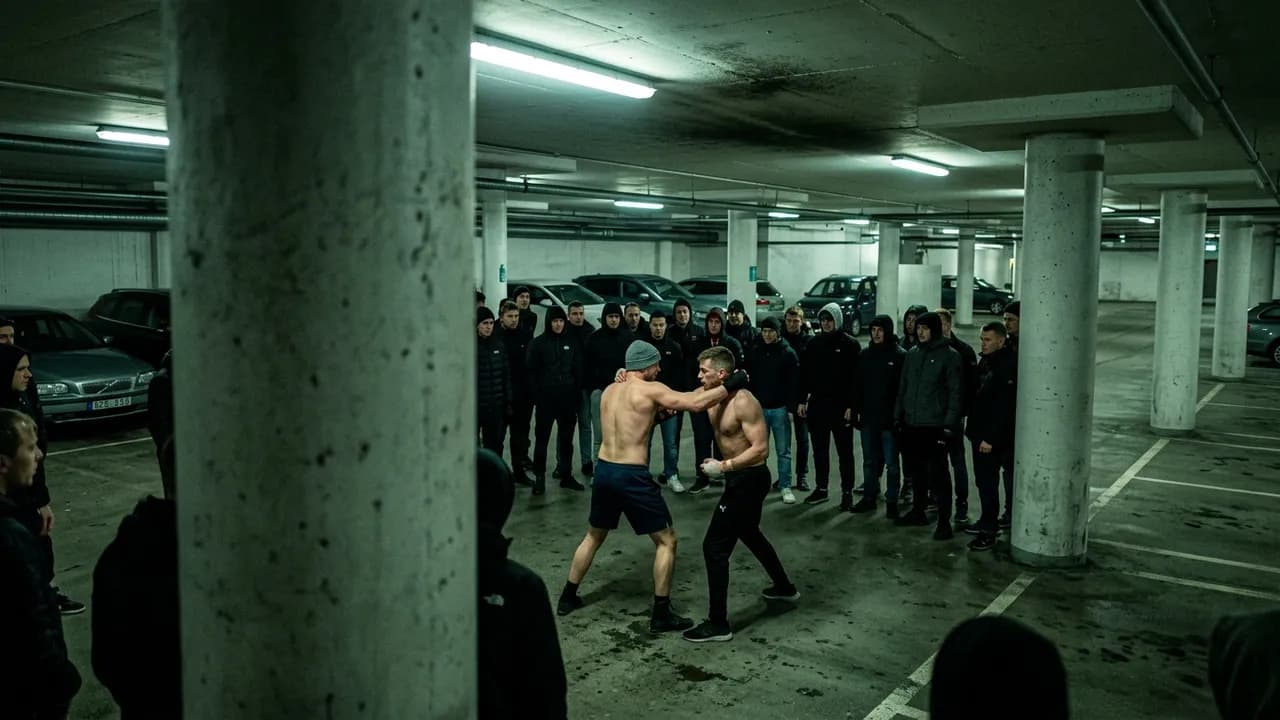
Gothenburg is not the first city that comes to mind when you think about underground fighting. Sweden's second-largest city is known for its Scandinavian design sensibility, its thriving tech industry, and its position as one of the most livable cities in Northern Europe. It is polite, prosperous, and well-organized. It is also the birthplace of the most notorious no-rules fight club on the internet.
King of the Streets (KOTS) was founded in Gothenburg in 2013 by an anonymous collective called Hype Crew. What started as filmed street fights between Swedish hooligans has grown into a global underground fighting brand with over one million YouTube subscribers at its peak, events staged in abandoned warehouses across Europe, and a reputation for the most uncompromising, unregulated fighting content on the internet.
Gothenburg created no-rules fighting as a genre. Understanding why requires understanding the city, its football culture, and the strange alchemy that turned Scandinavian hooliganism into a global entertainment phenomenon.
The Hype Crew Origin
The story of KOTS begins with Hype Crew -- an anonymous group of individuals drawn from Gothenburg's hooligan underground, organized crime networks, and street fighting subculture. The collective's identity has never been fully revealed, and that anonymity is itself part of the brand. Hype Crew does not have a public spokesperson, a registered business address, or an official organizational structure. It operates in shadows, communicating through social media and encrypted channels.
Gothenburg is home to IFK Goteborg, one of Sweden's most popular and historically successful football clubs. Like many European cities, Gothenburg has a firm culture -- organized groups of football supporters who engage in planned confrontations with rival firms. Swedish hooligan culture is less well-known internationally than its English, Russian, or Polish counterparts, but it is real, structured, and active. The men who formed Hype Crew came from this world.
Around 2013, members of Hype Crew began filming organized fights on the streets of Gothenburg. These were not spontaneous brawls caught on camera -- they were arranged confrontations between willing participants, staged in specific locations, and recorded with the explicit intention of creating content. The fighters were hooligans and street fighters. The rules were simple: there were none.
The early videos were uploaded to YouTube under the King of the Streets banner. The production was raw -- handheld cameras, dim lighting, ambient street noise. But the content was explosive. Fights on concrete, without gloves, without rounds, without referees, without any of the safety mechanisms that even the most underground fighting organizations typically employ. The channel grew steadily as algorithms pushed the content to viewers searching for fighting videos.
The No-Rules Philosophy
What set KOTS apart from every other underground fighting organization was its absolute refusal to impose rules. Other promotions -- even the most underground ones -- maintained at least some structure. Strelka had its sand ring to cushion falls. Streetbeefs had referees and headgear. King of the Ring used boxing gloves and timed rounds. KOTS offered none of these accommodations.
Fights took place on concrete -- hard, unforgiving concrete that turns every knockdown into a potential catastrophe. There were no gloves, no mouthguards, no shin guards. Fighters wore whatever they showed up in. There were no rounds; fights continued until someone was knocked out, submitted, or physically unable to continue. There were no weight classes, no medical staff, and no mechanisms for stopping a fight before it reached its natural conclusion.
The no-rules format was both KOTS's defining feature and its most controversial element. Critics called it reckless, dangerous, and a recipe for permanent injury or death. Supporters argued that it was the purest expression of real fighting -- that rules, however well-intentioned, sanitize combat into something it is not, and that KOTS had the courage to present fighting as it actually exists on the street.
The format drew heavily on the mythology of the 1999 film Fight Club, directed by David Fincher and based on Chuck Palahniuk's novel. The film's vision of underground fighting as an escape from the emasculating boredom of consumer capitalism resonated deeply with KOTS's audience, and Hype Crew leaned into the connection. Events were staged in abandoned warehouses, invoking the basement-fight aesthetic of the film. The secretive, invitation-only access reinforced the sense of participating in something forbidden.
Gothenburg's Warehouse Fights
The warehouse fights became KOTS's signature. Held in abandoned industrial spaces across Gothenburg and eventually throughout Sweden and Europe, these events transformed derelict buildings into gladiatorial arenas for a single night.
Inside the warehouses, the fights took place on raw concrete floors, sometimes with a circle of spectators serving as the only ring boundary.
The logistics of staging an illegal fight event in an abandoned warehouse are considerable. Hype Crew had to identify suitable locations, gain access without attracting police attention, set up minimal lighting and camera equipment, recruit fighters, manage spectators, and dismantle everything before authorities could intervene. The clandestine nature of the operations added to the mythology -- attendees were given location information at the last possible moment, and the events had the atmosphere of an illegal rave combined with a Roman colosseum.
Inside the warehouses, the fights took place on raw concrete floors, sometimes with a circle of spectators serving as the only ring boundary. The lighting was harsh and industrial. The acoustics amplified every punch, every grunt, every impact of a body hitting the floor. For spectators, the experience was visceral in a way that no professional fighting event could match. There was no protective distance between the audience and the violence. The fights were happening right there, feet away, with nothing between you and the action.
For the fighters, the warehouse events represented the ultimate test. Fighting on concrete without any protective equipment is an act that demands either extraordinary confidence or extraordinary recklessness -- and KOTS attracted both types. The roster included experienced martial artists looking for the most extreme competitive test, street fighters with nothing to lose, and hooligans from across Europe who traveled to Gothenburg specifically to prove themselves in the KOTS ring.
From Gothenburg to Europe
By 2018, KOTS had outgrown Gothenburg. Prominent hooligans from across Europe were signing up for the organization's unsanctioned brawls, and the YouTube channel had grown to over one million subscribers. The content was generating millions of views per video, with individual fights routinely crossing the one million mark.
The expansion followed the networks of European hooligan culture. Fighters traveled from Germany, the Netherlands, Poland, the Baltic states, and beyond to compete in KOTS events. The organization began staging fights outside of Sweden, using the same warehouse-and-concrete format that had defined its Gothenburg origins. Each new country brought new fighters, new audiences, and new cultural dimensions to the KOTS brand.
The European expansion also brought increased scrutiny. Swedish authorities, already uncomfortable with the existence of illegal fight clubs in their cities, stepped up enforcement efforts. YouTube periodically removed KOTS content for violating community guidelines against violence. The organization responded by distributing content across multiple platforms, building a presence on Telegram, Instagram, and its own website to insulate itself against any single platform's content moderation policies.
Through all the expansion and controversy, Gothenburg remained the spiritual home. The city's warehouses were the original arenas. Its hooligans were the original fighters. Its streets were the original concrete rings. KOTS may now operate across Europe, but it will always be a Gothenburg creation.
The Swedish Paradox
KOTS's emergence from Gothenburg presents a paradox that fascinates observers of the underground fighting world. Sweden is one of the safest, most prosperous, and most socially progressive countries on earth. Its welfare state provides universal healthcare, free education, and robust social safety nets. Its cities are clean, well-designed, and oriented toward quality of life. Gothenburg, specifically, is consistently ranked among the most livable cities in the world.
How does a place like this produce the most extreme, most dangerous underground fighting organization on the internet?
Part of the answer lies in the nature of Swedish hooligan culture itself. In countries where violence is common and poverty is pervasive, fighting is often a survival necessity. In Sweden, where most basic needs are met and violent crime is relatively rare, fighting becomes a choice -- a deliberate seeking-out of danger, intensity, and physical challenge in a society that has, by many measures, engineered those things away. The men who fight in KOTS are not fighting because they have to. They are fighting because the comfort and security of Scandinavian life is, for them, insufficiently stimulating.
This echoes the Fight Club mythology that KOTS explicitly invokes. The film's thesis -- that the sanitized, consumer-driven modern world has robbed men of meaningful physical experiences, and that fighting is a way to reclaim authenticity -- maps remarkably well onto the KOTS phenomenon. Gothenburg's fighters are not escaping poverty. They are escaping comfort.
KOTS's largest viewership demographics include young men from prosperous Western countries who watch no-rules fighting videos as a form of vicarious intensity.
The paradox extends to the audience. KOTS's largest viewership demographics include young men from prosperous Western countries who watch no-rules fighting videos as a form of vicarious intensity. The content provides something that their safe, well-ordered lives do not: genuine danger, genuine consequence, and the primal satisfaction of watching two people fight without any of the institutional buffers that modern society places between individuals and violence.
The Documentary and Cultural Legacy
KOTS's cultural impact has been significant enough to attract documentary attention. "King of the Streets: The Documentary" explores the organization's origins, its fighters, and the cultural forces that produced it. The film provides rare access to the anonymous figures behind Hype Crew and examines the tension between the organization's transgressive appeal and the real physical risks it imposes on participants.
The documentary treatment is reflective of KOTS's broader cultural position. The organization exists at the intersection of several contemporary phenomena: the democratization of media through YouTube, the persistence of hooligan subcultures in European football, the cultural fascination with extreme fighting content, and the philosophical questions about masculinity, violence, and authenticity that the Fight Club mythology continues to raise.
Gothenburg's legacy in the underground fighting world is now permanent. The city gave birth to no-rules fighting as an organized, filmed, and distributed genre of content. Every promotion that stages fights on concrete, every organization that markets itself on the absence of rules, every fight video that uses the raw-warehouse aesthetic -- all of it traces back to a group of anonymous Swedish hooligans who started filming fights on the streets of Gothenburg in 2013.
Related Reading
- King of the Streets (KOTS) -- Full organizational profile
- King of the Ring (KOTR) -- Manchester's community-focused alternative to the KOTS approach
- Strelka -- Russia's democratic fight club that influenced KOTS's format
- Underground Fighting in St. Petersburg -- The Russian city whose fighting culture parallels Gothenburg's