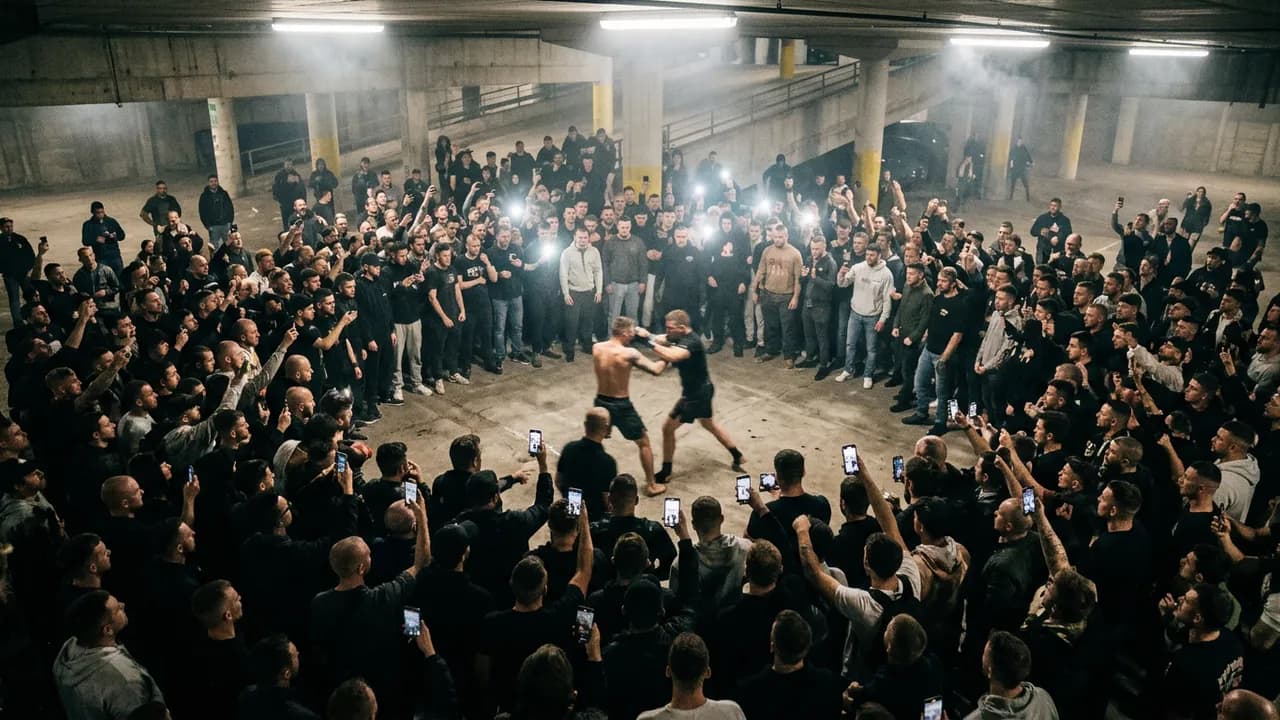
No-rules fighting is exactly what the name suggests: organized combat with few or no restrictions on technique, conducted outside the regulatory framework of sanctioned combat sports. It is the most extreme form of underground fighting, and it has grown from a niche within the European football hooligan scene into a continent-wide movement with organizations across Sweden, France, Denmark, Germany, and beyond.
Is no-rules fighting actually "no rules"?
Not entirely. Even the most extreme no-rules organizations operate with some implicit or explicit constraints. The term "no rules" is more branding than literal truth.
In practice, most no-rules organizations follow a minimal set of guidelines:
- Both fighters must agree to fight. Forced or coerced fighting is not part of the format.
- No weapons. Fighters use only their bodies.
- The fight can end by submission, knockout, or quitting. Fighters can stop at any time.
Beyond these basics, the restrictions vary by organization. KOTS permits headbutts, elbows, knees, chokes, and strikes to the spine -- techniques that are banned in virtually every sanctioned combat sport. FPVS in France follows a similar model. UUF in Denmark operates with "no gloves, no weapons" as the primary rule.
The key distinction is not that there are literally zero rules. It is that the rules that do exist are minimal, informal, and focused on the boundaries of participation (consent, no weapons) rather than the conduct of the fight itself (no prohibited strikes, no restrictions on targets).
Where did no-rules fighting originate?
The modern no-rules fighting movement traces directly to King of the Streets (KOTS), founded in Gothenburg, Sweden, in 2013 by an anonymous collective called "Hype Crew." KOTS grew out of the European football hooligan scene, where arranged fights between rival firms had evolved from group brawls to individual champion fights.
KOTS formalized this evolution by creating a branded organization with a YouTube channel, a distinctive format (concrete surface, bare hands, no rounds, no decisions), and an aesthetic that emphasized the raw, uncompromising nature of the fighting.
Before KOTS, the concept of no-rules fighting existed in various forms -- vale tudo in Brazil, pankration in ancient Greece, early UFC events -- but the modern no-rules movement as a branded, YouTube-distributed phenomenon is a KOTS creation.
What organizations are part of the no-rules movement?
The major no-rules organizations include:
King of the Streets (KOTS) -- Sweden/Europe. The original and most prominent no-rules organization. Fights on concrete, bare hands, no rounds, no decisions. Over 1 million YouTube subscribers.
FPVS -- France. Founded by two twenty-year-olds on the French Riviera. Follows the KOTS format: concrete surface, bare hands, no rules. Recruits through Telegram. Unaffiliated with KOTS but part of the broader movement.
UUF (Ultimate Underground Fights) -- Denmark. Operates in abandoned warehouses and industrial halls. No gloves, no weapons, basic protection only (shoes, mouthguards). Listed as affiliated with KOTS.
Holmgang -- Germany. The most extreme variant: fights with medieval weapons (swords, axes) with minimal protective equipment. Named after the historical Norse dueling practice.
These organizations are supplemented by numerous smaller, unaffiliated fight clubs across Europe that have adopted the no-rules format after discovering KOTS content on YouTube.
How is no-rules fighting different from MMA?
The differences are fundamental:
| Feature | No-Rules Fighting | MMA |
|---|---|---|
| Regulation | None | State athletic commissions |
| Gloves | None (bare hands) | 4oz MMA gloves |
| Surface | Concrete, outdoor terrain | Padded canvas in a cage or ring |
| Rounds | None (continuous fighting) | 3 or 5 rounds of 5 minutes |
| Time limit | None | 15 or 25 minutes |
| Decisions | No judges, no decisions | Judges score if fight goes to time |
| Prohibited techniques | Few or none | Extensive list (eye gouging, groin strikes, 12-6 elbows, etc.) |
| Medical support | Minimal or none | Ringside physician, ambulance on standby |
| Drug testing | None | USADA or state commission testing |
The most significant practical difference is the fighting surface. MMA takes place on a padded canvas that is designed to reduce injury from falls and takedowns. No-rules fighting on concrete makes every knockdown, takedown, and fall potentially catastrophic. A fighter who falls and hits their head on concrete faces a risk of skull fracture or traumatic brain injury that does not exist on a padded surface.
What happens in a typical no-rules fight?
A typical KOTS-style no-rules fight:
- Two fighters agree to fight. They may have been matched by the organization or may have accepted open challenges.
- The fighters shake hands and take their positions on the concrete surface.
- The fight begins. There is no bell, no round structure. The fight continues until one fighter is knocked out, submits, or quits.
- Anything goes. Punches, kicks, knees, elbows, headbutts, chokes, joint locks, takedowns -- all are permitted.
- The fight ends when one fighter cannot or will not continue. A referee or the organization's staff may intervene if a fighter is clearly unable to defend themselves, but intervention is not guaranteed.
- The fighters shake hands again after the fight, regardless of outcome.
Fights can be very short -- a single punch leading to a knockout -- or extended, lasting several minutes of grinding combat. The absence of rounds means there are no breaks, no corner advice, and no opportunity to recover between periods of action.
How dangerous is no-rules fighting?
Extremely dangerous. No-rules fighting combines the inherent dangers of combat with the additional risks of:
- Concrete surfaces that make every fall potentially catastrophic
- No protective equipment that could reduce the impact of strikes
- No time limits that would end the fight before cumulative damage becomes severe
- No medical support to address injuries as they occur
- No prohibited techniques to protect vulnerable targets (spine, back of the head, groin)
The specific injury risks include traumatic brain injuries from falls on concrete, skull fractures, spinal injuries from unrestricted strikes to the spine, broken hands from bare knuckle striking, and the full range of injuries common to underground fighting generally.
01 / Up next / Is no-rules fighting legal?
No deaths have been publicly documented at KOTS, FPVS, or UUF events, but the risk of fatal injury is substantially higher than in any sanctioned combat sport.
Is no-rules fighting legal?
No-rules fighting is illegal in virtually every jurisdiction where it takes place. Sweden, France, Denmark, and Germany all criminalize assault regardless of consent, and no-rules fighting clearly meets the legal definition of assault in all of these countries.
The organizations respond to this legal reality by operating covertly:
- Locations are communicated through encrypted messaging apps (Telegram) shortly before events
- Organizers maintain anonymity (KOTS's "Hype Crew" has never been publicly identified)
- Events are held in remote or industrial locations away from public view
- Fighter identities are sometimes obscured
Despite the illegality, enforcement has been limited. Law enforcement agencies in most European countries have not prioritized the prosecution of consensual underground fighting, though this could change if a serious injury or death attracts public attention.
Who fights in no-rules organizations?
The fighter demographic varies by organization but draws heavily from:
- Football hooligan networks -- the historical foundation of the European underground fight scene
- Combat sports practitioners -- boxers, kickboxers, and MMA fighters seeking a more extreme test
- Working-class young men -- construction workers, factory workers, and service industry workers, typically aged 18-30
- Military and law enforcement -- current or former personnel with combat training
Organizations like FPVS have emphasized that their fighters are "regular people" -- mechanics, restaurant workers, construction laborers -- drawn to the scene by the desire to test themselves in the most demanding combat environment available.
Can you make money in no-rules fighting?
Most no-rules fighters receive no payment. KOTS has experimented with membership models and PPV for premium content, and the organization's YouTube channel generates ad revenue, but the fighters themselves typically fight for reputation and experience rather than money.
The economics of no-rules fighting are similar to other underground organizations: the organization generates revenue through YouTube and digital content, while fighters absorb the physical risk for no financial compensation. For a detailed look at fighter pay across all organizations, see our underground fighter pay guide.
What is the culture of no-rules fighting?
Despite the extreme violence, no-rules fighting organizations operate under cultural codes that their participants take seriously:
- Respect between combatants. Fighters shake hands before and after fights. Mutual respect is expected regardless of the outcome.
- No attacking downed opponents (in most cases). While technically "no rules," most organizations expect fighters to allow a downed opponent to recover before continuing.
- No attacking bystanders. The violence is confined to the agreed-upon fight.
- Courage is the highest value. Showing up, standing, and fighting -- regardless of skill level or outcome -- earns respect. Running or refusing a fight brings shame.
These codes are imported directly from European football hooligan culture, where similar values governed arranged meets between rival firms for decades.
For more on the no-rules scene, see our analysis of football hooligans and the European fight scene or our complete underground fighting FAQ.