Quick Facts
| Detail | Info |
|---|---|
| Primary Organization | FPVS (F.P.V.S Social Fight Club) |
| Region | French Riviera (Cannes / Alpes-Maritimes) |
| Founded | ~2023 |
| Founders | Leon and Victor (both 20 years old at founding) |
| Format | No rules, no gloves, no rounds, concrete surface |
| Recruitment | Via Telegram |
| Movement | Part of the broader European "No Rules" movement |
| Social Media | Instagram: @fpvs.fr, TikTok: @fpvs.frrr |
Overview
France is not the first country that comes to mind when most people think of underground fighting. The nation's combat sports identity is historically rooted in Savate, the elegant French kickboxing discipline born in the port cities of Marseille and Paris, and in its world-class judo program, which has produced more Olympic medals in the sport than any country outside Japan. But beneath the veneer of sanctioned competition and government-regulated martial arts, a different kind of fighting has taken hold on the sun-drenched coast of the French Riviera.
FPVS -- F.P.V.S Social Fight Club -- is the most prominent underground fighting organization to emerge from France. Founded by two young men named Leon and Victor, both around twenty years old at the time of the organization's creation, FPVS operates out of abandoned buildings along the Cote d'Azur, staging bare-knuckle, no-rules fights on concrete with no gloves, no rounds, and no safety equipment of any kind. The organization is unaffiliated with King of the Streets (KOTS), the notorious Swedish-born fight club that pioneered the format, but it is very much a product of the same movement that KOTS unleashed across Europe.
What makes FPVS distinctive is the contrast it embodies. The French Riviera is synonymous with wealth, glamour, and exclusivity -- Cannes, Nice, Monaco, the yacht-lined harbors and designer boutiques that define the world's most famous coastline. FPVS exists in the shadows of that opulence. Its fighters are the young working-class men who bus tables at Riviera restaurants, pour concrete on construction sites, and stock shelves at superstores. They are, as one journalist described them, "the kind of lads the upper class of the Riviera probably cross the road from." The fight club gives them something that the service economy does not: agency, respect, and the raw thrill of proving themselves in the most primal way imaginable.
History and Origins
The Birth of FPVS
FPVS was established around 2023 by Leon and Victor, two friends from the French Riviera region. Both were approximately twenty years old at the time, part of a generation that had grown up watching KOTS videos on YouTube and absorbing the broader European No Rules fighting culture through social media. The name FPVS is a French acronym that, translated loosely and cleaned up considerably, means something along the lines of "Don't come around here trying to suck our dicks when we get big" -- a deliberately provocative statement of defiance that captures the anti-establishment attitude at the heart of the project.
Leon and Victor did not set out to build a franchise or a media empire. The initial motivation was simpler and more personal: they wanted to fight, they wanted to create something of their own, and they wanted to do it their way. The pair assembled a small crew of like-minded young men -- approximately half a dozen in the core group, all male, ranging in age from about 18 to 22 -- and began organizing events in the abandoned structures that dot the less glamorous stretches of the Riviera coastline.
Connection to the Broader No Rules Movement
To understand FPVS, it is necessary to understand the movement from which it emerged. The No Rules fighting subculture was born in 2013 when an anonymous Swedish collective called Hype Crew began filming street fights on the concrete of Gothenburg under the banner of King of the Streets. By 2018, KOTS had grown from a local curiosity into a continental phenomenon, drawing fighters from across Europe's hooligan and streetfighting subcultures.
The critical development, however, was not the growth of KOTS itself but the proliferation of independent imitators. Across Germany, England, Ireland, Denmark, Poland, and eventually France, small groups of young men began organizing their own No Rules events, adopting the format -- concrete surface, bare knuckles, no rounds, no restrictions -- without any formal affiliation to the Swedish originators. FPVS is one of these independent organizations. It follows the same rules (or, more accurately, the same absence of rules) as KOTS, but it operates entirely on its own terms, with its own identity, its own fighters, and its own cultural flavor.
French Hooligan Culture as a Foundation
France has a deep and often underappreciated hooligan tradition. The genesis of organized football hooliganism in France can be traced to the late 1970s and early 1980s, when fans in the Boulogne stand at Parc des Princes formed the Boulogne Boys, a supporter group modeled initially on Italian ultra culture but later adopting the violent methods of British football hooligans. Through the 1990s, as France grappled with rising unemployment that averaged nearly 12 percent for the decade, economic stagnation, and growing social division, the ultras and hooligan firms became a magnet for alienated young men seeking belonging, identity, and an outlet for frustration.
03 / Up next / How FPVS Works
This is the soil from which FPVS grew. The French Riviera may lack the concentrated football tribalism of Paris, Marseille, or Saint-Etienne, but it has its own disaffected working class -- young men who serve the wealthy tourists and residents of the Cote d'Azur without sharing in any of the prosperity. The hooligan mentality of organized, ritualised violence as a form of identity and community translates directly into the fight club ethos that FPVS represents. Several of the spectators and peripheral members who attend FPVS events are described as unaffiliated hooligans and street fighters who travel overnight by coach from other parts of France to attend.
How FPVS Works
Venues
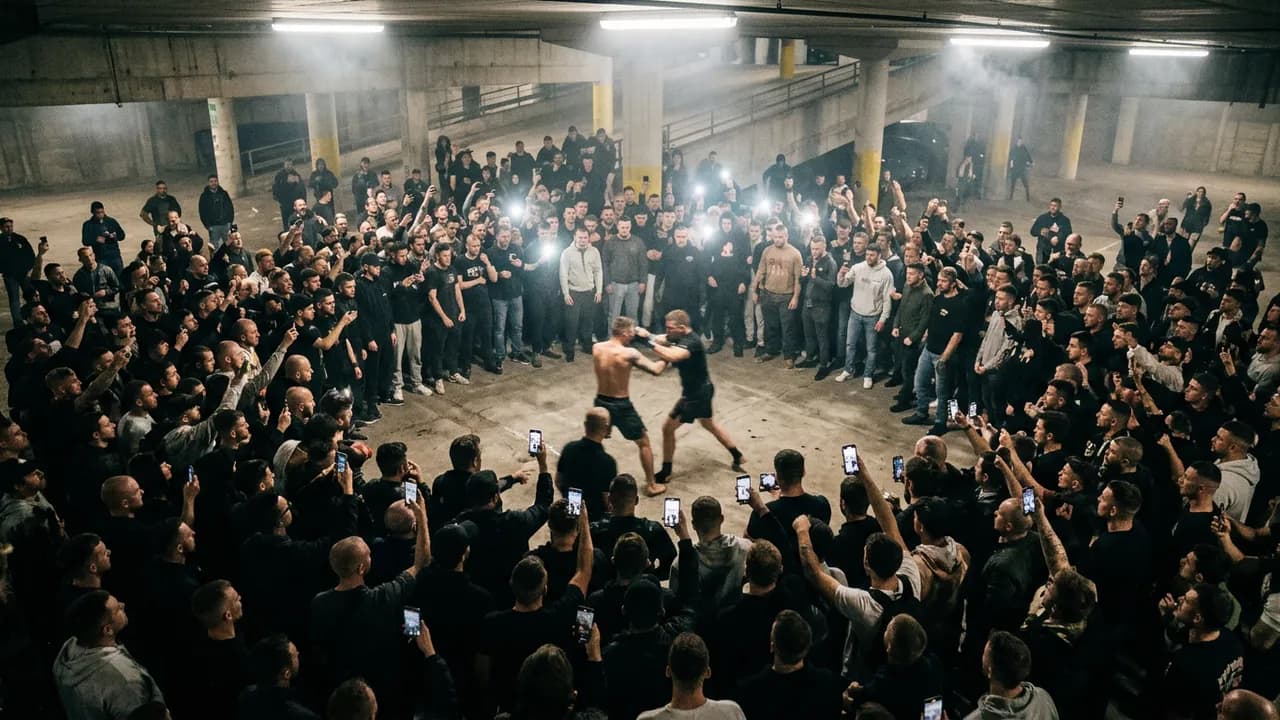
FPVS events take place in abandoned buildings along the French Riviera. The primary venue, as documented by journalist Jake Hanrahan in his "Away Days" series, is a derelict two-story structure located behind a locked gate with spiked fencing. The building features graffiti-covered walls, broken windows, and collapsing stairways -- the kind of place that most people would avoid, which is precisely what makes it ideal for an illegal fight club.
The fighting surface is bare concrete. This is not incidental; it is the defining characteristic of the No Rules format. Unlike Strelka, which uses a sand ring for cushioning, or traditional MMA, which employs padded canvas, the concrete floor of an FPVS venue offers no forgiveness. Every knockdown carries the risk of a skull striking an unyielding surface. Every takedown lands on stone. The FPVS crew cleans the concrete fighting area the night before each event, sweeping away debris to create a flat, unobstructed space, but no padding, mats, or protective materials are ever used.
There are no ropes, no cage, no ring. Spectators form a loose circle around the fighting area, standing mere feet from the action.
Fight Format and Rules
FPVS follows the same format as the broader No Rules movement:
- No gloves: Fighters compete bare-knuckle. Some fighters wrap their hands with cloth or tape for wrist support, but this is optional and provides no padding.
- No rounds: Each fight is a single continuous bout with no breaks, no rest periods, and no time limit.
- No rules: Virtually everything is permitted. Punching, kicking, elbowing, kneeing, headbutting, choking, biting, eye gouging, hair pulling, and head stomping are all legal. There are no banned techniques.
- Concrete surface: All fighting occurs on bare concrete.
- Fight to finish: A bout ends when one fighter is knocked out, submits, is unable to continue, or when a designated referee intervenes to protect a downed fighter.
The absence of rules does not mean the absence of order. FPVS maintains a referee or designated observer who can stop a fight when a competitor is clearly unable to defend themselves. This is not a formalized officiating role in the way that sanctioned combat sports employ referees, but it provides a minimal layer of intervention between an incapacitated fighter and continued punishment.
Recruitment and Participation
Prospective fighters contact FPVS through Telegram, the encrypted messaging application. There is no formal application process, no tryout, and no credential requirement. If someone expresses willingness to fight, the FPVS organizers assess whether to include them in an upcoming event. Location details are sent to participants at the last minute via Telegram, maintaining operational security and reducing the risk of law enforcement intervention.
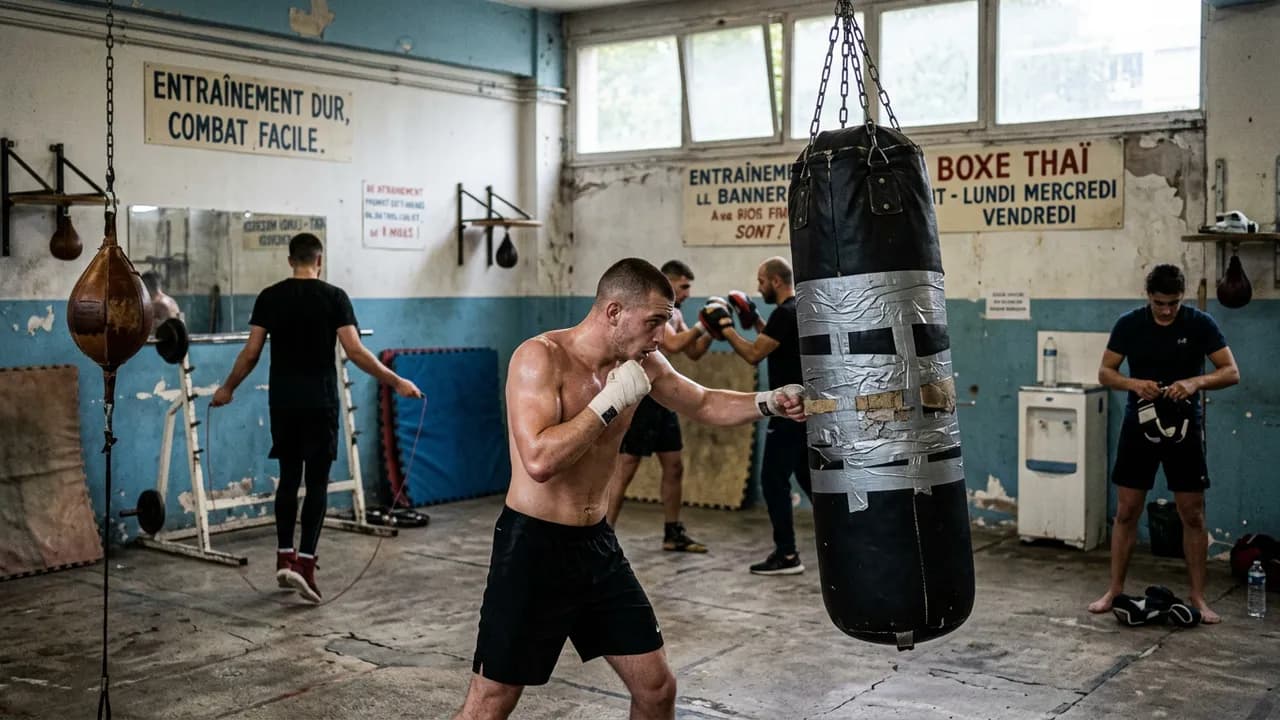
The demographics of FPVS fighters are remarkably consistent. Participants are overwhelmingly young men between the ages of 18 and 25. They are working-class -- construction laborers, restaurant servers, retail workers, and other service-industry employees who form the backbone of the Riviera's tourism-dependent economy. They are not professional fighters, trained martial artists, or combat sports veterans. Most have little to no formal training. What they have is willingness, toughness, and the desire to prove something to themselves and their peers.
Rituals and Ceremonies
Perhaps the most striking aspect of FPVS is the ritual that surrounds the violence. Before the fighting begins, the entire assembled group -- fighters, crew, and spectators alike -- stands together and sings "La Marseillaise," the French national anthem, with their hands placed over their hearts. This is not performed ironically or for social media content. It is a genuine expression of shared identity and national pride, a moment of collective solemnity before the brutality begins.
04 / Up next / Media Coverage and Documentation
The anthem singing speaks to something deeper than the fighting itself. For these young men, many of whom exist on the margins of French society, FPVS provides a sense of belonging and national identity that they may not find elsewhere. The anthem transforms the event from a simple brawl into something with weight and meaning -- a ritual, not just a fight.
Hand-wrapping is another pre-fight ritual observed at FPVS events. Fighters may wrap their hands and wrists with cloth or tape before competing. This is a practical measure -- bare-knuckle striking on concrete carries a high risk of broken metacarpals and wrist injuries -- but it also serves as a ritualistic preparation, a moment of focused intention before stepping into the fighting area.
After each fight, regardless of the outcome, the two combatants embrace. Winners do not taunt or celebrate over their fallen opponents. Losers are helped to their feet and shown respect. This post-fight protocol is enforced by the culture of the group itself rather than by any written rule, and it represents the code of honor that FPVS members take seriously. The fighting is savage, but the respect is genuine.
Media Coverage and Documentation
FPVS gained significant international visibility through the work of Jake Hanrahan, a British journalist known for embedding himself in underground and fringe communities around the world. Hanrahan traveled to the French Riviera to document FPVS for his "Away Days" documentary series, which reports from the global underground and focuses on hidden stories from the fringes of society. The episode, titled "No Rules on the Riviera," provided the first substantial English-language documentation of the organization.
Hanrahan's reporting captured both the violence and the humanity of FPVS. His coverage showed not just the fights themselves -- including a bout between "Louis," a 5'9" waiter in his early twenties, and "Warren," a 6'2" construction laborer of similar age -- but also the camaraderie, the rituals, and the motivations of the participants. The episode is available as part of the "Away Days Podcast" and a written version appears in Hanrahan's book "Gargoyle II."
The French sports newspaper L'Equipe also covered FPVS in a feature report, noting that the organization, created approximately two years prior to the article's publication, had found an "increasingly strong audience" in France. The L'Equipe piece situated FPVS within the broader European proliferation of clandestine fight clubs and highlighted its growing social media presence.
France 3, a major French television network, published coverage of the fight club phenomenon in the Alpes-Maritimes department, further bringing the underground scene into mainstream awareness.
FPVS also maintains an active social media presence. The organization's Instagram account (@fpvs.fr) and TikTok account (@fpvs.frrr) feature highlight clips, trailers, and promotional content that has attracted thousands of followers. These platforms serve as both a recruitment tool and a means of building the FPVS brand within the underground fighting community.
The Fighters
The fighters who step onto the concrete at FPVS events are not professional athletes. They are ordinary young men from the working-class communities of the French Riviera, driven by a combination of adrenaline, peer recognition, personal challenge, and the desire to test themselves in an environment where the stakes are real and the consequences are immediate.
A typical FPVS bout might feature two combatants like Louis and Warren, the fighters documented in Jake Hanrahan's "Away Days" coverage. Louis, a restaurant server standing about 5'9", and Warren, a construction laborer at 6'2", represent the demographic heart of the organization. These are not men with MMA contracts or boxing gyms in their background. They are young workers who have decided, for their own reasons, that they want to know what it feels like to fight with no protection, no safety net, and no way out except through.
The FPVS crew itself -- the organizers and inner circle who run the events -- consists of approximately half a dozen young men, all in their late teens to early twenties. They dress in the uniform of French streetwear culture: black tracksuits, Nike Tech fleeces, and the occasional piece of designer gear like Balenciaga. They are a tight-knit group, bound by shared purpose and the secrecy that the operation demands.
Spectators at FPVS events number around fifteen to twenty per gathering, a deliberately small crowd that reflects both the clandestine nature of the events and the intimate scale that the organizers prefer. Among the spectators are unaffiliated hooligans and street fighters from across France who travel to the Riviera specifically to attend.
Safety, Legality, and Controversy
FPVS operates entirely outside the boundaries of French law. Organized fighting without sanctioning from an athletic commission or government body is illegal in France, and the No Rules format -- with its absence of protective equipment, medical personnel, and regulated conditions -- places FPVS events firmly in the category of criminal activity, at least from a legal standpoint.
07 / Up next / FPVS vs. Other No Rules Organizations
The organization's response to this reality is operational security. Events are organized through encrypted Telegram channels, locations are disclosed only at the last minute, venues are chosen for their remoteness and abandonment, and the identities of organizers are not publicly disclosed. This cloak-and-dagger approach has so far allowed FPVS to operate without significant legal consequences, though the growing media attention and social media visibility inevitably raise the organization's profile with law enforcement.
From a safety perspective, FPVS events carry extreme risk. The combination of bare-knuckle strikes, no-rules techniques (including potentially lethal methods like choking and head stomping), and a concrete surface creates an environment where serious injury is not merely possible but probable. There are no medical personnel on site, no ambulance on standby, and no formal protocols for managing injuries.
One of the most widely circulated FPVS videos shows a fight between two combatants identified as "Trench Kid" and "K the Legionnaire." The fight, which lasted less than three minutes, ended when Trench Kid mounted his opponent and slammed his head into the concrete. The video drew widespread attention and criticism from the MMA community, with many observers expressing alarm at the concrete surface and the absence of any safety measures.
The MMA community has been largely critical of organizations like FPVS. Professional fighters and commentators have pointed to the concrete surface as particularly reckless, noting that even minor falls on such a surface can result in skull fractures, traumatic brain injuries, or death. The comparison to sanctioned combat sports -- which employ padded surfaces, ringside physicians, pre-fight medical screenings, and strict rulebooks -- underscores just how far outside the mainstream FPVS operates.
FPVS vs. Other No Rules Organizations
FPVS sits within a specific niche of the underground fighting ecosystem. Understanding where it falls relative to other organizations provides important context.
FPVS vs. KOTS
King of the Streets is the organization that started the No Rules movement. Founded in 2013 by Hype Crew in Gothenburg, Sweden, KOTS has been staging bare-knuckle fights on concrete for over a decade. FPVS is unaffiliated with KOTS but follows the same format. The key differences are scale and maturity. KOTS has a massive online following, an established brand, merchandise, and a documentary produced about it. FPVS is smaller, newer, and more localized. Where KOTS draws fighters from across Europe, FPVS is rooted specifically in the French Riviera's working-class culture.
FPVS vs. Strelka
Strelka is the world's largest fight club by participation, operating out of Russia with international branches including one in Italy. Strelka uses a sand ring and modified MMA rules that ban elbows and knees to the head. Compared to FPVS, Strelka is vastly larger, more organized, and significantly safer due to its sand surface and rule restrictions. FPVS is rawer, smaller, and more dangerous.
FPVS vs. Streetbeefs
Streetbeefs is an American backyard fighting organization that uses gloves, has a referee system, and enforces weight classes. It represents a fundamentally different philosophy from FPVS, prioritizing safety and conflict resolution over the no-holds-barred approach that defines the European No Rules movement.
The Future of Underground Fighting in France
FPVS represents a frontier in the broader European underground fighting scene. While the organization is still young and relatively small, its trajectory mirrors the early growth patterns of KOTS and other No Rules organizations that started as local curiosities before expanding into continental phenomena.
Several factors could shape the future of underground fighting in France:
Growing social media visibility. FPVS's presence on Instagram and TikTok exposes the organization to an ever-widening audience. As clips go viral and documentaries reach mainstream platforms, more young men across France may be inspired to either join FPVS or start their own organizations.
French media attention. Coverage by L'Equipe and France 3 has brought the fight club phenomenon into the consciousness of mainstream France. This attention is a double-edged sword -- it builds the brand and attracts new participants, but it also invites scrutiny from law enforcement and politicians.
Hooligan infrastructure. France's extensive network of football ultras and hooligan firms provides a natural recruitment pipeline for underground fighting. The organized violence, group loyalty, and anti-establishment ethos of hooligan culture translate directly into the fight club model.
Legal pressure. As FPVS and similar organizations become more visible, French authorities may increase enforcement efforts. The illegality of unsanctioned fighting is clear under French law, and a serious injury or death at an event could trigger a crackdown.
09 / Up next / Related Content
For now, FPVS continues to operate in the shadows of the Cote d'Azur, staging its no-rules bouts on concrete in abandoned buildings while the yachts drift past in the harbor and the tourists stroll the Croisette. It is a distinctly French contradiction: savagery and ceremony, brutality and brotherhood, existing side by side in a place known for none of those things.
Related Content
- King of the Streets (KOTS) -- The Swedish organization that started the No Rules movement
- Strelka -- The world's largest fight club, with an Italian branch
- Streetbeefs -- America's backyard fighting organization
- Top Dog Fighting Championship -- Russia's professional bare-knuckle promotion
FAQ
What does FPVS stand for?
FPVS is a French acronym that translates roughly and provocatively to "Don't come around here trying to suck our dicks when we get big." It reflects the defiant, anti-establishment attitude of the organization's founders.
Is FPVS affiliated with King of the Streets?
No. FPVS is entirely independent from KOTS and the Hype Crew. While FPVS follows the same no-rules, concrete-surface format that KOTS pioneered, the two organizations have no formal connection. FPVS is part of the broader No Rules movement that KOTS inspired, but it operates on its own terms.
How do you join FPVS?
Prospective fighters contact the FPVS organizers through Telegram. There is no formal application process. If the organizers determine that a potential fighter is serious and willing, they will be invited to a future event. Locations are disclosed only at the last minute for security purposes.
Where do FPVS events take place?
FPVS events are held in abandoned buildings along the French Riviera, reportedly in the Cannes area of the Alpes-Maritimes department. Exact locations are kept secret and communicated to participants via encrypted Telegram messages shortly before each event.
Is FPVS legal?
No. FPVS events are unsanctioned and illegal under French law. The organization operates clandestinely, using encrypted communication and secret venues to avoid law enforcement detection.
Has anyone been seriously injured at an FPVS event?
Specific injury reports are not publicly documented in detail. However, the combination of bare-knuckle strikes, no-rules techniques, and a concrete fighting surface creates conditions where serious injuries are virtually inevitable. Viral footage of FPVS fights has shown knockouts on concrete that drew widespread concern from the combat sports community.