The underground fighting industry was not born in a gym, a promoter's office, or an athletic commission hearing room. It was born on a video-sharing website that launched in February 2005 from a garage above a pizzeria in San Mateo, California. YouTube did not set out to create a global ecosystem of unsanctioned combat. It did not plan to fund backyard fight clubs, empower anonymous hooligan collectives, or generate hundreds of millions of dollars for people punching each other without gloves. But that is exactly what happened, and the story of how it happened is inseparable from the story of modern underground fighting itself.
From Kimbo Slice's grainy backyard brawls to Streetbeefs' 4.2 million subscribers, from Strelka's 2.45 million followers to Top Dog FC's arena shows -- every major underground fighting operation that exists today owes its audience, its revenue model, and in many cases its very existence to YouTube. This is the full history of that relationship: how it began, how it works, and why it may not last.
Before YouTube: The Internet Fighting Underground (2000 - 2005)
The Proto-Viral Era
Fight content existed on the internet before YouTube, but it moved through the digital ecosystem like a rumor rather than a broadcast. In the early 2000s, raw fight footage circulated on forums, peer-to-peer networks, and early video-hosting platforms that have since disappeared into the digital graveyard -- sites like Putfile, Break.com, and the original Worldstar Hip Hop.
The content was almost uniformly low quality. Handheld camera phone footage, shaky and pixelated, usually captured from the periphery of a crowd. Street fights, schoolyard brawls, unsanctioned boxing matches in basements and garages. There was no production value, no editing, no framing narrative. The appeal was purely visceral: real people, hitting each other, for real.
Distribution was manual. Someone would record a fight on a Motorola Razr, transfer the file to a computer, upload it to a hosting site or attach it to a forum post, and then share the link through email chains, instant messages, and message board threads. A truly exceptional fight video might accumulate a few hundred thousand views over weeks or months. There was no algorithm to amplify it. There was no recommendation engine to serve it to new audiences. There was no money.
The Kimbo Slice Catalyst
Into this primitive landscape walked Kevin Ferguson -- a six-foot-two, 240-pound Bahamian-American bouncer from Miami who had started fighting in backyards for cash in the early 2000s. His fights were filmed by friends and associates, and the resulting footage began circulating online around 2003.
Kimbo Slice's backyard fight videos were different from the ambient noise of internet fight footage. They had a star. Kimbo was physically extraordinary -- a massive, bearded presence with genuine knockout power who projected menace and charisma in equal measure. His fights had drama, tension, and definitive endings. They were, in essence, a product -- even if nobody thought of them that way at the time.
The videos spread through the old-fashioned viral mechanics of the pre-social-media internet: emailed links, forum posts, word of mouth. By 2005, when YouTube launched and began absorbing the internet's video content like a gravitational well, Kimbo Slice compilations were among the most-watched fight videos online. He proved the foundational insight of the entire industry: there was a massive, latent audience for real fighting that existed entirely outside the infrastructure of sanctioned combat sports.
The Algorithm Awakens (2005 - 2012)
YouTube's Early Recommendation System
YouTube's first recommendation algorithm was rudimentary. It surfaced videos based on keyword matching, view counts, and basic user behavior -- if you watched a video tagged "street fight," it would suggest other videos tagged "street fight." This was enough to begin concentrating fight content audiences in ways that had never been possible on the fragmented pre-YouTube internet, but it was not yet the engine that would build an industry.
The critical evolution came between 2008 and 2012, when YouTube began shifting its recommendation algorithm from optimizing for clicks to optimizing for watch time. This change -- driven by the realization that click-based optimization rewarded clickbait titles and thumbnails while watch-time optimization rewarded genuinely engaging content -- had profound and unintended consequences for fight content.
Each view fed data back to the algorithm, which refined its understanding of the fight content audience and served more recommendations to more people.
Fight videos are, by almost every metric YouTube's algorithm values, algorithmically perfect content. They have near-total completion rates because viewers do not want to miss the outcome. They drive binge behavior because a viewer who watches one fight will often watch ten more in a single session. They generate high click-through rates because the visual language of combat -- two people facing off, a moment of impact, the aftermath of a knockout -- is inherently attention-grabbing. And they create the kind of comment-section engagement that signals to the algorithm that a video is generating active viewer response.
When YouTube began optimizing for watch time rather than clicks, it began systematically recommending fight content to viewers who had never searched for it. Watch one Kimbo Slice video and the sidebar would fill with street fight compilations, backyard brawl channels, and amateur boxing footage. Each view fed data back to the algorithm, which refined its understanding of the fight content audience and served more recommendations to more people. The feedback loop was established, and it was self-reinforcing.
The First Wave of Fight Channels
This algorithmic environment attracted the first generation of dedicated fight content creators. Channels began aggregating, editing, and uploading fight footage -- sometimes their own, sometimes sourced from other platforms -- to capture the audience the algorithm was building. Most of these early channels were simple aggregators: compilations of street fights, knockouts, and brawls presented with minimal context.
But a few operations recognized that original content would outperform compilations. They began organizing fights specifically for the camera, creating a product that did not exist until YouTube made it economically viable.
The Content Creators Build Their Empires (2008 - 2018)
Streetbeefs: The Template
Streetbeefs, founded by Chris "Scarface" Wilmore in Harrisonburg, Virginia, in 2008, became the template for every YouTube-native fighting organization that followed. Wilmore's original motivation was not content creation -- it was community intervention. He wanted to give people in his community a structured alternative to gun violence, a place where disputes could be settled with fists instead of firearms. The "Fists Up, Guns Down" philosophy was sincere.
But the YouTube algorithm did not care about Wilmore's social mission. It cared that Streetbeefs videos were consistently uploaded, had high completion rates, generated engagement, and drove session depth. The algorithm rewarded Streetbeefs with recommendations, recommendations drove views, views generated ad revenue, and ad revenue allowed Wilmore to quit his day job as a personal trainer and run Streetbeefs full time.
The growth was exponential. From a handful of backyard scraps per year in the early days to upwards of 180 fights annually. From a few thousand subscribers to over 4 million. From a one-man operation to a cultural institution profiled by The New York Times, ESPN, The Washington Post, and The New Yorker. All of it powered by an algorithm that Wilmore did not design, did not fully understand, and could not control.
The Streetbeefs model established the economics that every subsequent YouTube fighting operation would follow: upload consistently, keep videos the right length for algorithmic optimization, create returning characters and rivalries that drive repeat viewership, and let the algorithm build your audience for free. Television networks charge millions for distribution. YouTube charges nothing -- but it takes its cut, and it can revoke the privilege at any time.
Strelka: The Russian Explosion
In Russia, Strelka applied the same model with even more dramatic results. Founded in St. Petersburg in 2011, Strelka dropped fighters into an outdoor sand ring for raw, amateur bouts with no rounds and no time limits. The format was perfectly calibrated for YouTube consumption -- unpredictable, dramatic, and visually distinctive. The sand ring became an instantly recognizable brand element, and Strelka's YouTube channel accumulated over 2.45 million subscribers and 1.5 billion views.
Strelka's growth demonstrated that the algorithm's appetite for fight content was not limited to English-speaking audiences. The Russian-language fight content ecosystem proved just as fertile, if not more so, eventually spawning Top Dog FC, Mahatch FC, and dozens of smaller operations that collectively represent one of the largest online fight content markets in the world.
The Proliferation Across Europe
In Scandinavia, the anonymous Hype Crew collective launched King of the Streets in 2013, filming no-rules concrete fights in Gothenburg, Sweden. The channel surpassed one million subscribers before its first major takedown. In Denmark, UUF emerged as a feeder system for the KOTS network. In France, FPVS replicated the concrete-fighting format on the Riviera. Each operation followed the same playbook: film fights, upload to YouTube, let the algorithm find the audience.
The Ad Revenue Model: How Fights Became a Business
The Economics of Violence
YouTube's Partner Program is the economic engine that transformed amateur fighting from a hobby into an industry. The program allows channels meeting minimum thresholds -- currently 1,000 subscribers and 4,000 hours of watch time -- to monetize their content through advertising. YouTube places ads on monetized videos and shares a portion of the revenue with the creator, typically calculated as CPM (cost per thousand impressions).
Fight content channels with over 500,000 subscribers routinely attract sponsorship from betting platforms, supplement companies, and combat sports equipment brands.
For fight content, the economics are substantial. Fully monetized fight videos from established channels can generate CPMs of $3 to $8, meaning a single video with one million views might earn $3,000 to $8,000 in ad revenue. A channel like Streetbeefs, uploading multiple times per week with consistent viewership, can generate annual revenue in the hundreds of thousands of dollars from AdSense alone.
But AdSense is only the baseline. The YouTube monetization ecosystem includes channel memberships, Super Chats during livestreams, merchandise shelf integration, and the indirect revenue of sponsorship deals that become viable once a channel reaches critical mass. Fight content channels with over 500,000 subscribers routinely attract sponsorship from betting platforms, supplement companies, and combat sports equipment brands.
The Dual-Revenue Model
The most economically resilient operations in underground fighting discovered what amounts to an arbitrage: use live events to create content, and use content to promote live events. Streetbeefs, The Scrapyard, and Rough N' Rowdy all generate revenue from both ticket sales at live events and YouTube monetization of the resulting footage. The event subsidizes the content, and the content promotes the next event. Neither revenue stream is dependent on the other, which provides a financial cushion that pure-YouTube operations lack.
Top Dog FC took this model further by developing its own streaming platform, reducing its dependence on YouTube's monetization policies while still using the platform for discovery and audience development.
Channel Takedowns: The Sword of Damocles
How YouTube Polices Fight Content
The relationship between YouTube and fight content has always been defined by contradiction. The algorithm recommends it because it performs well. The content policy team restricts it because it depicts violence. These two institutional forces exist in permanent tension, and every fight content creator operates under the constant threat of demonetization, age restriction, or outright channel termination.
YouTube's Community Guidelines prohibit content that depicts "real-world violence intended to shock or disgust" and content where "the focal point is on blood, violence, or injury, when presented without other context." Fight content creators have learned to navigate these policies through strategic framing -- adding commentary, backstories, post-fight interviews, and narrative context that transforms a raw fight into something YouTube's content moderation systems are more likely to classify as "documentary" or "sports" rather than "gratuitous violence."
The Takedown Pattern
Channel takedowns follow a predictable pattern in the underground fighting space. A channel accumulates strikes -- YouTube's penalty system for content policy violations -- through a combination of automated AI flagging and user reports. Three strikes within a 90-day window results in channel termination. For fight content creators, this is not an edge case. It is a near-certainty given enough time and enough uploads.
King of the Streets has been the most prominent victim of this pattern. The original KOTS channel, which had surpassed one million subscribers, was terminated by YouTube. The organization migrated to new channels, which were also eventually targeted. This cycle of growth, takedown, and migration has become a defining feature of the most extreme underground fighting channels.
Even channels that avoid termination face the slow attrition of demonetization. YouTube's AI moderation systems can flag individual videos as "limited ads" or "no ads," cutting off revenue for content that the algorithm is simultaneously recommending to millions of viewers. The irony is not lost on creators: YouTube profits from the engagement that fight content generates while selectively denying creators their share of that revenue.
The Migration to Alternative Platforms
Repeated takedowns and demonetization have driven some operations to explore alternative platforms. Rumble, which positions itself as a less restrictive alternative to YouTube, has attracted some fight content creators. Kick has emerged as an option for live-streamed events. Telegram has become a crucial communication and distribution channel, particularly for European operations like KOTS and UUF that use encrypted messaging for event coordination and recruitment.
But no alternative platform has replicated YouTube's recommendation engine. A viewer does not go to Rumble searching for backyard fighting content. They stumble across it on YouTube because the algorithm served it to them. That discovery mechanism is irreplaceable, and it is why even channels that have been burned by YouTube's policies continue to treat it as their primary distribution channel.
The Algorithm's Children: A New Generation (2018 - Present)
The Pandemic Amplifier
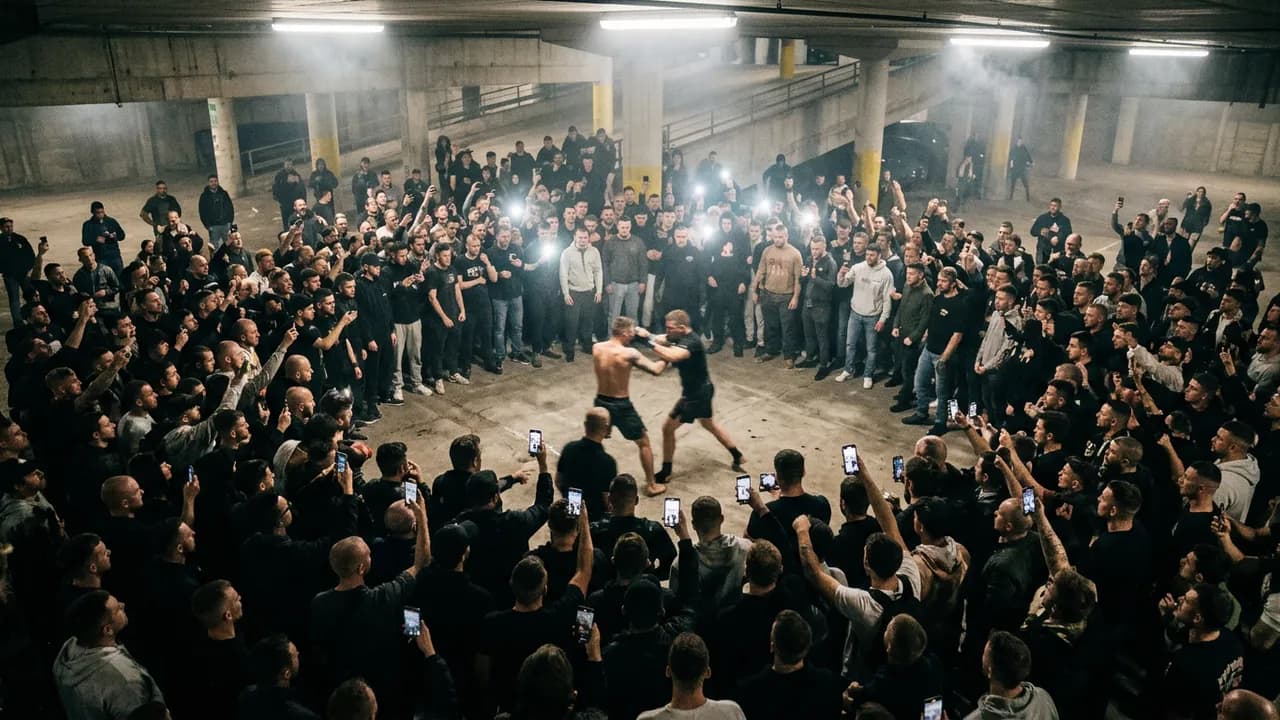
The COVID-19 pandemic proved to be the most significant accelerator of YouTube-based fight content since Kimbo Slice's original videos. With sanctioned combat sports shut down and audiences starving for live action, YouTube's fight content ecosystem exploded. New channels launched. Existing channels saw viewership spike. Top Dog FC was literally born during the pandemic, growing from parking lot fights into Russia's biggest bare-knuckle promotion in a matter of months.
06 / Up next / The Current Landscape
Backyard Squabbles, launched during the pandemic period, captured the American market with a looser, more chaotic format and grew rapidly through YouTube's recommendation engine. The pandemic demonstrated that the algorithm's appetite for fight content was not a historical artifact -- it was a permanent feature of online video consumption.
The Current Landscape
The YouTube fighting ecosystem in 2026 is a mature industry built on foundations that remain fundamentally unstable. The largest channels -- Streetbeefs, Strelka, Top Dog FC -- have audiences that rival mid-tier television networks. The total economic footprint, including ad revenue, sponsorships, merchandise, event revenue, and the secondary economies of fighter training, equipment sales, and media coverage, likely exceeds $100 million annually across all operations worldwide.
Yet every dollar of that economy flows through a platform controlled by a single company. YouTube's decisions -- algorithmic adjustments, policy changes, monetization rule modifications, content moderation enforcement -- can redirect the flow overnight. The smartest operators in the space are building email lists, developing proprietary streaming platforms, securing broadcast deals, and diversifying revenue in every way possible.
What YouTube Built -- and What It Could Destroy
The history of YouTube's relationship with underground fighting is a case study in unintended consequences at scale. A software company built an algorithm to maximize engagement. That algorithm discovered that people wanted to watch other people fight. That discovery created a multi-million-dollar industry that employs hundreds, entertains millions, and has fundamentally altered the landscape of combat sports.
But the industry's creation story is also its greatest vulnerability. YouTube did not consciously choose to build the underground fighting economy. It happened as a byproduct of algorithmic optimization, and it can be undone just as unconsciously. A policy change, an advertiser boycott, a regulatory intervention, a shift in algorithmic weighting -- any of these could dismantle in months what took nearly two decades to build.
The underground fighting industry exists because of YouTube. Whether it can survive without YouTube is the question that will define its next chapter. The promotions that treated the platform as a launching pad -- building real businesses with diversified revenue and direct audience relationships -- will adapt. The ones that treated YouTube as a foundation will discover that foundations built on someone else's algorithm are not foundations at all.
They are favors. And favors can be revoked.
Key YouTube Videos That Built the Industry
The clips, channels, and viral moments that demonstrate how YouTube's algorithm created a global fighting industry from nothing.
- Kimbo Slice vs Big D — The Original Viral Fight: The fight that predated YouTube itself. Uploaded to early video platforms in 2003, it proved the existence of a massive audience for raw fighting content before the infrastructure existed to serve it.
- Streetbeefs Official Channel: The most successful YouTube-native fighting operation in history. Over 4 million subscribers built entirely through algorithmic recommendation, consistent uploads, and the "Guns Down, Gloves Up" philosophy.
- Streetbeefs: Death Sentence: One of the most-viewed individual Streetbeefs fights -- the kind of content that YouTube's algorithm identifies as high-engagement and recommends to millions of viewers who never searched for it.
- Strelka Official Channel: 2.45 million subscribers, 1.5 billion views. Proof that the algorithm's appetite for fight content transcends language, geography, and culture.
- KOTS: Simon vs Ronin: King of the Streets content that drove the channel past one million subscribers before YouTube's content moderation team took it down -- the perfect illustration of the tension between algorithmic promotion and platform policy.
- Jorge Masvidal Backyard Fight: A future UFC star fighting in a Miami backyard. The ultimate proof that YouTube's fighting ecosystem can produce talent that transitions to the highest levels of sanctioned combat sports.
- Top Dog FC: Best Knockouts: The Russian bare-knuckle promotion born during the pandemic, built entirely on YouTube. From parking lot fights to CSKA Arena shows, powered by algorithmic growth.