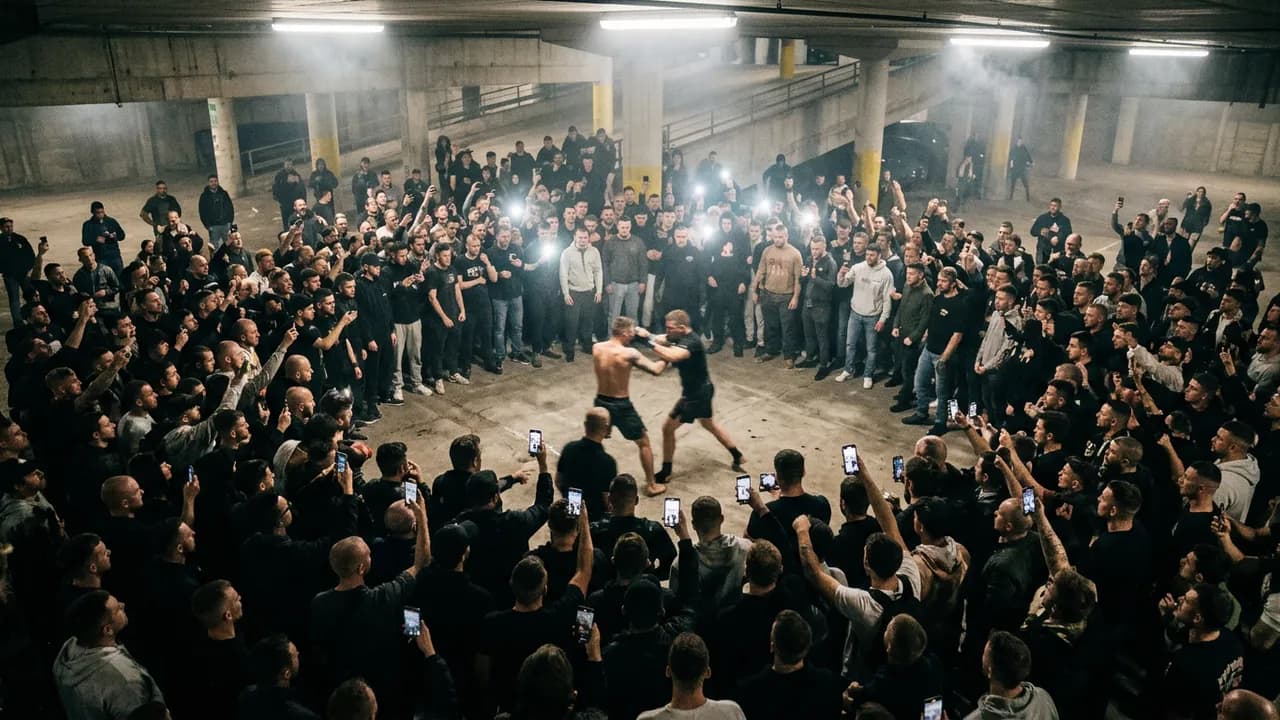
YouTube built the audience. Telegram runs the operation.
That distinction -- between the public-facing platform where millions of viewers discover underground fighting content and the private, encrypted infrastructure where events are actually organized -- is fundamental to understanding how the modern underground fighting industry works. The most secretive and operationally sophisticated fighting organizations in the world do not coordinate through email, social media DMs, or phone calls. They use Telegram, Signal, and other encrypted messaging platforms that provide the anonymity, security, and operational flexibility that unregulated fighting requires.
King of the Streets, UUF, FPVS, and dozens of smaller European underground fighting operations have built their entire organizational infrastructure on encrypted communication. Recruitment, event logistics, location disclosure, fighter management, and post-event coordination all flow through channels that are designed to resist surveillance, interception, and legal discovery. The result is a communication architecture that enables organizations to operate at scale while maintaining the operational security that keeps organizers out of court and events out of police reach.
This is how encrypted apps power underground fighting -- and what the reliance on these platforms means for the sport's future.
Why Encryption Matters: The Operational Problem
The Fundamental Tension
Underground fighting organizations face an operational challenge that is unique in the content creation economy: they need to be simultaneously public and private. The content must be maximally visible -- uploaded to YouTube, shared on social media, promoted to the widest possible audience. But the operations must be maximally hidden -- event locations concealed from police, organizer identities protected from prosecution, participant information shielded from legal discovery.
This tension -- public product, private process -- cannot be resolved through conventional communication channels. Email is discoverable. Social media direct messages are stored on servers controlled by platforms that cooperate with law enforcement. Phone calls can be intercepted. Text messages are retained by carriers. Any communication channel that leaves a trail is a channel that can be subpoenaed, seized, or surveilled.
Encrypted messaging solves this problem. Platforms like Telegram and Signal use end-to-end encryption that prevents third parties -- including the platform operators themselves, in Signal's case -- from reading message content. Telegram offers additional features that are particularly valuable for underground operations: self-destructing messages that automatically delete after a set period, anonymous accounts that do not require real-name identification, group channels that can be controlled by administrators whose identities are hidden, and secret chats with enhanced encryption and screenshot notifications.
For organizations that operate in legal gray areas across multiple jurisdictions, these features are not conveniences. They are operational necessities.
How KOTS Uses Telegram
The Communication Architecture
King of the Streets and the Hype Crew have built what amounts to a parallel organizational infrastructure on Telegram. The platform serves multiple functions that together constitute the backbone of KOTS operations:
Public-facing channels: KOTS maintains Telegram channels that function as a combination of social media presence and community hub. These channels publish event announcements, fight footage, merchandise promotions, and general content that builds and maintains the KOTS audience. These channels are discoverable by anyone with a Telegram account and serve the same promotional function as social media profiles on Instagram or X -- they are the public face of the organization on an encrypted platform.
Recruitment channels: Fighters who want to compete at KOTS events are directed to specific Telegram channels or accounts where they can register interest, provide basic information about their fighting background, and enter the pipeline for event selection. These recruitment channels allow the Hype Crew to vet potential participants without exposing organizer identities or event details to unscreened individuals.
Event logistics groups: The operational core of KOTS's Telegram usage is the event logistics function. When an event is being organized, details are shared through restricted groups that include only confirmed participants and essential personnel. Location information -- the most sensitive operational detail -- is disclosed through these groups on a just-in-time basis, typically hours before the event.
Fighter communication: Individual fighters communicate with KOTS organizers through Telegram direct messages or small group chats. Matchmaking, scheduling, rule clarifications, and pre-event instructions all flow through these channels, creating a communication record that exists only on the participants' devices and can be set to self-destruct.
The Location Disclosure Protocol
The most operationally critical use of Telegram in KOTS events is the disclosure of event locations. The protocol follows a pattern designed to minimize the window of vulnerability between location disclosure and event commencement:
- Fighters and approved attendees receive a general notification that an event is scheduled for a specific date.
- As the date approaches, participants receive increasingly specific geographic information -- a city, then a neighborhood, then a meeting point.
- The final location -- the exact address or GPS coordinates of the event venue -- is disclosed via Telegram only hours before the event begins.
- This information is sent through channels or messages that can be set to self-destruct, eliminating the digital trail after the event.
This graduated disclosure model ensures that even if an attendee's account is compromised, the location information is only available for a limited window. By the time law enforcement could act on a tip derived from a compromised account, the event would already be underway or concluded.
UUF Denmark: The Hype Crew's Encrypted Extension
Operating in the Shadows of a Small Country
UUF (Ultimate Underground Fights) in Denmark faces a more intense version of the operational security challenge that all underground fighting organizations confront. Denmark is a small country with an efficient police force and a media landscape that can amplify a story to national prominence within hours. Operating an unsanctioned fight club in this environment requires exceptional operational discipline, and encrypted communication is the foundation of that discipline.
The audience for UUF events -- typically capped at around 100 spectators -- is curated through the same channels, with attendance by invitation only.
UUF's Telegram usage mirrors the KOTS model but with adaptations for the Danish context. The organization recruits fighters through encrypted channels, organizes events through restricted groups, and discloses locations on a need-to-know basis with just-in-time timing. The audience for UUF events -- typically capped at around 100 spectators -- is curated through the same channels, with attendance by invitation only.
The Danish podcast investigation "Undergrunden: Den danske fightclub" revealed aspects of UUF's encrypted communication practices, demonstrating that while the system is effective at preventing casual discovery, it is not impervious to sustained investigative effort. The journalists who penetrated UUF's network did so through patient cultivation of contacts within the fighting community, gaining access to the encrypted channels that UUF uses for recruitment and logistics.
This journalistic penetration highlighted both the strengths and limitations of Telegram-based operational security. The encryption itself was never broken -- the journalists gained access through social engineering rather than technical compromise. But the incident demonstrated that the human element remains the weakest link in any security architecture, and that encrypted communication cannot protect against the trust failures that are inherent in any organization that involves hundreds of participants.
FPVS: French Riviera Encrypted
The Young Founders' Digital Native Approach
FPVS, the French underground fighting organization founded by two twenty-year-olds known as Leon and Victor, represents a generational evolution in encrypted communication usage. Where the Hype Crew adopted Telegram as a tool to solve an operational problem, FPVS's founders are digital natives who grew up with encrypted messaging as a default communication mode. For them, Telegram is not a specialized operational tool -- it is simply how they communicate.
This generational comfort with encrypted platforms has produced an organization that is encrypted by default rather than encrypted by design. FPVS's entire social and organizational infrastructure exists on encrypted platforms, from casual conversations among the founding group to formal event coordination to post-event debriefing. The separation between "operational" and "personal" communication that older organizations maintain is less relevant for a generation that conducts all communication through the same encrypted channels.
FPVS uses Telegram for fighter recruitment on the French Riviera and in expanding French markets. The organization's young demographic -- participants are predominantly in the 18-25 age range -- aligns with Telegram's user base in France, where the platform has gained significant traction among young adults. This demographic alignment means that FPVS does not need to onboard fighters onto an unfamiliar platform. The fighters are already there.
Beyond Telegram: The Encrypted Ecosystem
Signal, WhatsApp, and Other Platforms
While Telegram is the dominant encrypted platform in underground fighting, it is not the only one. Different organizations and different markets use different platforms based on regional popularity, specific security requirements, and user preferences.
Signal offers stronger encryption than Telegram's default chats -- all Signal messages are end-to-end encrypted by default, whereas Telegram's standard chats use server-client encryption with only "Secret Chats" using end-to-end encryption. Signal's emphasis on privacy and its open-source protocol have made it the preferred platform for users who prioritize security above all else. Some underground fighting operators use Signal for the most sensitive communications -- organizer-to-organizer messaging, legal discussions, and financial coordination -- while using Telegram for broader community and recruitment functions.
WhatsApp provides end-to-end encryption and is the dominant messaging platform in many markets where underground fighting operates. In Latin America, Africa, and parts of Asia, WhatsApp groups serve the same function that Telegram channels serve in Europe -- community building, recruitment, and event coordination. However, WhatsApp's ownership by Meta (Facebook's parent company) and its history of compliance with law enforcement requests make it less attractive to organizations with serious operational security concerns.
Discord occupies a hybrid space between social media and encrypted messaging. Several fighting communities maintain Discord servers for community interaction, but the platform's moderation policies and cooperation with law enforcement make it unsuitable for operational coordination of unsanctioned events.
The Platform Selection Decision
Underground fighting organizations choose their communication platforms based on a cost-benefit analysis that weighs security features against user adoption. The most secure platform is useless if fighters and community members will not use it. The most popular platform is useless if it exposes organizers to legal risk.
Telegram has emerged as the dominant choice because it offers a favorable balance: sufficient security features (end-to-end encryption in secret chats, self-destructing messages, anonymous accounts) combined with a massive user base and a feature set (channels, groups, bots, media sharing) that supports both community building and operational coordination. It is not the most secure option available, but it is secure enough for most purposes while being accessible enough for mass adoption.
The Implications: What Encrypted Communication Means for Underground Fighting
Enabling Scale
Encrypted communication has been a critical enabler of the underground fighting industry's growth. Before Telegram and similar platforms, organizing an unsanctioned fighting event required in-person coordination, phone calls that could be intercepted, and word-of-mouth information sharing that was slow and unreliable. These limitations capped the scale at which underground fighting could operate.
06 / Up next / Complicating Law Enforcement
Encrypted messaging removed those caps. An organization like KOTS can now coordinate events across multiple countries, recruit fighters from a continent-wide talent pool, manage logistics for complex multi-bout cards, and disclose sensitive location information to hundreds of participants -- all through a single platform that resists surveillance and leaves minimal forensic evidence.
This capability has transformed underground fighting from a local phenomenon into a transnational industry. The European no-rules fighting network -- KOTS, UUF, FPVS, Holmgang, and their affiliates -- could not exist in its current form without encrypted communication. The network's geographic scope, the frequency of its events, and the fluidity of its participant pool all depend on the ability to coordinate across borders through secure channels.
Complicating Law Enforcement
The encrypted communication infrastructure that enables underground fighting also complicates law enforcement efforts to regulate, investigate, or suppress it. Police agencies that might successfully monitor phone calls, intercept emails, or subpoena social media records face significantly greater challenges when the communication they need to access is protected by end-to-end encryption.
This does not make enforcement impossible. As the UUF podcast investigation demonstrated, human intelligence -- informants, undercover operations, social engineering -- can penetrate encrypted networks where technical surveillance cannot. And Telegram's cooperation with law enforcement, while more limited than platforms like Facebook or Google, is not zero -- the platform has complied with court orders in some jurisdictions.
But encryption raises the cost and complexity of enforcement significantly. A police investigation that might have been straightforward in the era of unencrypted communication becomes resource-intensive and technically demanding when the targets communicate through encrypted channels. For under-resourced local police departments -- the agencies most likely to encounter underground fighting events in their jurisdictions -- these barriers may be effectively prohibitive.
Creating Accountability Gaps
The same encryption that protects organizers from law enforcement also protects them from accountability. When an injury occurs at an underground fighting event organized through Telegram, the encrypted communication that coordinated the event cannot easily be accessed to determine who was responsible, what safety measures were or were not implemented, and what decisions led to the injury.
This accountability gap is the dark side of encrypted communication's role in underground fighting. The safety concerns that attend any unregulated combat activity are compounded by a communication infrastructure that makes it difficult to assign responsibility, investigate incidents, or implement corrective measures after something goes wrong.
The Dependency Risk
What Happens If Telegram Changes?
The underground fighting industry's reliance on Telegram creates a dependency risk that mirrors the YouTube dependency risk on the content side. Just as a YouTube policy change could devastate fight content channels, a Telegram policy change could disrupt the operational infrastructure of dozens of underground fighting organizations simultaneously.
Telegram has faced regulatory pressure in multiple jurisdictions, including calls for the platform to be banned or restricted in countries where it is used to coordinate illegal activities. In 2024, Telegram founder Pavel Durov was detained in France in an investigation related to the platform's use for criminal activities. While the investigation was not specifically related to underground fighting, the episode demonstrated that Telegram's operational continuity is not guaranteed.
If Telegram were to significantly restrict its features -- eliminating self-destructing messages, requiring real-name verification, or increasing cooperation with law enforcement -- the impact on underground fighting would be immediate and severe. Organizations would need to migrate to alternative platforms, a process that would involve audience attrition, operational disruption, and the security risks inherent in any transition.
The most operationally sophisticated organizations maintain presence on multiple platforms as contingency, but Telegram's unique combination of features and user base makes it difficult to replace. The underground fighting industry's encrypted communication infrastructure is, like its content distribution infrastructure, built on a platform it does not control.
The Encrypted Future
The relationship between encrypted communication and underground fighting is not a temporary phenomenon. As long as fighting organizations operate outside legal frameworks, they will need communication channels that resist surveillance and protect operational details. As encryption technology improves and encrypted messaging becomes more ubiquitous, the tools available to underground fighting organizations will become more powerful and more accessible.
The implications cut both directions. Better encryption enables better operational security, which enables larger, more complex events that reach more participants and more audiences. But better encryption also deepens the accountability gaps that make underground fighting dangerous, reducing the likelihood that safety failures will be investigated and corrected.
The underground fighting industry's encrypted communication infrastructure is the invisible foundation on which the visible spectacle is built. YouTube provides the audience. Telegram provides the organization. Between the two platforms -- one public, one private; one algorithmically optimized, one cryptographically secured -- the entire underground fighting economy operates.
Neither platform was designed for this purpose. Both are essential to it. And the industry's future depends, in no small part, on the decisions made by the companies that control them -- decisions that the people organizing fights in warehouses, on concrete, and in hay bale rings have no power to influence.
The message is encrypted. The risk is not.