Nobody knows who they are. That is not a figure of speech or a marketing conceit -- it is a statement of operational fact. The Hype Crew, the anonymous collective that founded and operates King of the Streets (KOTS), has maintained near-total anonymity since the organization's inception in 2013. No public-facing founders. No corporate filings that trace to identifiable individuals. No interviews given under real names. No photographs without skull masks or digital face-blurring. In an era where every fight promoter from David Feldman to Dana White has a public persona, the people who run one of Europe's most notorious underground fighting organizations remain ghosts.
This anonymity is not accidental. It is engineered, maintained through operational security practices that would be familiar to organized crime syndicates but are applied here in service of something more unusual: a no-rules fighting organization that operates in the gray area between legality and prosecution across multiple European jurisdictions. The Hype Crew is simultaneously a brand, a crew, a content production outfit, and a transnational operation whose members face potential criminal liability every time they stage an event.
This is everything that is known -- and everything that remains unknown -- about the people who really run King of the Streets.
Origins: Gothenburg's Hooligan Underground
The Football Connection
The roots of the Hype Crew are embedded in the football hooligan subculture of Gothenburg, Sweden's second-largest city. Gothenburg is home to three major football clubs -- IFK Goteborg, BK Hacken, and GAIS -- and the city has a long history of supporter culture that, at its edges, shades into organized violence. The casual firms and hooligan crews associated with Swedish football have historically been smaller and less internationally notorious than their English, Polish, or Russian counterparts, but they share the same fundamental culture: young men bonded by tribalism, physicality, and a willingness to fight.
The founding members of the Hype Crew emerged from this ecosystem. The available evidence -- drawn from KOTS's own published content, journalistic investigations, social media analysis, and the Danish podcast "Undergrunden: Den danske fightclub" -- indicates that the core group consisted of young men in their twenties from Gothenburg's hooligan scene who were already participating in organized hooligan fights (sometimes called "forests" or "arranged" encounters in Scandinavian hooligan parlance) by the early 2010s.
These arranged hooligan fights followed a specific format: opposing firms would agree on a time and location -- typically a forest clearing or industrial area away from police surveillance -- and engage in group combat. The fights had unwritten rules (no weapons, no kicking downed opponents in some cases), were filmed on phones, and served as tests of courage and crew solidarity. They were, in essence, proto-KOTS events: organized, filmed, and conducted under a rough code of conduct.
From Firm Fights to Fight Club
The transition from hooligan firm fights to KOTS was a natural evolution driven by two insights. First, the individual fight format was more compelling for video content than chaotic group brawls. A one-on-one encounter had a clear narrative arc -- buildup, conflict, resolution -- that a group melee lacked. Second, the audience for fight content on YouTube was massive and underserved, as the algorithm was already demonstrating by 2013.
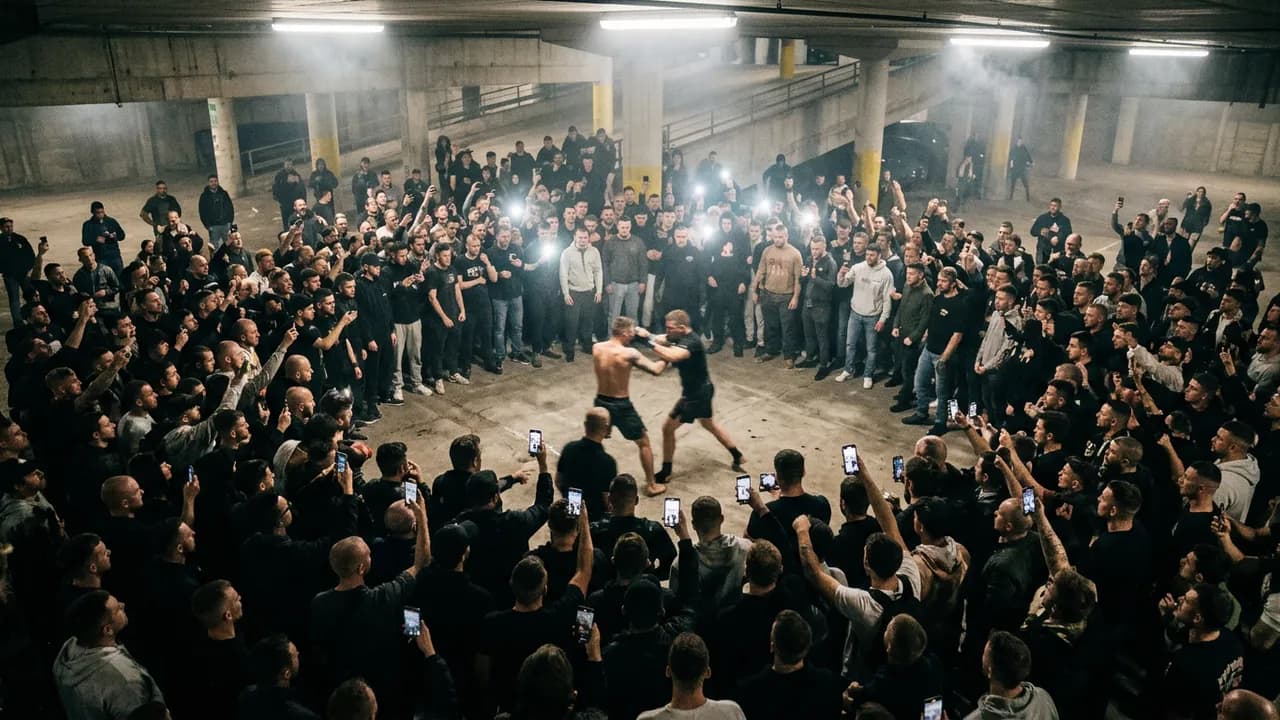
Around 2013, members of what would become the Hype Crew began filming individual street fights in and around Gothenburg. The early KOTS videos had a raw, documentary quality -- two fighters, a circle of masked spectators, a concrete or asphalt surface, and the unforgiving reality of no gloves, no rounds, and no rules. The fighters were drawn from the same hooligan networks that produced the crew itself, and the events had the atmosphere of a firm gathering rather than a sports event.
The name "King of the Streets" evoked the hooligan aspiration -- dominance of public space through physical force -- while "Hype Crew" described the collective's role: they were the ones who generated the hype, who promoted the events, who turned raw violence into a branded product.
The Skull Masks: Branding and Anonymity
More Than Aesthetic
The skull masks and balaclavas worn by Hype Crew members at KOTS events serve a dual purpose that perfectly illustrates the organization's hybrid nature. On one level, they are branding. The skull imagery -- which appears on KOTS merchandise, social media, and video thumbnails -- creates a visual identity that is instantly recognizable and deliberately intimidating. It communicates danger, rebellion, and underground authenticity in a way that conventional fight promotion branding does not.
Other European underground fighting organizations have adopted similar visual languages, from FPVS's blurred faces to UUF's own masked aesthetic.
On another level, the masks are operational security. Every KOTS event is potentially a crime scene. Organizing unsanctioned fights on concrete, without medical oversight, without athletic commission approval, and without the consent-defense protections that come with sanctioned competition exposes organizers to prosecution for assault, aiding and abetting bodily harm, or equivalent offenses under Swedish, Danish, German, or whichever country's law applies to the venue. The masks prevent law enforcement from identifying organizers through video evidence.
This dual function -- cool branding that also prevents criminal identification -- is one of the Hype Crew's most effective innovations. It turned a practical necessity into an aesthetic choice that enhanced rather than diminished the organization's appeal. Other European underground fighting organizations have adopted similar visual languages, from FPVS's blurred faces to UUF's own masked aesthetic.
The Persona Game
Individual Hype Crew members have developed semi-public personas that allow them to interact with fighters, fans, and media without revealing their identities. These personas are conducted through KOTS's social media accounts, encrypted messaging channels, and the occasional video appearance where the member is masked, voice-altered, or filmed from behind.
This approach creates an unusual dynamic: the Hype Crew is simultaneously present and absent. They are the most visible presence at every KOTS event -- the masked figures who manage the crowd, set up the fighting area, handle logistics, and oversee the production -- but they are also the most anonymous. Fighters who compete at KOTS events may interact with Hype Crew members dozens of times without ever learning their real names.
Operational Security: How KOTS Stays Underground
Location Security
The single most critical operational security challenge for KOTS is venue selection. Every event requires a location that meets specific criteria: large enough to accommodate fighters, crew, and spectators; private enough to avoid detection by police or uninvited visitors; structurally suitable for fighting (concrete or hard surface, adequate lighting for filming); and accessible enough for invited participants to find.
KOTS has used a variety of venue types over the years: abandoned warehouses, industrial facilities, parking structures, underpasses, and outdoor concrete plazas. The common thread is that these locations are disclosed only to approved participants through encrypted communication channels -- primarily Telegram -- and only shortly before the event. Fighters and approved spectators receive coordinates or a meeting point within hours of the event, minimizing the window during which a compromised attendee could alert authorities.
This practice mirrors the operational model used by rave organizers in the 1990s and by hooligan firms arranging fights: compartmentalized information, need-to-know distribution, and just-in-time disclosure. It is effective but not foolproof -- KOTS events have been disrupted by police in the past, and the Danish podcast investigation into UUF demonstrated that journalistic penetration of the network is possible with sufficient persistence.
Digital Security
The Hype Crew's digital security practices reflect an awareness of online surveillance that exceeds what most content creators consider. KOTS communicates with fighters and community members primarily through Telegram, an encrypted messaging platform that allows for self-destructing messages, anonymous accounts, and group channels that can be controlled and moderated by administrators whose identities are hidden.
The organization's YouTube presence has been managed through a series of channels rather than a single persistent account. When a channel is terminated -- as has happened multiple times -- the Hype Crew migrates to a new channel, bringing as much of its audience as possible through cross-platform promotion. This channel-hopping strategy accepts audience attrition as the cost of staying on YouTube while minimizing the impact of any single takedown.
Social media accounts on Instagram, X (formerly Twitter), and TikTok are managed by individuals whose personal accounts are not publicly linked to the KOTS brand. The separation between personal and organizational digital identities is maintained with the kind of discipline that suggests at least some members have backgrounds in security, technology, or the kind of criminal enterprise where poor operational security leads to prison.
The European Network: Beyond Gothenburg
Building the KOTS Ecosystem
The Hype Crew's ambitions extended beyond Gothenburg from relatively early in KOTS's history. By 2018, the organization was staging events across Europe, drawing fighters from Sweden, Denmark, Norway, Germany, Poland, England, Ireland, and France. This expansion was not the product of a franchise model or corporate growth strategy. It was organic, driven by the same hooligan networks that had created the Hype Crew in the first place.
04 / Up next / UUF Denmark: The First Affiliate
European football hooliganism is inherently transnational. Firms travel to away matches, interact with counterparts from other countries at tournaments, and maintain connections across borders through social media and messaging apps. The Hype Crew leveraged these existing networks to recruit fighters, identify potential event organizers, and build audiences in new markets. A hooligan from Copenhagen who followed KOTS on YouTube could be recruited to fight at a Swedish event through a Telegram group, and his participation would introduce the organization to his own network of Danish fighters and fans.
UUF Denmark: The First Affiliate
UUF (Ultimate Underground Fights) in Denmark represents the Hype Crew's most visible expansion beyond Sweden. Listed on the official KOTS website as an affiliated fight club, UUF operates as a regional proving ground where Danish fighters build reputations before competing on larger KOTS cards. UUF events are held in abandoned warehouses and industrial halls for audiences of up to 100 spectators, with the same no-rules format that defines KOTS.
The UUF affiliation demonstrates the Hype Crew's organizational model: a decentralized network of semi-autonomous operations unified by a common brand, ruleset, and communication infrastructure. Local organizers handle the logistics of venue selection, fighter recruitment, and event production. The Hype Crew provides the brand, the platform, and the audience. This structure minimizes the Hype Crew's direct exposure while maximizing the organization's geographic reach.
FPVS, Holmgang, and the Imitators
Beyond formal affiliates, the Hype Crew's influence extends to a constellation of independent organizations that have adopted the KOTS model without direct affiliation. FPVS on the French Riviera stages concrete fights under the same no-rules format but is not a KOTS franchise. Holmgang operates independently in Scandinavia. Dozens of smaller, unnamed operations across Europe film no-rules fights on concrete and upload them to YouTube, TikTok, or Telegram channels that explicitly reference KOTS as their inspiration.
The Hype Crew's response to this proliferation has been ambiguous. On one hand, imitators dilute the brand and create potential liability if an imitator's event results in a death or serious injury that is attributed to the KOTS ecosystem. On the other hand, the proliferation validates KOTS as the originator and dominant force in European no-rules fighting, reinforcing the brand's cultural significance.
What We Know About the Members
The Known Unknowns
Despite their operational security, certain facts about the Hype Crew have been established through journalistic investigation, legal proceedings, and the inevitable information leakage that accompanies any organization that operates for over a decade.
Number of core members: The Hype Crew's inner circle appears to consist of between five and fifteen individuals, based on the number of distinct masked figures visible at KOTS events and the estimated personnel required to manage logistics, production, and fighter relations.
Age and demographics: Core members appear to be in their late twenties to mid-thirties, consistent with an organization founded by men in their early twenties around 2013. The membership is exclusively male, as far as public-facing evidence indicates.
Geographic base: While KOTS events take place across Europe, the organizational center of gravity remains in Gothenburg and the broader Swedish west coast. The consistency of certain masked individuals across events spanning years suggests that at least some core members are permanent residents of the area.
Professional backgrounds: The production quality of KOTS content -- which has improved significantly over the years, incorporating multiple camera angles, professional editing, and sound design -- suggests that at least some members have backgrounds or training in videography and content production. The organization's merchandising operation, which sells branded clothing through online stores, requires e-commerce and logistics competence.
Criminal exposure: The Hype Crew operates in awareness that their activities may constitute criminal offenses in most European jurisdictions. Whether individual members have criminal records related to KOTS events or other activities is unknown, but the level of operational security employed suggests either direct experience with law enforcement or informed paranoia about potential prosecution.
What Remains Unknown
The fundamental questions about the Hype Crew remain unanswered. Who founded the collective? What are their real names? What do they do when they are not organizing fights? How are the revenues from YouTube, merchandise, and events distributed among members? Is there a hierarchical leadership structure or a flat collective? Do they have legal representation that advises on risk management? Have any members attempted to leave the organization, and if so, under what circumstances?
05 / Up next / The Paradox of Anonymous Fame
These questions may eventually be answered by investigative journalism, legal proceedings, or the inevitable attrition of operational security over time. For now, the Hype Crew remains what it has always been: a faceless collective that built one of Europe's most notorious fighting brands from the shadows and has, so far, managed to stay there.
The Paradox of Anonymous Fame
The Hype Crew occupies an unusual position in the underground fighting landscape. They are simultaneously one of the most recognized brands in the space and one of the least known organizations. The KOTS name, the skull masks, the concrete surfaces, the no-rules format -- these are instantly recognizable to millions of fight content consumers worldwide. But the people behind the brand remain invisible.
This anonymity is both KOTS's greatest strength and its most fundamental limitation. It protects the organization from prosecution and maintains the underground credibility that is central to its appeal. But it also prevents the Hype Crew from building the kind of public-facing brand that could survive a YouTube takedown, negotiate broadcast deals, or attract corporate sponsorship.
Streetbeefs has Chris "Scarface" Wilmore. Top Dog FC has Danil "Regbist" Aleyev. BKFC has David Feldman. These promotions have human faces that can do interviews, build relationships with media, and personify the brand in ways that drive audience loyalty beyond the content itself. KOTS has skull masks and Telegram channels.
The question is whether that trade-off -- security over visibility, anonymity over growth -- is sustainable as the underground fighting industry matures. The Hype Crew has survived for over a decade through operational discipline and the willingness to sacrifice commercial potential for operational security. Whether that calculation still makes sense as competitors grow and the regulatory environment evolves is a question only the people behind the masks can answer.
And they are not talking.
Essential KOTS and Hype Crew Videos
The footage from the most notorious anonymous fight organization in Europe. Due to repeated channel takedowns, KOTS content migrates frequently -- these represent key fights and documentary coverage.
- KOTS: Simon vs Ronin — Full Fight: One of the most viewed KOTS fights, showcasing the no-rules, concrete-surface format that defines King of the Streets. No gloves, no rounds, no weight classes -- just two fighters and the masked Hype Crew.
- KOTS — No Rules Street Fighting Documentary: Documentary coverage exploring the Hype Crew's operations, their hooligan roots in Gothenburg, and the operational security that keeps the organizers anonymous.
- Top Dog FC: Best Knockouts: While not KOTS directly, Top Dog represents the Russian side of the European no-rules fighting ecosystem that KOTS helped inspire. The production values show where the genre is heading.
- Undergrunden: Den danske fightclub — UUF Investigation: Coverage related to the Danish podcast investigation into UUF, the KOTS affiliate in Denmark, revealing how the Hype Crew's network operates across European borders.
- KOTS Highlights — Concrete Fights Compilation: A compilation of KOTS's most dramatic moments -- the skull masks, the warehouse venues, the raw violence on concrete that has made the organization both famous and hunted by European law enforcement.