Is Rough N' Rowdy Still Running? (2026 Status)
No — not since August 2024. RnR 25 is the most recent Rough N' Rowdy event, and as of August 2026 Barstool has announced no 2026 card. The promotion has not been formally wound up: the sign-up pages at roughnrowdybrawl.com remain live, and if a new card is announced it will be sold through BuyRnR.com like every Barstool-era event. Dave Portnoy has said publicly that declining pay-per-view numbers could end the promotion for good, which is the closest thing to an official statement on its future that exists.
Does Barstool still do Rough N' Rowdy?
Barstool still owns the promotion but has not staged an event in two years. Barstool Brawl LLC, the joint venture formed with founder Christopher MacCorkle Smith in November 2017, has never been publicly dissolved, and the fighter and ring girl sign-up pages are still open. What Barstool has not done is book a card. Until one is announced, Rough N' Rowdy exists on paper and on the sign-up form but not on a calendar — an indefinite hiatus rather than a confirmed cancellation.
Quick Facts
| Detail | Info |
|---|---|
| Founded | 1996 (acquired by Barstool Sports in 2017) |
| Location | West Virginia (primary); touring nationally |
| Founder | Christopher MacCorkle Smith |
| Format | Amateur boxing, 3 one-minute rounds, no headgear required |
| Platform | Pay-per-view via BuyRnR.com |
| PPV Price | $29.99 |
| Peak PPV Buys | 41,000+ per event |
| Events Held | 25+ (as of 2024) |
| Commentators | Dave Portnoy, Dan "Big Cat" Katz |
| Website | roughnrowdybrawl.com |
| Social Media | X/Twitter, Instagram, TikTok |
Overview
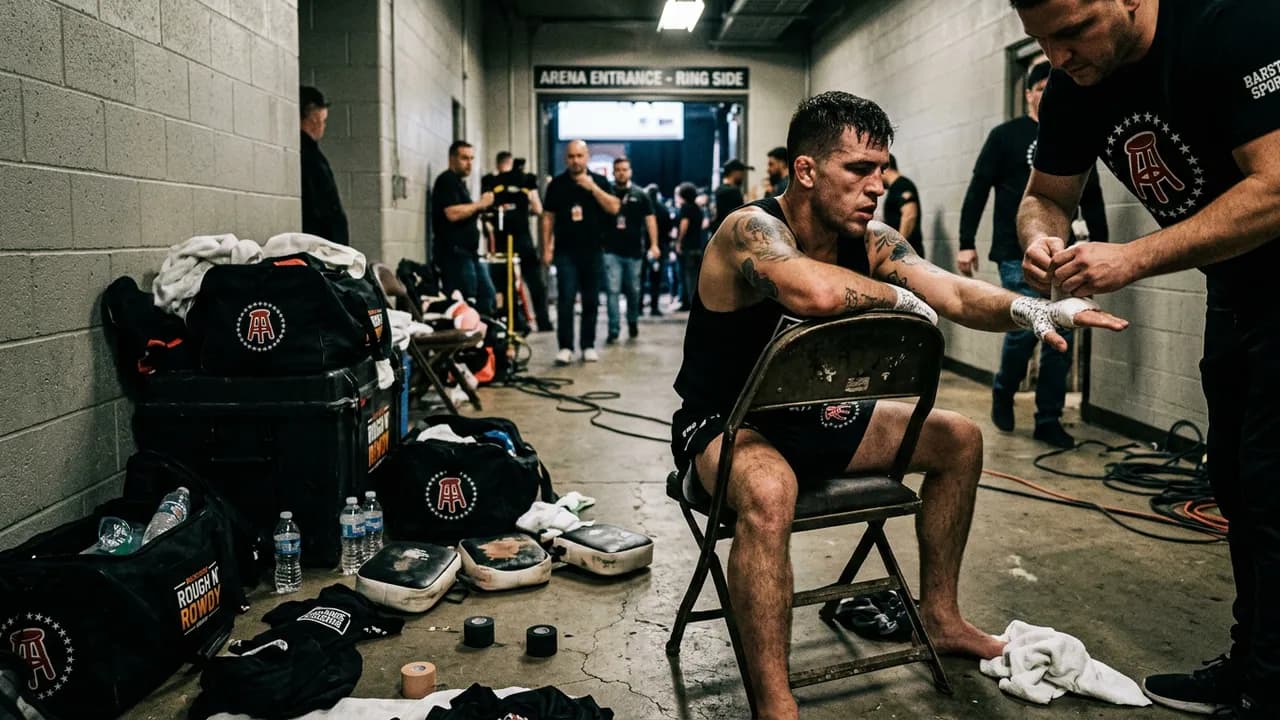
Rough N' Rowdy is the most commercially successful amateur boxing promotion in the United States and arguably the most unhinged night of live combat sports you can buy on pay-per-view. Born in the coal hollows of southern West Virginia and supercharged by the marketing machine of Barstool Sports, RnR takes ordinary people -- bartenders, coal miners, college kids, middle-aged dads with something to prove -- puts 16-ounce gloves on their hands, and turns them loose in a boxing ring for three one-minute rounds of controlled chaos.
There is no headgear requirement. There is no amateur boxing experience requirement. There are ring girls in elaborate costumes, fighters making their walkouts in everything from Confederate-flag robes to full trash-can suits, and two of the most popular podcasters in America calling the action like it is a heavyweight championship. The result is a product that sits somewhere between a county fair, a WWE event, and an actual boxing card -- and it has generated tens of millions of dollars in pay-per-view revenue.
At its peak, Rough N' Rowdy was pulling over 41,000 PPV buys per event, numbers that would make many professional boxing undercards jealous. The promotion has held 25 numbered events since Barstool's acquisition and built a roster of recurring amateur fighters whose names -- the Abel Brothers, Bobby Lang, Big Dick Booty Daddy -- sound like they were invented by a wrestling promoter on a bender. But beneath the absurdity is a genuine cultural phenomenon rooted in one of the most economically depressed regions in America.
History and Origins
Coal Country Beginnings
The story of Rough N' Rowdy starts with a failed show and a man too stubborn to quit. Christopher MacCorkle Smith was a former amateur boxer whose competitive career ended in the mid-1990s. His wife Andrea suggested he try promoting.
In 1996, Smith staged his first event at the Charleston Civic Center, a 13,000-seat arena. Six hundred people showed up. Smith absorbed a $20,000 loss. A second event in Richmond, Virginia, flopped as well. By 1997, he was on the verge of giving up. "It was the last show we were going to do," Smith later said. "Either we were going to do well here or we were going to hang it all up."
The "here" was Williamson, West Virginia -- a coal town of roughly 3,000 people wedged so deep into the Appalachian mountains that cellphone signals barely reach. Williamson sits in Mingo County, the heart of what was once the richest coal-producing region in the world and is now one of the most economically distressed. The Hatfield-McCoy feud happened just up the road.
On fight night, Smith walked into the Williamson Armory and found a capacity crowd of more than 3,000 people. Entire families had turned out. Some fighters came straight from the mines, faces still smudged gray with coal dust. Winners left with a trophy, a jacket, and a check for $1,000 -- the equivalent of a few weeks of underground work.
A West Virginia Institution
After Williamson, Smith never looked back. Rough N' Rowdy became an annual tradition -- one weekend every March, almost the entire population of the town would pack into the armory to watch their friends, neighbors, and co-workers beat each other bloody. The fights were raw, they were loud, and they were the biggest entertainment event the region had all year.
04 / Up next / The Barstool Connection
For nearly two decades, Smith ran Rough N' Rowdy as a grassroots operation across small-town West Virginia, drawing coal miners, truck drivers, bar bouncers, and anyone else who wanted to test themselves. By the time the outside world noticed, the Washington Post, Denver Post, and other national outlets were painting the event as a window into a forgotten America -- a place where a boxing card was still the social event of the year and the line between fighter and spectator was thin enough that anyone might cross it.
The Barstool Connection
The Acquisition
In March 2017, Barstool sent a production crew to Welch, West Virginia, and streamed a Rough N' Rowdy event on pay-per-view for the first time, with a Barstool blogger headlining the card. More than 10,000 people paid to watch. The numbers were promising enough that in November 2017, Barstool and Smith formalized their relationship by creating Barstool Brawl LLC. Smith would continue to run day-to-day operations -- scouting fighters, booking venues, organizing the cards -- while Barstool would provide the marketing muscle, production value, and pay-per-view infrastructure.
The partnership was transformative. Barstool brought professional cameras, lighting, and graphics overlays to what had been a bare-bones local production. More importantly, Barstool brought an audience. The first few Barstool-produced events pulled PPV numbers in the low teens of thousands; by 2018, the events were clearing 40,000 buys. At $19.99 per purchase, a single RnR event could generate well over $800,000 in PPV revenue alone before accounting for sponsorships, ticket sales, and merchandise.
The Barstool Treatment
What Barstool added was not just production value -- it was personality. Dave Portnoy and Dan "Big Cat" Katz, host of the massively popular Pardon My Take podcast, became the permanent commentary team. Their booth work is part color commentary, part comedy roast: they mock the fighters' physiques, invent nicknames on the fly, and openly express disbelief at what they are witnessing. It is deeply unprofessional and overwhelmingly entertaining.
Barstool also introduced narrative elements borrowed from professional wrestling. Fighters were given elaborate ring names and encouraged to film trash-talk promos. Recurring rivalries were cultivated across cards. The ring girl competition became a major part of the broadcast. Barstool personalities like Frank the Tank and Jersey Jerry were woven into the cards as participants, commentators, or instigators. The result was less a boxing card and more a chaotic variety show with punching.
Format and Rules
The Basics
Rough N' Rowdy events feature approximately 15 to 20 refereed boxing bouts on each card. The fights are structured as follows:
- Rounds: Three rounds per fight
- Round Length: One minute per round
- Gloves: 16-ounce boxing gloves (provided by the promoter)
- Headgear: Not required in West Virginia; if one fighter opts to wear headgear, the opponent must also wear it
- Scoring: Standard 10-point boxing scoring; fights can also end by knockout, TKO, or referee stoppage
Fighter Eligibility
The eligibility rules are designed to keep the fights genuinely amateur:
- Fighters must not have more than five combined wins in amateur boxing, kickboxing, or MMA. Toughman and Rough N' Rowdy bouts do not count toward this limit.
- Age restrictions apply (fighters must be legal adults)
- All fighters undergo a pre-event physical examination
- Fighters must arrive by 4:30 PM on fight day to complete paperwork and physicals; late arrivals may be turned away
Equipment
The promoter provides all mandatory safety equipment:
- 16-ounce boxing gloves
- Headgear (available if requested, though not required)
- Groin protection
Fighters must bring their own mouthpiece. No other personal equipment is permitted. You cannot bring your own gloves.
What Makes It Different
The one-minute round format is the key design decision. Professional rounds last three minutes; most amateur formats use two or three. At one minute per round, there is no time for strategy or feeling out an opponent. Fighters come out swinging from the opening bell because the round will be over before they can think. The result is nonstop action, frequent knockdowns, and a pace that keeps casual fans engaged even if they know nothing about boxing.
The absence of a headgear requirement adds another layer. Cuts, swelling, and visible damage accumulate fast. Fighters often leave the ring looking like they survived a bar fight -- which is precisely the aesthetic the promotion is going for.
Notable Moments
Billy Football vs. Jose Canseco (RnR 13, February 2021)
The single most famous moment in Rough N' Rowdy history. Jose Canseco, the former MLB slugger and admitted steroid user, was matched against Billy Football, a 22-year-old Barstool Sports intern. The fight was the culmination of a feud that started when Canseco trashed Alex Rodriguez on a Barstool podcast and Billy Football called him out.
When the bell rang, Billy rushed forward and dropped Canseco in the first round.
When the bell rang, Billy rushed forward and dropped Canseco in the first round. The referee stopped the fight almost immediately. The knockout happened so fast that "Jose Canseco" was trending on Twitter within minutes. Controversy followed: Rough N' Rowdy's promoter publicly claimed Canseco may have taken a dive, and reports circulated that Canseco was paid over a million dollars for the appearance. Regardless of what actually happened, the moment delivered exactly what pay-per-view audiences wanted -- spectacle, shock, and a story everyone would be talking about the next day.
The Abel Brothers
Among the recurring fighters who have become genuine RnR stars, the Abel Brothers stand out. Their ongoing presence across multiple cards has given the promotion something rare in amateur boxing: continuity. Fans who buy one PPV want to see what happens next, and the Abel Brothers have become a reliable draw across multiple events.
400-Pound Fighters in Jeans
The visual absurdity of Rough N' Rowdy is half the appeal. Events have featured fighters well over 400 pounds entering the ring in jeans, mismatches pairing fighters separated by a full foot of height, five-second knockouts, and heavyweight bouts where neither fighter appears to have thrown a punch in anger before stepping through the ropes. These moments circulate endlessly on social media and serve as the promotion's most effective marketing tool.
Technical Difficulties
Not every moment has been a highlight. Barstool's production has suffered technical difficulties during live PPV streams on multiple occasions, leading to frustrated online viewers and, at least once, booing from the arena crowd when fights were delayed to fix streaming issues. A reminder that beneath the professional veneer, this remains a scrappy operation broadcasting live combat sports from places where the Wi-Fi is not always reliable.
How to Watch
Pay-Per-View
Rough N' Rowdy events are available exclusively through pay-per-view. Here is how to access them:
- Purchase: One-time PPV passes can be bought at BuyRnR.com for $29.99 plus tax
- What's Included: Each pass includes access to the live PPV stream and the on-demand replay
- Devices: Stream on iPhone/iPad (via Safari), Android (via Chrome), desktop browsers, or cast to your TV via AirPlay or compatible Roku/Smart TV devices
- Simultaneous Streams: Up to 3 devices at once per purchase
Free Content
Between PPV events, Rough N' Rowdy and Barstool Sports release a substantial amount of free content:
- Fight highlights and knockout compilations on YouTube and social media
- Fighter introduction videos and trash-talk promos
- Behind-the-scenes content from the Barstool podcast universe
- Ring girl competition clips
- The "Ref N' Robbie" series breaking down top knockouts and moments
Replays
PPV replays are available for a limited window after each event (typically several weeks). Past events can sometimes be accessed through the Rough N' Rowdy website or Barstool Sports platforms.
How to Fight
Signing up to fight at Rough N' Rowdy is deliberately simple. The promotion's entire model depends on a steady supply of willing amateurs, so the barriers to entry are kept as low as possible.
Step-by-Step
- Visit the sign-up page: Go to roughnrowdybrawl.com/participate when registration is open for an upcoming event
- Submit your information: Basic personal details, physical stats (height, weight), and any prior fighting experience
- Eligibility check: You must not have more than five combined wins in amateur boxing, kickboxing, or MMA
- Arrive on fight day: Fighters must arrive at 4:30 PM to complete paperwork, sign waivers, and undergo a physical examination by an on-site medical professional
- Get matched: The promotion's matchmakers will pair you against an opponent of similar size. Experience matching is attempted but not guaranteed -- part of the appeal for viewers is the unpredictability of who gets matched with whom
- Fight: Three one-minute rounds of boxing. Win or lose, you go home with a story
Ring Girl Competition
The ring girl competition is open for sign-ups through the same participation page. Contestants are judged by a panel of Barstool personalities on appearance, costume creativity, and dance performance, with awards for best costume and best dance move alongside overall placement.
What to Expect
Be prepared for the unexpected. You may be matched against someone bigger, older, or more experienced than anticipated. You will be hit. The crowd will be loud, drunk, and opinionated. The Barstool commentary team may mock you on a live broadcast watched by tens of thousands of people. Despite all of this, the fighter pipeline has never dried up -- the allure of fighting on a nationally broadcast PPV keeps the sign-up sheets full for every event.
Business Model, Scale, and Future
Rough N' Rowdy operates on a model that most traditional boxing promoters would find baffling. The fighters are unpaid amateurs. The venues are mid-sized arenas and civic centers. The commentary team consists of bloggers and podcasters. And yet the numbers have worked -- at least until recently.
As of August 2026, two years on from RnR 25, no new event has been announced and the promotion's future remains an open question.
At its peak around 2018, RnR was pulling 41,000+ PPV buys per event at $19.99 a pop, generating over $800,000 in PPV revenue per event before ticket sales, sponsorships, and merchandise. But the economics have shifted. PPV buys dropped into the 30,000 range by 2020 and continued to soften. The price has since climbed to $29.99. Ahead of RnR 25 in August 2024, Portnoy publicly stated on The Unnamed Show that the event needed at least 20,000 buys to justify its continued existence: "I may bring an end to Rough n' Rowdy if I don't like the numbers here."
That kind of public brinkmanship is classic Portnoy -- part genuine concern, part promotional tactic. But it underscores a real vulnerability: the promotion lives and dies on PPV buys from a casual audience with no obligation to return. As of August 2026, two years on from RnR 25, no new event has been announced and the promotion's future remains an open question.
Most events have been held across West Virginia -- at the Williamson Armory (the original home), WesBanco Arena in Wheeling, venues in Clarksburg, Charleston, and Huntington. Under the Barstool partnership, RnR expanded nationally, most notably to Providence, Rhode Island, where sold-out events at the Amica Mutual Pavilion in 2019, 2022, and 2024 proved the concept could travel. West Virginia remains the spiritual heartland, but the brand has demonstrated it can fill arenas well beyond Appalachia.
How Rough N' Rowdy Compares
Rough N' Rowdy sits in a unique space. Compared to Streetbeefs, which operates as a free, community-based organization built around the philosophy of "Fists Up, Guns Down," RnR is a fully commercial PPV enterprise. Both feature amateur fighters, but the production values and spectacle put them in different categories entirely.
Against professional bare-knuckle promotions like BKFC, RnR fighters wear 16-ounce gloves and the bouts are far shorter. The fighters are genuine amateurs, not former professionals, a status that also explains why regulated sportsbooks never lined RnR. The appeal is raw unpredictability, not technical skill.
Compared to King of the Ring or street fighting organizations, RnR is far more structured -- referees, ring doctors, proper equipment, and a sanctioned ruleset inside an actual boxing ring.
FAQ
What is Rough N' Rowdy?
Rough N' Rowdy is an amateur boxing promotion founded in West Virginia by Christopher MacCorkle Smith and now operated in partnership with Barstool Sports. Events feature 15-20 boxing bouts between amateur fighters and are broadcast live on pay-per-view with commentary from Dave Portnoy and Big Cat.
How much does it cost to watch Rough N' Rowdy?
A one-time PPV pass costs $29.99 plus tax. This includes access to the live stream and the on-demand replay. Events can be purchased at BuyRnR.com.
Can anyone sign up to fight at Rough N' Rowdy?
Most adults can sign up, provided they have not accumulated more than five combined wins in amateur boxing, kickboxing, or MMA competition. Toughman and prior RnR bouts do not count toward this limit. Fighters sign up through the official website and must pass a pre-event physical.
Is Rough N' Rowdy real or staged?
The fights are real. Fighters are genuine amateurs who sign up to compete in refereed boxing matches. The entertainment elements -- ring names, trash-talk promos, elaborate entrances -- are borrowed from professional wrestling's playbook, but the punches are real and the outcomes are not predetermined. The Jose Canseco controversy at RnR 13 is the one notable exception where questions about legitimacy were publicly raised.
Do Rough N' Rowdy fighters get paid?
Fighters in the amateur bouts are not paid standard appearance fees in the way professional boxers are. In Smith's original West Virginia events, winners could earn a $1,000 prize. Celebrity or headliner participants like Jose Canseco have been compensated separately. The specific financial arrangements for fighters under the Barstool-era model are not publicly disclosed.
Who commentates Rough N' Rowdy?
Dave Portnoy, founder of Barstool Sports, and Dan "Big Cat" Katz, host of the Pardon My Take podcast, serve as the primary commentary team. Their irreverent, comedic style has become a defining feature of the broadcast. Other Barstool personalities rotate in throughout the night.
How is Rough N' Rowdy different from Toughman contests?
RnR evolved from the same tradition as Toughman contests, but the key differences are the Barstool Sports production overlay, the PPV distribution model, the entertainment-focused presentation, and the one-minute round format.
Is Rough N' Rowdy still running?
Not currently. RnR 25, held in August 2024, was the most recent confirmed event, and no 2026 dates have been announced as of August 2026. Dave Portnoy has publicly stated that declining PPV numbers could lead to the end of the promotion, but Barstool has not confirmed a cancellation.
Is Rough N' Rowdy cancelled?
Not officially. There has been no cancellation announcement from Barstool or from Christopher MacCorkle Smith. What exists is a two-year gap since RnR 25 and Portnoy's public comment that the numbers might end it. Treat it as an indefinite hiatus rather than a confirmed closure.
Where are events held?
Primarily in West Virginia (Wheeling, Clarksburg, Charleston, Huntington, and the original home of Williamson), with national touring to cities like Providence, Rhode Island.
How do I become a ring girl?
Sign-ups are available through roughnrowdybrawl.com/participate. Contestants compete in a judged competition with categories for best costume and best dance move.