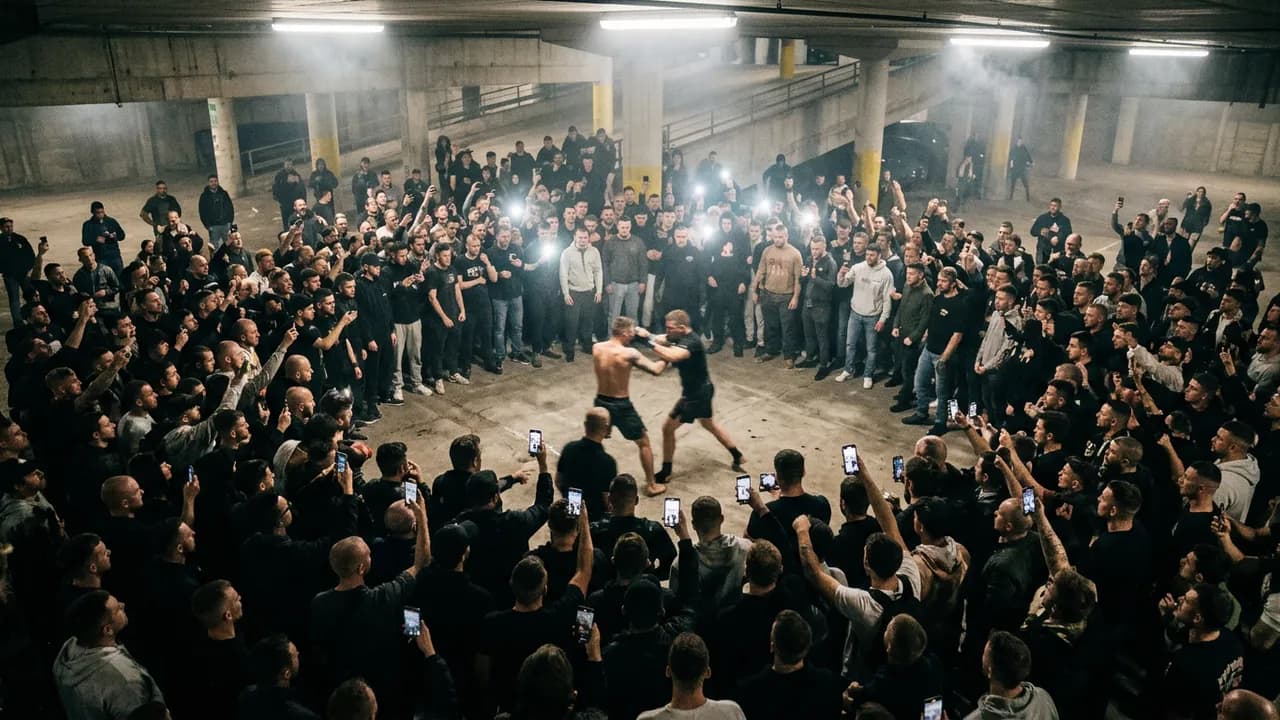
King of the Streets (KOTS) is frequently described as having "no rules." This is largely accurate -- KOTS fights take place on concrete, with bare fists, no rounds, no time limits, and no weight classes. But the reality is more nuanced than the label suggests. Even in KOTS, there are unwritten codes and practical conventions that shape how fights unfold.
This FAQ breaks down everything about the KOTS format -- what is allowed, what is not, and what makes it the most extreme fighting format of any major organization.
Does KOTS really have no rules?
KOTS operates with minimal formal rules. The official format includes:
- No rounds. Fights continue without breaks until a conclusion is reached.
- No time limits. There is no clock. A fight lasts as long as it needs to.
- No weight classes. Fighters are not matched by weight. Size mismatches are common and considered part of the challenge.
- No gloves. All strikes are delivered with bare fists. No hand wraps, no protective gear of any kind.
- No protective equipment. No headgear, no shin guards, no mouthguards (unless a fighter chooses to wear one personally).
However, there are unwritten conventions that most KOTS fights follow:
- Fights typically end when one fighter can no longer continue -- when they are knocked out, when they verbally submit, or when they are clearly unable to defend themselves.
- Weapons are not used. Despite the "no rules" label, KOTS fights are hand-to-hand combat, not armed combat.
- Both fighters agree to fight. Participation is voluntary, and fighters generally shake hands or acknowledge each other before the fight begins.
What surface do KOTS fights take place on?
KOTS fights take place on concrete floors -- typically in abandoned warehouses, industrial buildings, or similar disused spaces across Sweden and Europe. The concrete surface is one of the defining and most dangerous elements of the KOTS format.
Fighting on concrete introduces risks that do not exist in any sanctioned combat sport:
- Falls and knockdowns onto concrete can cause skull fractures, traumatic brain injuries, and spinal injuries
- Ground fighting is extremely dangerous, as any ground-and-pound occurs on an unyielding surface
- Skin abrasions and lacerations from contact with rough concrete are common
The concrete surface is what separates KOTS from organizations that also have minimal rules. Strelka fights on sand. Top Dog FC uses hay bales as ring barriers. Even FPVS in France fights on concrete, but KOTS was the organization that made concrete-surface fighting iconic.
Are there weight classes in KOTS?
No. KOTS does not use weight classes. Fighters are not weighed in, and significant size disparities between opponents are common. A 180-pound fighter may face a 240-pound opponent with no adjustment or accommodation.
This absence of weight classes is both a philosophical statement and a practical reality:
- Philosophically, KOTS positions itself as a test of pure fighting ability. In a real street confrontation, you do not get to choose your opponent's size. KOTS mirrors that reality.
- Practically, the organization's underground, secretive nature makes formal weigh-ins and structured matchmaking difficult.
The lack of weight classes means that size, strength, and durability can matter as much as -- or more than -- technical skill. This is a significant departure from every sanctioned combat sport, where weight classes exist specifically to create competitive equity.
What strikes are allowed in KOTS?
Virtually everything. KOTS permits:
- Punches (with bare fists)
- Kicks
- Knees
- Elbows
- Headbutts (not explicitly prohibited)
- Ground strikes
- Clinch work
There is no formal prohibition on any striking technique. This makes KOTS closer to historical bare-knuckle prize fighting or vale tudo than to any modern regulated combat sport.
Is grappling allowed in KOTS?
Grappling is not prohibited. However, most KOTS fights remain standing. The concrete surface discourages ground fighting for practical reasons -- neither fighter wants to be on the ground on concrete. When fights do go to the ground, they tend to be resolved quickly, either through ground strikes or through one fighter returning to their feet.
The absence of a formal grappling prohibition, combined with the deterrent effect of the concrete surface, creates a format that is predominantly striking-based without being formally limited to striking.
How do KOTS fights end?
KOTS fights typically end through one of these scenarios:
- Knockout. One fighter is rendered unconscious or unable to continue.
- Verbal submission. A fighter concedes the fight.
- Corner stoppage. A fighter's associates intervene to stop the fight (this is informal and not always respected).
- Mutual agreement. Both fighters agree to stop, usually after exhausting themselves.
- Inability to continue. A fighter is visibly unable to defend themselves, and the fight is recognized as over by the crowd and the opposing fighter.
There is no formal referee in KOTS. The absence of a neutral official to stop fights when a fighter is in danger is one of the most significant safety concerns with the format.
How does the KOTS format compare to other organizations?
| Feature | KOTS | Streetbeefs | BKFC | Strelka | KOTR |
|---|---|---|---|---|---|
| Surface | Concrete | Grass/dirt | Ring canvas | Sand | Outdoor ground |
| Gloves | None | Boxing/MMA | None (wraps only) | MMA gloves | Boxing gloves |
| Rounds | None | Varies | 5 x 2 min | None | 3 x 1 min |
| Weight classes | None | Informal | Yes | Informal | None |
| Referee | None | Yes | Yes | Yes | Yes |
| Rules | Minimal | Structured | Full regulation | Moderate | Basic boxing |
KOTS occupies the extreme end of the spectrum -- the least regulated, most dangerous format of any major fighting organization.
Why do fighters agree to fight under these conditions?
Fighters participate in KOTS for several reasons:
- Reputation. A KOTS victory -- particularly against a larger or more experienced opponent -- carries enormous credibility in European underground fighting and hooligan culture.
- Personal testing. Many fighters describe KOTS as the ultimate test of their fighting ability, precisely because the conditions are so extreme.
- Community. The KOTS scene has a tight-knit community of fighters who share a culture of physical confrontation and mutual respect.
- Exposure. With over 1 million YouTube subscribers, KOTS offers visibility that can open doors to other opportunities in fighting and beyond.
The motivations are not financial -- KOTS fighters are generally not paid.
For more on KOTS legality, see our KOTS legal FAQ. For an overview of no-rules fighting formats, see our no-rules fighting FAQ.