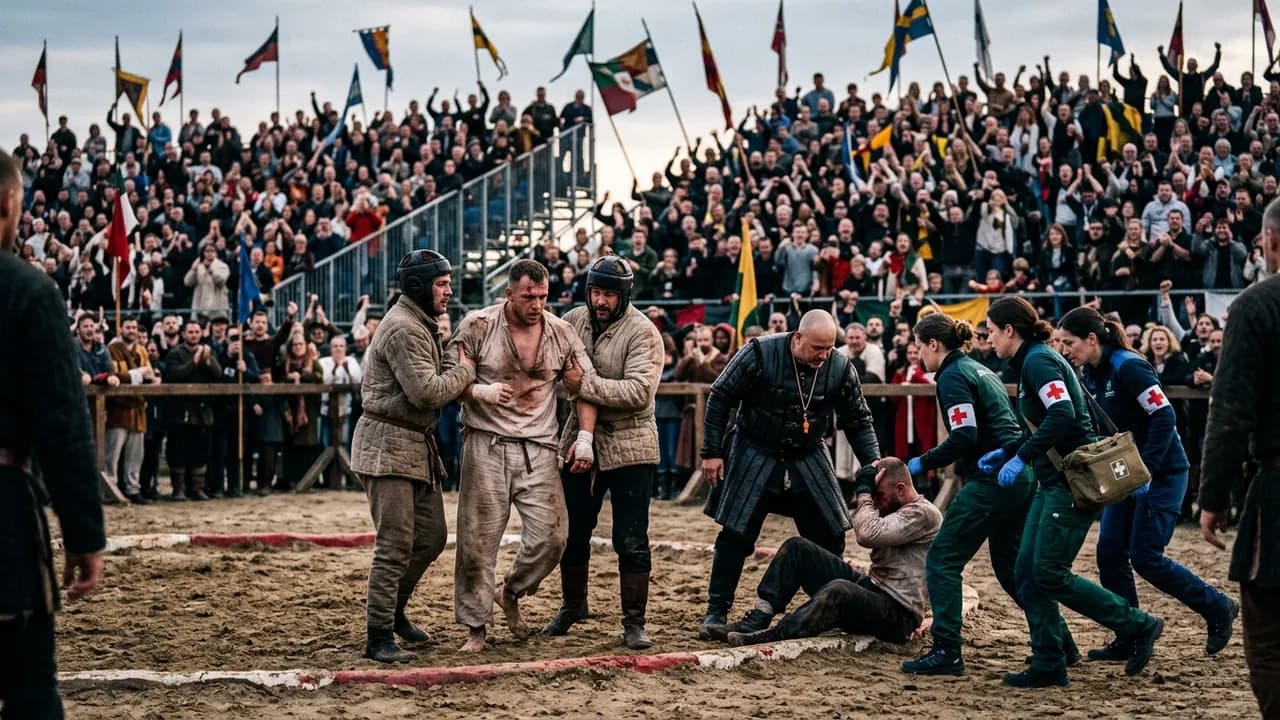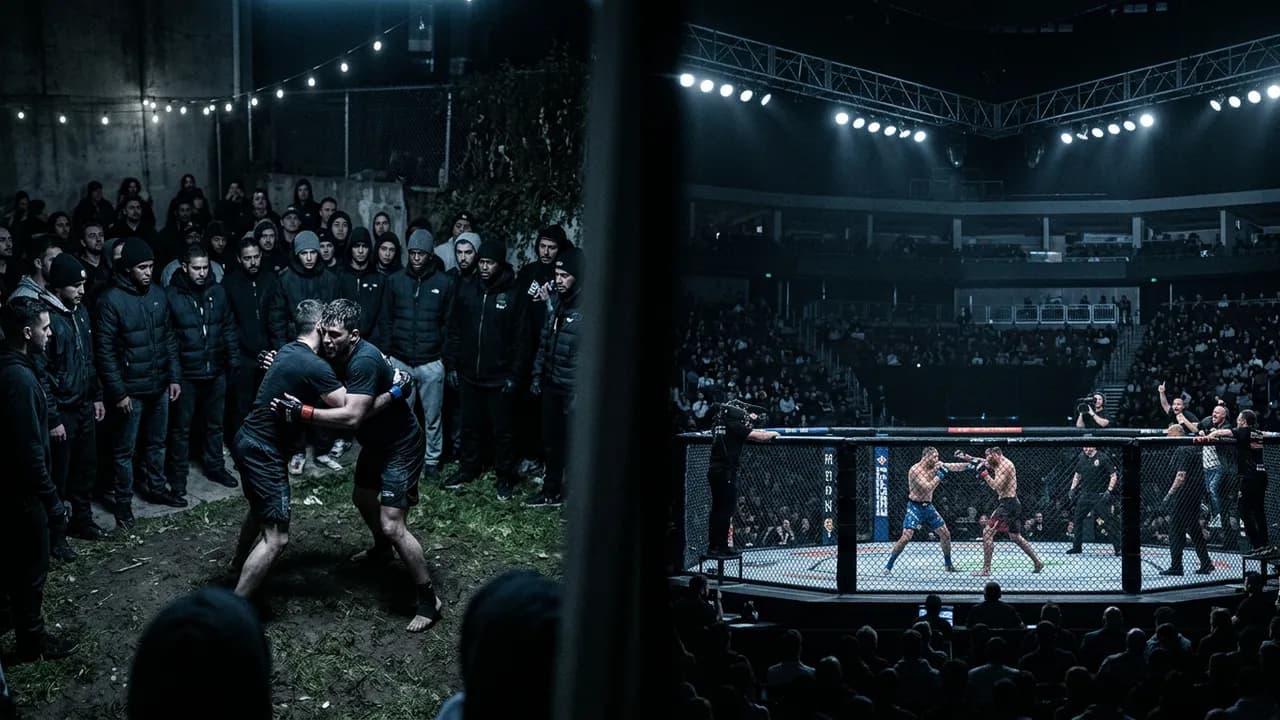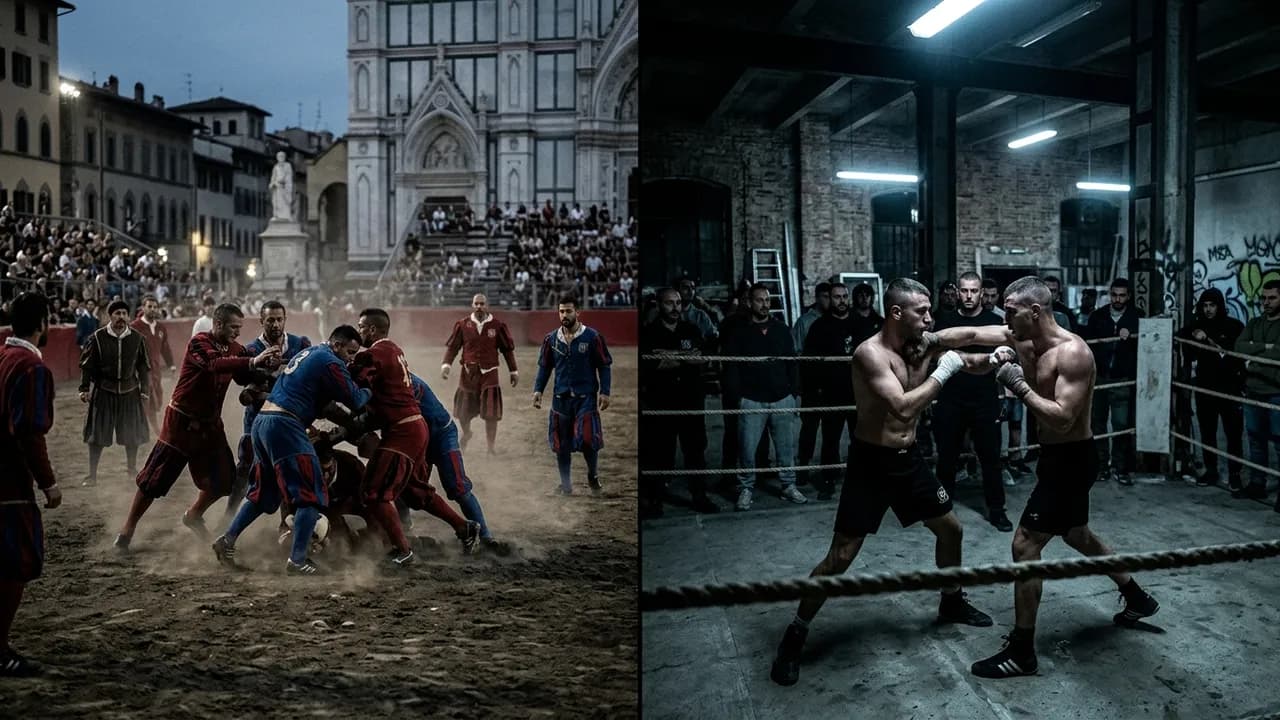
In Florence's Piazza Santa Croce, 27 men per side charge into a sand-covered arena wearing Renaissance-era costumes, engaging in a sport so violent that even rugby players have called it insane. Across the Atlantic and across Europe, modern underground fight clubs stage one-on-one combat in parking garages, backyards, and warehouses. These two worlds -- Calcio Storico Fiorentino and modern unsanctioned fight organizations -- are separated by five centuries but connected by humanity's enduring appetite for raw physical confrontation.
This comparison examines how Florence's ancient sport stacks up against today's underground fighting scene across rules, violence, cultural significance, and the experience of being there.
Quick Comparison
| Feature | Calcio Storico | Modern Fight Clubs |
|---|---|---|
| Origin | Florence, Italy, 16th century | Various, late 20th/early 21st century |
| Format | 27 vs 27 team sport | One-on-one combat |
| Duration | 50 minutes continuous | Single round or multi-round bouts |
| Rules | Minimal -- punching, kicking, wrestling allowed | Varies by organization |
| Objective | Score "cacce" (goals) | Knockout, submission, or decision |
| Legal Status | Sanctioned cultural event | Unsanctioned / gray area |
| Frequency | Three matches per year (June) | Year-round |
| Participants | Florentine residents by district | Open to willing fighters |
| Audience | 4,000+ in stadium | 30-500 depending on organization |
| Pay | None -- pride and district honor | $0-$500 typical for underground |
Historical Roots
Calcio Storico
Calcio Storico -- literally "historic football" -- traces its origins to at least the 16th century, though some historians link it to the Roman game of harpastum. The modern codification of rules dates to 1580, when Giovanni de' Bardi published the first formal rulebook. The most famous historical match took place on February 17, 1530, when Florentines defiantly played a game in Piazza Santa Croce while the city was under siege by Emperor Charles V's army.
The sport was played regularly by Florentine nobility, including several future popes. It fell out of regular practice in the 17th century but was revived in 1930 under Mussolini's fascist government, which saw it as a symbol of Italian martial heritage. Since then, it has been played annually in June as part of Florence's Festa di San Giovanni celebrations.
Modern Fight Clubs
Modern underground fight organizations emerged in the late 20th and early 21st centuries from diverse roots. Streetbeefs grew from Virginia's rural dispute-resolution culture. Strelka arose from Russian street fighting traditions. KOTS channeled Scandinavian urban aggression. Top Dog FC professionalized Russian underground fighting for YouTube.
Unlike Calcio Storico, modern fight clubs have no single origin point. They emerged independently across different cultures in response to similar impulses: the desire for physical testing outside regulated systems, community bonding through shared risk, and the audience demand created by social media.
Rules and Violence
Calcio Storico Rules
The rules of Calcio Storico are deceptively simple and alarmingly permissive:
- 27 players per team divided into positions (forwards, midfielders, backs, goalkeepers)
- Played on a sand-covered field roughly 100 meters by 50 meters
- 50 minutes of continuous play, no halftime
- A "caccia" (goal) is scored by throwing the ball over the opponent's end fence
- Punching, kicking, elbowing, headbutting, and wrestling are all legal
- Sucker punches, kicks to the head of a downed player, and 2-on-1 attacks are prohibited
- No substitutions -- injured players must leave, and their team plays short-handed
- Players cannot wear any protective equipment
The result is organized chaos. While the nominal objective is scoring goals, much of a Calcio Storico match consists of brutal one-on-one and group fights across the sand pitch. Players strategically target opponents to create numerical advantages, and fights can escalate to extraordinary levels of violence. Broken noses, dislocated shoulders, and concussions are routine. Serious injuries including broken bones and torn ligaments occur every year.
Modern Fight Club Rules
Rules vary dramatically across modern fight organizations:
| Organization | Rules Summary |
|---|---|
| Streetbeefs | Gloved or bare knuckle, stand-up focused, referee stops |
| Top Dog FC | Bare knuckle, stand-up only, timed rounds |
| Strelka | Bare knuckle, minimal rules, crowd circle |
| KOTS | Bare knuckle, no groin/eye, stand-up emphasis |
Modern fight clubs are one-on-one affairs where the violence, while intense, is concentrated between two willing participants. The total violence in a Calcio Storico match -- spread across 54 players over 50 minutes -- likely exceeds any single underground fight card.
Cultural Significance
Calcio Storico
Calcio Storico is inseparable from Florentine identity. The four teams represent Florence's historical quarters: Santa Croce (Blues), Santa Maria Novella (Reds), Santo Spirito (Whites), and San Giovanni (Greens). Players must be residents of their quarter -- this is not a sport you can buy your way into. Rivalries between quarters run generations deep, and the annual tournament is the most anticipated event in Florence's cultural calendar.
04 / Up next / Modern Fight Clubs
The sport enjoys official recognition from the city government, which funds the June tournament and treats it as a cultural heritage event alongside the Festa di San Giovanni. Calcio Storico has been featured in documentaries, films, and travel programming worldwide, drawing tourists who want to witness what many call the most violent team sport on earth.
There is no social stigma attached to playing Calcio Storico. Players are celebrated in their neighborhoods and treated as community heroes. This stands in sharp contrast to the perception of modern fight club participants.
Modern Fight Clubs
Modern underground fight organizations occupy a different cultural position entirely. They exist in legal gray areas, their participants often fight anonymously or under ring names, and mainstream society generally views them with suspicion or condemnation. While individual organizations like Streetbeefs have built genuine community around their events, they do not enjoy the institutional support or cultural reverence that Calcio Storico commands.
That said, the YouTube era has given modern fight clubs a form of cultural legitimacy that previous generations of underground fighting never achieved. Streetbeefs' Chris Wilmore became a recognized public figure. Top Dog FC events draw hundreds of thousands of online viewers. The cultural gap between Calcio Storico and modern fight clubs is narrowing, but it remains vast.
The Experience of Being There
Calcio Storico
Attending a Calcio Storico match is unlike any other sporting event. The Piazza Santa Croce is transformed into an arena, with temporary stands accommodating roughly 4,000 spectators. The atmosphere combines the pageantry of a Renaissance festival -- costumed flag-throwers, marching drummers, historical processions -- with the raw energy of a combat sports event.
The crowd is overwhelmingly local. Florentine families pack the stands, wearing their quarter's colors and screaming support. When a particularly vicious fight breaks out on the pitch, the crowd erupts. When a caccia is scored, sections of the stadium explode. The combination of historical pageantry and genuine violence creates an atmosphere that visitors describe as electrifying and surreal.
Modern Fight Clubs
The modern underground fight experience varies enormously. A Top Dog FC event in Moscow features professional production, hundreds of spectators, and an energy that approaches sanctioned MMA events. A Streetbeefs bout in Harrisonburg, Virginia, has a backyard barbecue feel with a dozen friends watching. A Strelka fight in a Russian park is raw street culture with a crowd forming a circle.
What unites them is proximity. At almost every underground event, spectators are within arm's reach of the fighters. There are no barriers, no security perimeters, no separation between audience and action. This intimacy creates an intensity that no arena sport can replicate -- you can hear the impact of punches, see the sweat and blood, feel the energy of two people trying to hurt each other.
Injury Rates and Safety
Calcio Storico's injury rate is staggering. In a typical three-match June tournament, multiple players are carried off the field with significant injuries. A 2019 tournament saw dozens of injuries including broken bones, torn ligaments, and concussions across the three matches. Despite this, the sport has no recorded fatalities in its modern era (post-1930 revival).
Modern fight clubs have more variable safety records. Organizations like Streetbeefs, which use gloves and have referees, report relatively few serious injuries. More permissive organizations carry higher risk. The one-on-one format generally limits the scope of injury compared to Calcio Storico's 27-on-27 melee, but the lack of medical oversight in most underground organizations means that injuries that do occur may not receive prompt treatment.
What They Share
Despite being separated by 500 years and fundamentally different formats, Calcio Storico and modern fight clubs share several core elements:
- Community identity: Both build strong bonds among participants and supporters
- Voluntary risk: All participants choose to be there, understanding the dangers
- Minimal equipment: Neither relies on protective gear to moderate violence
- Authenticity: Both reject the commercialization and over-regulation of mainstream sports
- Generational tradition: Calcio Storico explicitly, fight clubs implicitly through mentor-student relationships
- Male-dominated participation: Though this is slowly changing in modern organizations
The Verdict
Calcio Storico and modern fight clubs answer the same human question through radically different formats. Florence's ancient sport channels violence through team competition, cultural tradition, and civic pride, producing a spectacle that is simultaneously more brutal and more socially accepted than anything the modern underground offers. Modern fight clubs strip combat to its individual essence, leveraging social media and grassroots community to create something that -- while legally precarious -- serves real human needs for physical testing and belonging.
If you could attend only one, see Calcio Storico. It is one of the most extraordinary sporting events on earth, a living artifact of humanity's relationship with violence that has survived half a millennium. But if you want to understand why people fight outside the system in the modern world, spend time with the communities that have grown up around organizations like Streetbeefs, KOTS, and Top Dog FC. They are writing their own traditions in real time.
For more on underground fighting culture, see our Underground Fighting vs Sanctioned Combat Sports comparison and our Underground Fighting Organizations Ranked.
Watch and Learn More
YouTube Channels
- Streetbeefs -- Modern community fight club for comparison
- KOTS Official -- Modern no-rules fighting
Recommended Fights
- Streetbeefs Top 5 Knockouts -- Modern backyard fighting at its best
Read More on UNSANCTIONED FIGHTS
- Calcio Storico -- Full profile of the 500-year-old Florentine sport
- Streetbeefs Organization Profile -- America's biggest backyard fight club
- King of the Streets -- Europe's most extreme modern fight club
- Holmgang Organization Profile -- Another historical fighting tradition revived
- All Underground Fighting Organizations Ranked -- Where Calcio Storico ranks among all orgs
- Dambe vs Lethwei vs Bare Knuckle -- Other traditional fighting arts compared