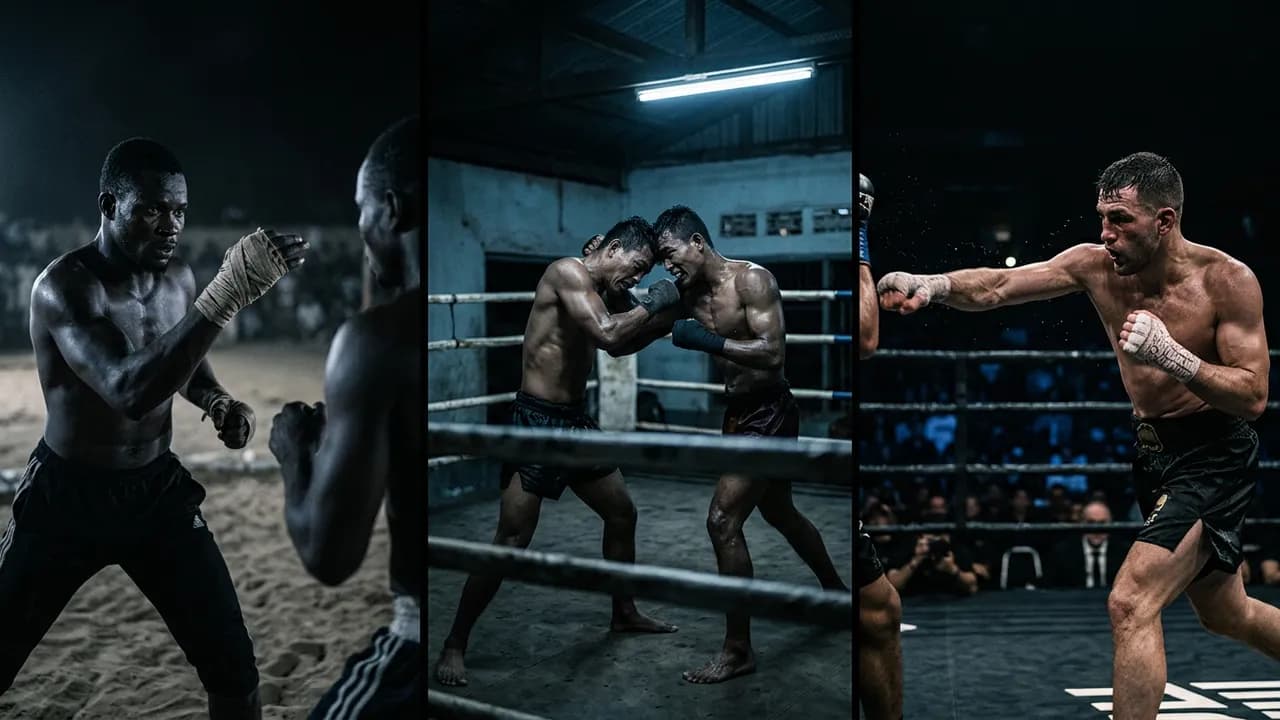
Three fighting traditions span three continents and hundreds of years of history, yet all share a common thread: combat without gloves. Nigerian Dambe, Burmese Lethwei, and Western bare knuckle boxing each developed independently but face similar challenges in the modern era. This comparison examines how these ungloved fighting arts stack up against each other.
For individual deep dives, see our guides on Dambe and Lethwei.
Origins and History
| Aspect | Dambe | Lethwei | Bare Knuckle Boxing |
|---|---|---|---|
| Origin | Nigeria (Hausa people) | Myanmar (Burma) | England |
| Age | 500+ years | 1,000+ years | 300+ years |
| Original purpose | Warrior training, harvest festivals | Military training | Prizefighting |
| Cultural role | Tied to Hausa identity and butcher guilds | National sport of Myanmar | Working-class entertainment |
| Modern revival | Dambe Warriors, World Series | Lethwei FC, World Lethwei Championship | BKFC, BKB |
Rules Comparison
| Rule | Dambe | Lethwei | Bare Knuckle Boxing |
|---|---|---|---|
| Striking hand | One "spear" hand (wrapped), one "shield" hand | Both hands, bare | Both hands, wrapped wrists |
| Kicks | Yes (front leg) | Yes (all kicks) | No |
| Headbutts | No | Yes (signature technique) | No |
| Elbows | No | Yes | No |
| Knees | No | Yes | No |
| Clinch | Limited | Yes | Limited |
| Takedowns | Win by knockdown | No (standup only) | No |
| Rounds | 3 rounds (untimed traditionally) | 5 rounds, 3 minutes | 5 rounds, 2 minutes |
| Win condition | Knockdown = win ("killing") | Knockout only (trad.) / decision | KO/TKO/Decision |
Technical Breakdown
Dambe
Dambe fighters adopt a side-on stance with the lead "shield" hand extended for defense and the rear "spear" hand cocked for devastating single strikes. The emphasis is on one-shot knockout power. Footwork involves the lead leg being used for sweeps and kicks. The traditional concept of the "kill" (knockdown) rewards explosive, fight-ending power.
Lethwei
Lethwei is the most complete striking art of the three. Fighters use punches, kicks, elbows, knees, and the signature headbutt. The clinch is used extensively for knee strikes and sweeps. Traditional Lethwei has no decisions; fights can only be won by knockout, though modern promotions have introduced scoring.
Bare Knuckle Boxing
Modern bare knuckle boxing is the most restricted technically but the most refined in terms of boxing skill. Without kicks or grappling, fighters must rely entirely on punch accuracy, footwork, and ring craft. Hand positioning differs from gloved boxing due to the risk of hand fractures.
Danger and Injury Profile
Dambe produces dramatic knockdowns but relatively fewer cuts due to the wrapped striking hand. The biggest risks are concussions from the single devastating punch and leg injuries from kicks. Traditional fights in villages have minimal medical support.
Lethwei is widely considered the most dangerous of the three. Headbutts create massive lacerations, and the combination of every striking weapon makes defense nearly impossible. Myanmar's traditional version allowed unconscious fighters to be revived and continue, though modern rules have eliminated this practice.
Bare knuckle boxing produces more facial cuts than gloved boxing but potentially fewer concussions. Modern promotions like BKFC provide full medical support. The injury profile is well-documented in our bare knuckle injury statistics guide.
Cultural Significance
Dambe is inseparable from Hausa culture in northern Nigeria and across West Africa. Historically tied to the butcher caste, it has evolved into a mainstream spectator sport. The Dambe World Series represents the sport's modernization while maintaining cultural roots.
Lethwei holds deep national significance in Myanmar. It is taught in schools, featured in national festivals, and considered part of Burmese identity. The sport suffered during colonial periods but has experienced resurgence.
Bare knuckle boxing's cultural significance is tied to working-class identity in Britain and America. From 18th-century London prizefighting to modern BKFC events, it represents a rejection of over-regulation and a celebration of raw combat. Our complete timeline traces this history.
Modern Commercial Viability
| Factor | Dambe | Lethwei | Bare Knuckle Boxing |
|---|---|---|---|
| Largest promotion | Dambe Warriors | Lethwei FC | BKFC |
| Est. global audience | 5-10M | 3-5M | 20-30M |
| Television deals | Regional African TV | Limited international | TBS, ESPN+ (BKFC) |
| Fighter pay (top) | $5,000-$20,000 | $5,000-$15,000 | $200,000-$1M+ |
| International events | Growing (US, UK) | Limited outside Myanmar | Global |
| Social media presence | Growing rapidly | Niche | Large and growing |
Bare knuckle boxing leads commercially by a wide margin, but Dambe's viral potential on social media is driving rapid growth. Lethwei remains the most geographically constrained.
Which Would Win in a Crossover?
This question comes up frequently in combat sports forums. Under neutral rules allowing all striking:
- Lethwei fighters have the most complete striking arsenal and would likely have an advantage with their headbutts, elbows, and clinch work.
- Dambe fighters have devastating single-shot power but would be vulnerable to the broader arsenal of Lethwei.
- Bare knuckle boxers have the best pure boxing but would struggle against kicks and clinch strikes.
Under pure boxing rules, bare knuckle boxers hold the advantage. Under full striking rules, Lethwei fighters are favored.
Related Reading
- Traditional Fighting Sports List
- Dambe World Series 2026 Results
- Every Bare Knuckle Organization in the World
Watch and Learn More
YouTube Channels
- BKFC Official -- Modern bare knuckle at its most polished
- Top Dog FC -- Russian bare knuckle for comparison with traditional formats
Recommended Fights
- Top Dog FC Best Knockouts -- Modern bare knuckle fighting at its most brutal
- BKB at the O2 Arena -- Western bare knuckle in a major venue
Read More on UNSANCTIONED FIGHTS
- Lethwei vs Muay Thai -- Deep dive into Southeast Asian striking arts
- Bare Knuckle vs MMA -- How modern BK compares to mixed martial arts
- BKFC Organization Profile -- The world's largest bare knuckle promotion
- Calcio Storico -- Another ancient fighting tradition that survived to the modern era
- All Underground Fighting Organizations Ranked -- Every org ranked from 23 to 1
- History of Bare Knuckle Boxing -- Origins of the sport