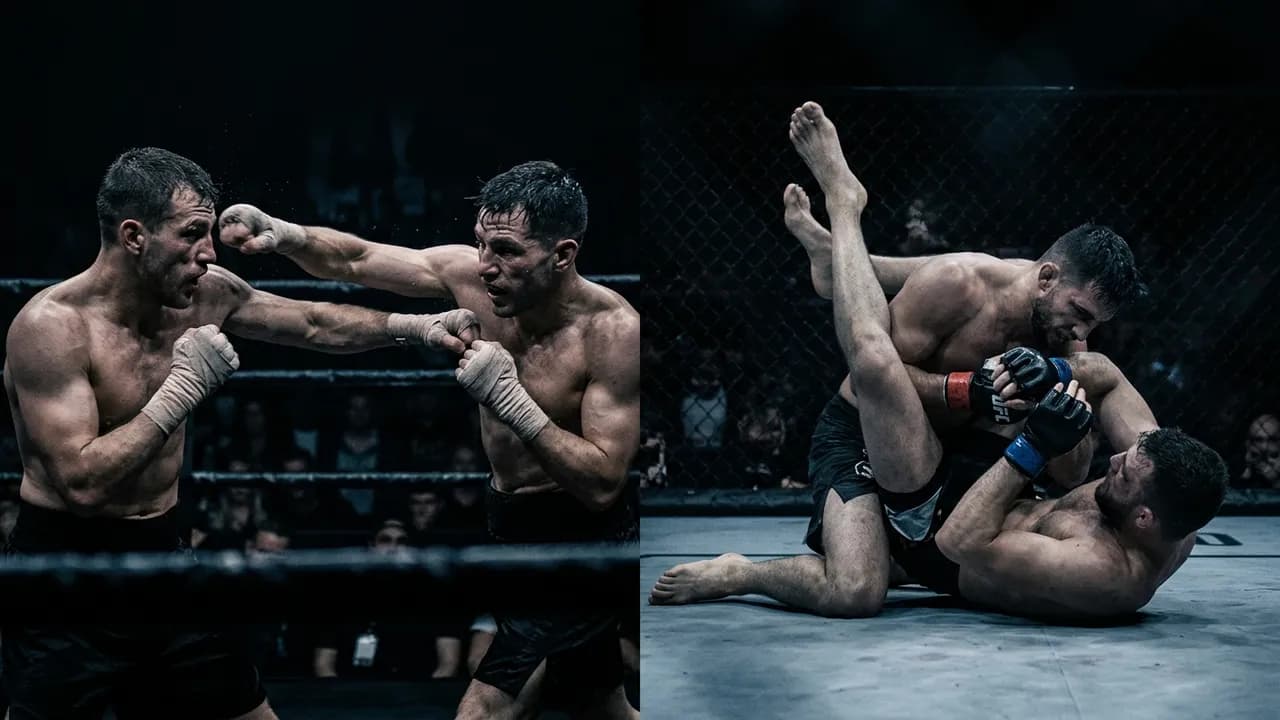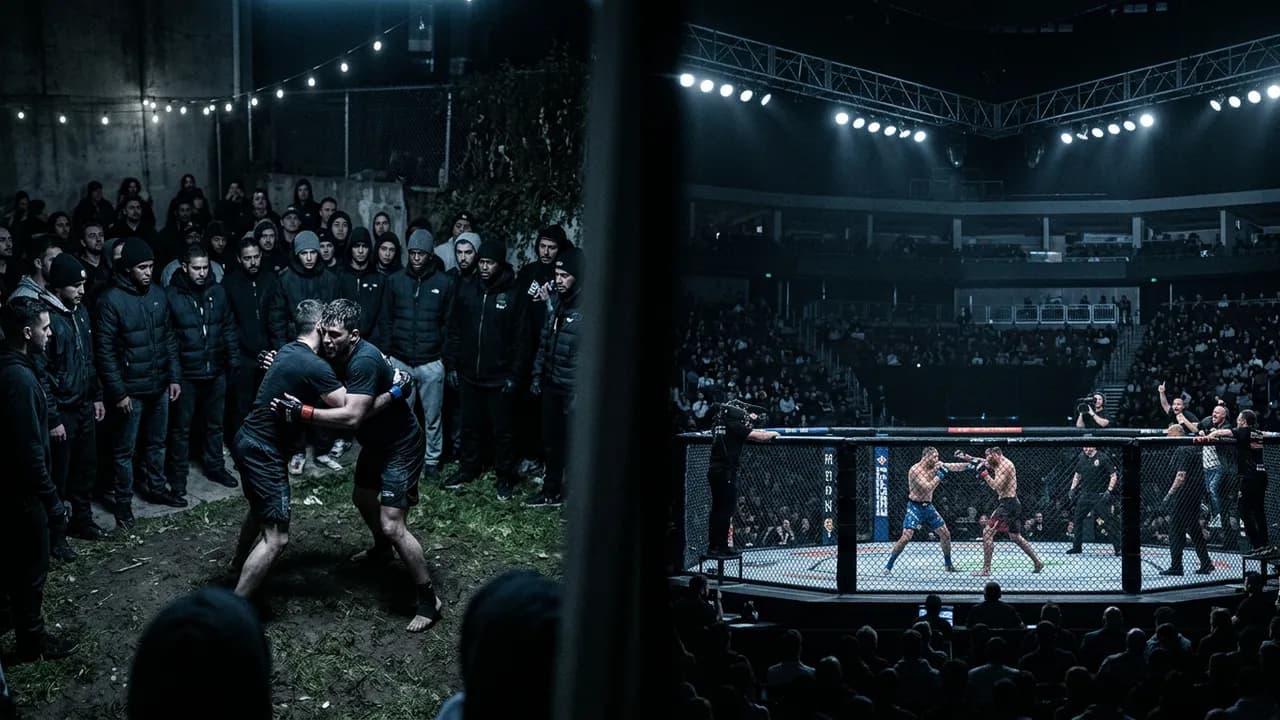
The combat sports world exists on a spectrum. On one end sit fully sanctioned, regulated professional organizations -- the UFC, professional boxing, BKFC. On the other end sit underground fighting operations -- Streetbeefs, KOTS, Strelka, and countless unnamed fight clubs that operate in backyards, warehouses, and parking lots around the world. Between them lies a vast gray area of semi-regulated events, amateur organizations, and promotions that defy easy categorization.
This breakdown examines every meaningful dimension of comparison between underground and sanctioned fighting.
Quick Comparison
| Feature | Underground Fighting | Sanctioned Combat Sports |
|---|---|---|
| Regulation | None to minimal | Athletic commission oversight |
| Medical Screening | Rarely | Pre-fight physicals required |
| Drug Testing | None | USADA, commission testing |
| Insurance | None | Fighter insurance required |
| Judging | Informal or none | Licensed judges, scorecards |
| Referee | Varies -- sometimes none | Licensed referee required |
| Pay | $0 - $500 typical | $2,000 - $10,000,000+ |
| Audience | 10 - 500 in person, YouTube views | Hundreds to millions (live + broadcast) |
| Legal Status | Gray area to illegal | Fully legal and licensed |
| Career Path | Dead end or stepping stone | Professional development pathway |
| Entry Barrier | Very low -- show up and fight | Training, amateur record, licensing |
Regulation and Oversight
Underground
Underground fighting operates outside the regulatory framework that governs sanctioned combat sports. This means:
- No athletic commission oversight -- no state or national body approves matchups, enforces safety standards, or licenses participants
- No standardized rules -- each organization (or individual event) sets its own rules, which may be communicated verbally and enforced inconsistently
- No mandatory medical testing -- fighters are not required to pass physicals, blood work, or neurological screening before competing
- No post-fight medical suspensions -- fighters who are knocked out or suffer injuries can fight again the next day if they choose
- No drug testing -- performance-enhancing drugs, recreational substances, and alcohol are unregulated
Some underground organizations self-regulate more effectively than others. Streetbeefs enforces consistent rules, uses referees, and prohibits alcohol at events. Top Dog FC has professional production and structured matchmaking. But even the best-run underground operations lack the institutional oversight that sanctioned sports provide.
Sanctioned
Sanctioned combat sports operate under layers of regulation:
- Athletic commissions (state-level in the US, national bodies elsewhere) license fighters, referees, judges, and promoters
- Unified rules provide consistent standards across jurisdictions
- Pre-fight medicals including physical examination, blood work (HIV, Hepatitis B/C), and sometimes neurological testing
- Ringside physicians authorized to stop fights for medical reasons
- Post-fight medical suspensions preventing fighters from competing while recovering from injuries
- Drug testing through organizations like USADA or commission-administered programs
- Insurance covering fighters for injuries sustained in competition
This regulatory infrastructure exists because combat sports are inherently dangerous. Every layer of regulation represents a lesson learned, often from a tragedy.
Safety
This is the most consequential difference between underground and sanctioned fighting.
Underground Safety Record
The underground fighting world has a mixed safety record that varies enormously by organization:
Better-run operations (Streetbeefs, Top Dog FC):
- Consistent referees who will stop mismatches
- Basic first aid available
- Rules communicated and generally enforced
- Size matching attempted (if not always achieved)
- Serious injuries are uncommon
Poorly run operations:
- No referee or an ineffective one
- No medical supplies or personnel
- Rules improvised or nonexistent
- Gross mismatches in size, skill, or experience
- Serious injuries including concussions, broken bones, and worse
The absence of medical screening is the most dangerous aspect of underground fighting. A fighter with an undiagnosed brain bleed, heart condition, or other medical issue could die in competition. This is not hypothetical -- deaths have occurred in unsanctioned fighting events, though precise statistics are difficult to compile due to the unregulated nature of the activity.
Sanctioned Safety Record
Sanctioned combat sports are not safe -- they are dangerous by design. But the regulatory framework dramatically reduces the risk of catastrophic outcomes:
- Pre-fight medicals catch many disqualifying conditions before fighters enter the ring
- Ringside physicians can intervene during fights
- Post-fight medical suspensions prevent fighters from competing while vulnerable
- Standardized rules reduce the likelihood of uncontrolled violence
- Drug testing limits (but does not eliminate) the use of substances that could increase danger
Deaths in sanctioned MMA and boxing still occur -- approximately 10-12 boxing deaths occur globally per year, and MMA has had a handful of fatalities in sanctioned competition. But the rate of catastrophic injury per bout is dramatically lower in sanctioned competition than in unregulated fighting.
Fighter Pay
Underground Pay
Most underground fighters receive little to no compensation:
| Organization Type | Typical Pay |
|---|---|
| Backyard operations | $0 (fighting for free) |
| Streetbeefs-level | $0 (fighting for reputation/content) |
| Top Dog FC-level | $200 - $1,000 per fight |
| Semi-pro underground | $100 - $500 per fight |
| YouTube revenue sharing | Varies, usually minimal for fighters |
Underground fighters are motivated by factors other than money: reputation, conflict resolution, personal testing, content creation, and the experience itself. Some underground fighters have monetized their fighting through personal YouTube channels, social media followings, and merchandise, but this is the exception rather than the rule.
Sanctioned Pay
Sanctioned combat sports pay varies enormously:
| Level | Boxing | MMA (UFC) | Bare Knuckle (BKFC) |
|---|---|---|---|
| Debut | $1,000 - $10,000 | $12,000 - $24,000 | $2,000 - $9,000 |
| Mid-tier | $25,000 - $200,000 | $50,000 - $150,000 | $20,000 - $30,000 |
| Top contender | $500,000 - $5M | $300,000 - $1M | $100,000 - $300,000 |
| Champion/Star | $1M - $100M+ | $1M - $30M+ | $400,000 - $1M+ |
The pay gap between underground and sanctioned fighting is the single biggest practical difference. A UFC debut fighter earns more for one fight than most underground fighters earn in their entire fighting career. This financial reality is what makes the underground-to-sanctioned pipeline so appealing for talented fighters who start outside the system.
Career Path
Underground to Nowhere?
For most underground fighters, there is no career path. They fight for a period of their lives, accumulate some YouTube views, and eventually stop. There is no pension, no alumni network, no career services program.
However, the underground-to-sanctioned pipeline is real and growing:
- Streetbeefs to Rough N' Rowdy: Several Streetbeefs fighters have competed in Rough N' Rowdy, Barstool Sports' amateur boxing promotion
- Underground to regional MMA: Fighters who prove themselves in underground organizations sometimes attract the attention of regional MMA promoters
- YouTube fame to opportunities: The exposure from underground fighting can create opportunities in content creation, personal training, and other adjacent fields
Sanctioned Career Ladder
Sanctioned combat sports offer a structured (if brutally competitive) career path:
- Amateur competition -- build a record, develop skills
- Regional promotions -- fight for small purses, gain professional experience
- National/international promotions -- larger purses, broadcast exposure
- Championship contention -- life-changing money, mainstream recognition
- Post-career -- coaching, commentary, gym ownership, media
This pathway is well-established in boxing and MMA. It is still developing in bare knuckle fighting but becoming more defined as BKFC and other promotions mature.
Fan Experience
Underground Events
The underground fan experience is defined by proximity and intensity:
- Standing within arm's reach of fighters
- No security barriers between audience and action
- Raw, unfiltered violence with visible blood and impact
- Small crowds that create intense, personal atmosphere
- No commercials, no filler, no production padding
- Often free to attend or minimal door charge
- Authenticity -- nothing is scripted or manufactured
For many fans, this proximity and authenticity is addictive. Once you have watched a fight from three feet away, arena combat sports can feel sterile by comparison.
Sanctioned Events
The sanctioned fan experience is defined by production and spectacle:
- Professional lighting, sound, and video production
- Commentary teams providing analysis and context
- Structured card with undercard building to main event
- Arena atmosphere with thousands of fans
- Broadcast quality viewing at home
- Pre-fight narratives, weigh-ins, press conferences
- Post-fight interviews and analysis
Sanctioned events offer a more complete entertainment product but sacrifice the raw intimacy that underground events provide.
Legal Considerations
Underground Fighting Legality
The legal status of underground fighting is complicated and jurisdiction-dependent:
- Consensual fighting between adults is not explicitly illegal in many jurisdictions, but can be prosecuted under assault statutes
- Organized fighting events without athletic commission approval may violate state or national laws
- Promoters face greater legal risk than fighters -- organizing unsanctioned fights can carry criminal penalties
- Liability for injuries is effectively unlimited -- no insurance, no waivers (in most cases), no legal protections
- Online content of underground fights has generally not been prosecuted, though platforms periodically remove violent content
The legal gray area is what keeps underground fighting underground. Most organizations operate below the radar of law enforcement, relying on remote locations, word-of-mouth promotion, and the general unwillingness of participants to report injuries to authorities.
Sanctioned Fighting Legality
Sanctioned combat sports operate within clear legal frameworks:
- Athletic commissions provide the legal authority for regulated fighting
- Promoters, fighters, referees, and judges are licensed
- Insurance covers injuries sustained in competition
- Contracts govern the relationship between promoters and fighters
- Tax obligations are clear and enforceable
The Gray Area
Many organizations do not fit neatly into either category:
- Rough N' Rowdy: Amateur boxing events with professional production but limited athletic commission oversight
- Top Dog FC: Professional-quality production and significant purses but operating outside traditional sanctioning
- Regional MMA in some jurisdictions: Technically sanctioned but with minimal actual oversight
- Gamebred Bareknuckle MMA: Seeking sanctioning while operating a novel format
This gray area is where much of combat sports' growth and innovation occurs. Organizations that start underground and professionalize over time often pass through this middle zone, adopting more regulation while retaining the energy and authenticity that made them compelling in the first place.
The Verdict
Underground fighting and sanctioned combat sports serve different purposes for different people. Sanctioned sports provide the safety, career structure, and financial opportunity that allow combat sports to function as a profession. Underground fighting provides the raw experience, low barriers to entry, and community bonding that formal organizations cannot replicate.
The ideal combat sports ecosystem includes both. Underground organizations serve as cultural laboratories where fighters test themselves and audiences discover their appetite for combat. Sanctioned organizations provide the structure that allows the most talented fighters to build careers and the most passionate fans to follow their sport safely and legally.
Neither world is going away. Both will continue to evolve, and the border between them will continue to shift. The fighters and fans who move between both worlds are often the most interesting people in combat sports.
For more on specific underground organizations, see our Underground Fighting Organizations Ranked. For sanctioned bare knuckle comparisons, visit BKFC vs BKB and Bare Knuckle Fighting vs MMA.
Watch and Learn More
YouTube Channels
- BKFC Official -- The most sanctioned "underground" promotion
- KOTS Official -- The most unsanctioned end of the spectrum
- Streetbeefs -- Community-based backyard fighting
Recommended Fights
- Streetbeefs Top 5 Knockouts -- Grassroots fighting at its best
- KOTS: Simon Henriksen vs Ronin -- The extreme unsanctioned end
Read More on UNSANCTIONED FIGHTS
- BKFC Organization Profile -- The sanctioned end of bare knuckle
- King of the Streets -- The unsanctioned extreme
- Streetbeefs Organization Profile -- Community-based underground fighting
- Underground Fighting vs Professional MMA -- Detailed comparison
- All Underground Fighting Organizations Ranked -- Every org from sanctioned to unsanctioned
- No-Rules Organizations Ranked -- KOTS, FPVS, UUF, and Holmgang compared