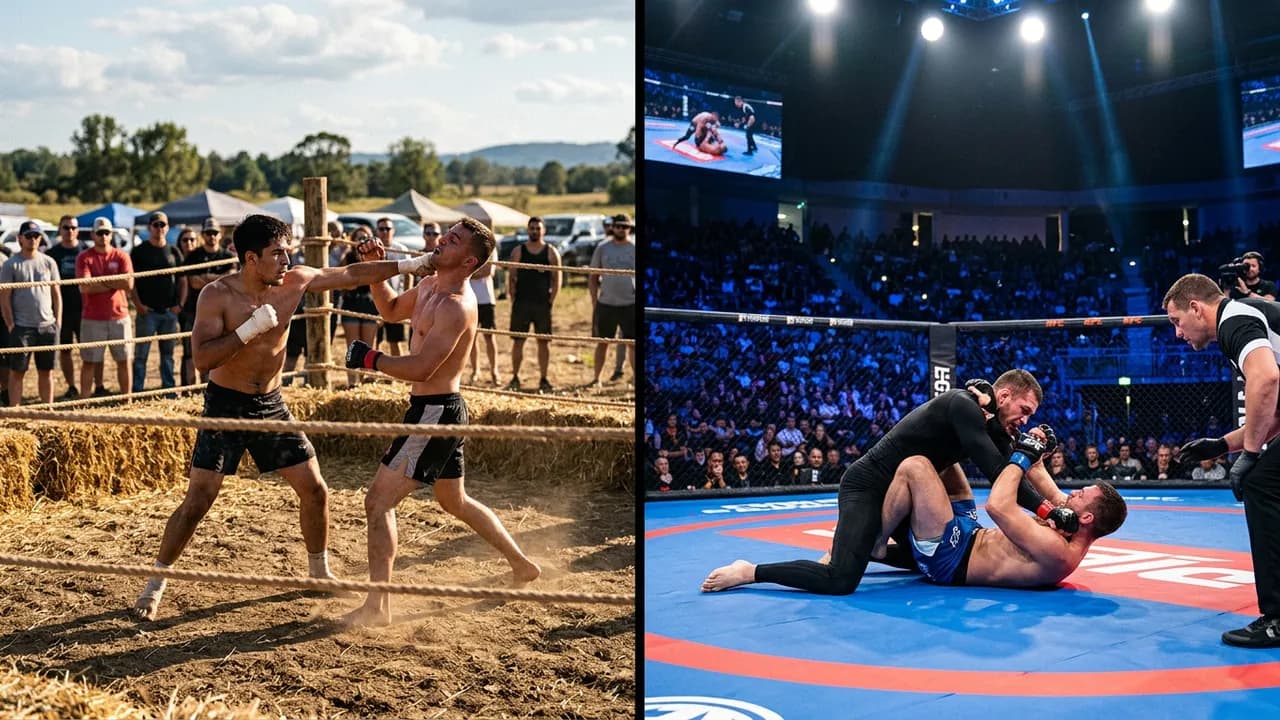
Professional MMA and underground fighting both involve two people trying to impose their will on each other through combat. That is where the similarities end. The two worlds are separated by vast differences in regulation, safety infrastructure, compensation, career opportunity, and cultural standing. Understanding these differences matters -- whether you are a fan trying to appreciate what you watch, a fighter weighing your options, or someone simply curious about why both worlds continue to thrive simultaneously.
This article provides a comprehensive, category-by-category comparison of underground fighting and professional MMA as they exist today.
Defining the Terms
Professional MMA refers to mixed martial arts contests sanctioned by state or national athletic commissions, governed by the Unified Rules of Mixed Martial Arts, and promoted by licensed organizations. The UFC is the dominant promotion, but Bellator (now PFL), ONE Championship, and dozens of regional promotions also operate within this framework.
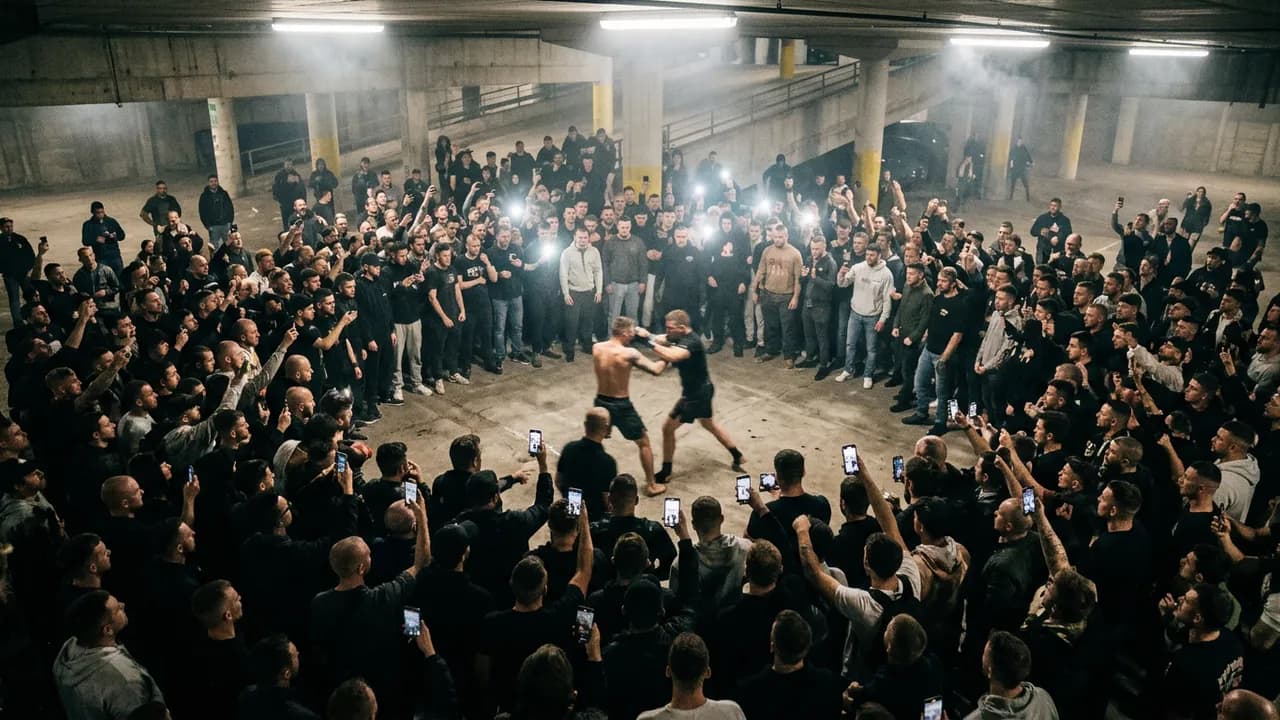
Underground fighting encompasses unsanctioned combat events held outside athletic commission oversight. This includes organizations like Streetbeefs, King of the Streets (KOTS), and numerous smaller operations worldwide. The underground world ranges from community-oriented backyard boxing to no-rules brawls on concrete. For this comparison, we address the underground spectrum broadly while noting where specific organizations fall.
Regulation and Oversight
| Factor | Professional MMA | Underground Fighting |
|---|---|---|
| Governing Body | State/national athletic commissions | None |
| Ruleset | Unified Rules of MMA (standardized) | Varies wildly -- from structured rules to no rules at all |
| Licensing | Promoters, fighters, referees, judges all licensed | No licensing required |
| Pre-Fight Approval | Commission must approve all bouts | Self-selected or promoter-matched |
| Venue Inspection | Required by commission | No inspection |
| Insurance Requirement | Mandatory fighter insurance | No insurance |
| Post-Event Reporting | Results reported to commission | No reporting |
The Unified Rules of Mixed Martial Arts were first adopted by the New Jersey State Athletic Control Board (NJSACB) in 2000 and have since become the de facto standard across North America and much of the world. These rules define everything from legal striking zones to the size of the fighting area to the criteria judges use to score rounds. Every sanctioned MMA event operates within this framework, and commissions have the power to stop fights, suspend fighters, and revoke promoter licenses for violations.
Underground fighting has no equivalent regulatory infrastructure. Some organizations, like Streetbeefs, impose their own rules -- three rounds, no biting, no eye gouging -- but enforcement depends entirely on the organization's internal culture. Others, like KOTS, embrace the absence of rules as their defining feature. There is no external body to appeal to, no post-fight medical suspensions, and no formal accountability for promoters who endanger fighters.
Rules Comparison
Professional MMA (Unified Rules)
The Unified Rules define 31 specific fouls, including but not limited to:
- Eye gouging, biting, hair pulling
- Strikes to the spine, back of the head, or groin
- Headbutting, fish-hooking
- Small joint manipulation
- 12-6 elbows (though this rule was removed in 2024)
- Spiking an opponent on their head
- Attacking during a break or after the bell
Fights take place in either a cage (octagon) or ring, with rounds of 5 minutes each -- typically three rounds for non-title fights and five rounds for main events and title fights. Fights can be won by knockout, technical knockout, submission, judges' decision, or disqualification.
Underground Fighting
Rules vary by organization:
| Organization | Rules Summary |
|---|---|
| Streetbeefs | Boxing, kickboxing, MMA, or BJJ rules depending on format. No biting, eye gouging, or throat strikes. Three rounds. Gloves required. |
| KOTS | No rules, no rounds, no time limits. Eye gouging allowed (but prize money forfeited if won by gouge). Fights on concrete. |
| Typical Backyard Operations | Informal rules -- usually "no biting, no eye gouging" with everything else allowed. Single-round fights until stoppage. |
The rules gap creates fundamentally different fighting experiences. Professional MMA fighters can develop gameplans around specific rules -- knowing that grounded strikes have specific restrictions, that rounds create natural reset points, and that fouls will be penalized. Underground fighters must account for the possibility that their opponent may use any technique, that there may be no time limit, and that the referee's threshold for stoppage (if there is a referee) may be unclear.
Safety and Medical Requirements
This is the most consequential difference between the two worlds.
Professional MMA
| Safety Measure | Requirement |
|---|---|
| Pre-Fight Physical | Mandatory -- includes blood work, neurological screening, cardiac testing |
| Pre-Fight Eye Exam | Required in most jurisdictions |
| Ringside Physician | Mandatory -- must be present and empowered to stop fights |
| Ambulance | Required on-site at all sanctioned events |
| Post-Fight Medical Exam | Mandatory for all fighters |
| Medical Suspension | Automatically imposed after KO/TKO losses (typically 30-180 days) |
| MRI/CT Requirements | Required after certain types of stoppages in many jurisdictions |
| Minimum Recovery Period | Commission-mandated between fights |
| Referee Training | Licensed, trained, and evaluated |
State athletic commissions exist specifically to protect fighter safety. A ringside physician can stop a fight at any time regardless of what the referee, promoter, or fighter wants. Medical suspensions after knockouts ensure fighters' brains have time to recover before absorbing more damage. These protections are imperfect -- fighters still suffer serious injuries and long-term consequences -- but the infrastructure is real and meaningful.
Underground Fighting
| Safety Measure | Typical Status |
|---|---|
| Pre-Fight Physical | None (some organizations do informal screening) |
| Ringside Physician | Rarely present (Streetbeefs has a registered nurse) |
| Ambulance | Not typically on-site |
| Post-Fight Medical Exam | None |
| Medical Suspension | None -- fighters can fight again immediately |
| MRI/CT Requirements | None |
| Minimum Recovery Period | None |
| Referee Training | Self-taught or experienced fighters acting as refs |
The absence of medical suspensions is arguably the most dangerous aspect of underground fighting. In professional MMA, a fighter who suffers a concussion is suspended for a minimum of 30 days and often much longer, with medical clearance required before returning. In underground fighting, a fighter knocked unconscious on Saturday could theoretically fight again on Sunday. The cumulative brain trauma implications of this are severe.
Streetbeefs deserves credit for evolving its safety practices -- adding a registered nurse, prohibiting drugs and alcohol at events, and requiring protective equipment. But even the best-intentioned underground operation cannot replicate the multi-layered safety infrastructure that athletic commissions mandate.
Drug Testing
| Testing Type | Professional MMA (UFC) | Underground Fighting |
|---|---|---|
| Anti-Doping Program | USADA partnership (UFC); varies by promotion | None |
| In-Competition Testing | Yes | No |
| Out-of-Competition Testing | Yes (UFC/USADA) | No |
| Banned Substances List | WADA Code or equivalent | No banned substances |
| Consequences of Violation | Suspension (6 months to 4 years), fine, result overturned | None |
The UFC's partnership with the United States Anti-Doping Agency (USADA), active since 2015, represents the most comprehensive drug testing program in combat sports. Fighters are subject to random out-of-competition testing year-round, and violations carry serious consequences.
Underground fighting has zero drug testing. Fighters may compete under the influence of performance-enhancing drugs, recreational drugs, or alcohol with no testing or consequences. Some organizations like Streetbeefs prohibit drugs and alcohol at events, but this is a behavioral rule (no showing up intoxicated) rather than a testing program.
Fighter Pay
The financial landscape reveals stark contrasts and some surprising overlaps.
Professional MMA
| Tier | Estimated Pay Per Fight |
|---|---|
| UFC Entry-Level | $10,000 -- $30,000 (show + win) |
| UFC Mid-Tier | $80,000 -- $250,000 |
| UFC Top-Tier | $500,000 -- $5,000,000+ |
| Regional MMA | $200 -- $2,000 (amateur); $2,000 -- $10,000 (professional) |
| Average UFC Fighter | ~$150,000 (mean); ~$91,000 (median) |
The average UFC fighter earns approximately $150,249 per year, though this number is heavily skewed by top earners. The median -- a more representative figure -- is around $91,250. Entry-level UFC fighters earn between $10,000 and $30,000 per fight, which sounds substantial until you consider that most fighters compete only 2-3 times per year and must pay for their own training camps, coaches, travel (in some cases), and health insurance between fights.
Regional MMA pay is far worse. Many regional professional fighters earn $2,000 to $10,000 per fight and maintain full-time jobs outside of fighting. Amateur fighters often fight for free or for nominal amounts that barely cover expenses.
Underground Fighting
| Organization | Pay Structure |
|---|---|
| Streetbeefs | $0 -- fighters are not paid (by design, to maintain legal status) |
| KOTS | Winner-take-all prize money; amounts undisclosed but "depend on your level" |
| Typical Backyard Events | $0 to a few hundred dollars; sometimes crowd-sourced purses |
Underground fighter pay ranges from literally nothing to undisclosed prize money. Streetbeefs fighters receive zero compensation -- this is a deliberate legal strategy, since paying fighters would trigger athletic commission regulation in Virginia. KOTS pays winners only, with amounts varying by the fighter's profile and the event's significance.
The irony is that a regional MMA fighter earning $2,000 for a fight on a small promotion card may not be materially better off than an underground fighter, once you subtract training camp costs, travel, and the commission's cut.
Career Path and Advancement
Professional MMA Career Ladder
- Amateur MMA -- Compete for experience under modified rules (no elbows, shin pads in some jurisdictions)
- Regional Professional -- Build a record on small shows, develop skills
- Mid-Level Promotions -- Compete in organizations like LFA, Invicta, or Cage Warriors for exposure
- Major Promotions -- UFC, PFL/Bellator, ONE Championship
- Title Contention -- Ranked competition for championship opportunities
This is a recognized, if brutally competitive, career path. Talent scouts, managers, and matchmakers actively watch lower-level shows for prospects. A fighter with a strong regional record and exciting style can reasonably expect opportunities to move up. The infrastructure exists to support upward mobility.
Underground Fighting "Career" Path
There is no formal career path in underground fighting. There are no rankings, no sanctioned records, no managers scouting backyard brawls for the next UFC contender. Some underground fighters have transitioned to professional careers:
- Several Streetbeefs alumni have moved into amateur and professional boxing and MMA
- Some bare knuckle fighters have crossed into BKFC or BKB from unsanctioned events
- A small number of underground fighters have used viral video fame to secure professional opportunities
But these transitions are the exception, not the rule. More commonly, underground fighting is a dead-end from a career perspective. Wins and losses are not recorded in any database that professional matchmakers consult. Injuries sustained without medical oversight can derail careers before they start. And the stigma of underground participation can actually harm a fighter's prospects with legitimate promotions.
Production and Spectator Experience
| Aspect | Professional MMA | Underground Fighting |
|---|---|---|
| Venue | Licensed arenas, convention centers, stadiums | Backyards, warehouses, parking lots, undisclosed locations |
| Broadcast | Major networks (ESPN, DAZN), PPV | YouTube, social media, some PPV |
| Commentary | Professional broadcast teams | Usually none, or informal narration |
| Cameras | Multi-camera HD/4K production | Single camera to multi-camera (varies widely) |
| Replays/Graphics | Full broadcast package | Minimal to none |
| Walk-Out Music | Standard feature | Sometimes |
| Audience Size (Live) | Hundreds to 20,000+ | Dozen to a few hundred |
| Ticket Price | $50 -- $2,500+ | Usually free |
The production gap has narrowed in recent years. Organizations like KOTS invest in multi-camera setups, graphics, and editing that approach professional standards. Streetbeefs' raw, unedited format is part of its appeal -- viewers feel like they are in the backyard, not watching a produced show.
But the fundamental experience is different. Professional MMA is a spectator sport designed for mass consumption, with commentary explaining the action, replays highlighting key moments, and production designed to maintain engagement across a multi-hour broadcast. Underground fighting is participatory media -- the appeal is the realness, the informality, the feeling that you are witnessing something unfiltered.
Weight Classes
Professional MMA
The Unified Rules define specific weight classes:
| Weight Class | Upper Limit |
|---|---|
| Strawweight | 115 lbs |
| Flyweight | 125 lbs |
| Bantamweight | 135 lbs |
| Featherweight | 145 lbs |
| Lightweight | 155 lbs |
| Welterweight | 170 lbs |
| Middleweight | 185 lbs |
| Light Heavyweight | 205 lbs |
| Heavyweight | 265 lbs |
Fighters weigh in the day before competition and must make weight within the limit for their division. Missing weight results in financial penalties and potential bout cancellation.
Underground Fighting
Most underground organizations have no formal weight classes. Matchmaking is done informally -- promoters try to match fighters of similar size, but significant size disparities are common and sometimes deliberate (David-vs-Goliath matchups generate views). Streetbeefs makes an effort to match fighters by approximate size, but there are no weigh-ins or official limits.
KOTS is particularly notorious for mismatches, with size differences of 30-50+ pounds not uncommon. Without weight classes, heavyweight brawlers have a structural advantage that no amount of skill can fully overcome.
Insurance and Liability
Professional MMA
Athletic commissions require promoters to carry fighter insurance that covers medical expenses resulting from competition. The UFC and other major promotions provide:
- Short-term medical insurance covering fight-related injuries
- Access to medical facilities for post-fight treatment
- Long-term health programs (the UFC's partnership with the Cleveland Clinic, for example)
This coverage is not comprehensive lifetime health insurance, and fighters have long advocated for better long-term medical support. But some meaningful safety net exists.
Underground Fighting
Underground fighters have no insurance coverage from promoters or organizations. Any injury sustained during an unsanctioned fight is the fighter's personal financial responsibility. Given that underground fighters are overwhelmingly from working-class backgrounds -- and many lack health insurance entirely -- a serious injury can be financially devastating.
The liability picture is equally grim for promoters. While Streetbeefs has avoided legal issues through its no-pay, private-property structure, other underground operations have faced lawsuits and criminal charges when fighters suffer serious injuries.
Audience and Cultural Position
Professional MMA
MMA has achieved mainstream acceptance. The UFC has broadcast deals with ESPN and Disney+, fighters appear on mainstream talk shows, and the sport is regulated in all 50 US states and most countries worldwide. An estimated 600+ million fans follow MMA globally, and UFC events regularly draw 10,000-20,000 live spectators with millions more watching broadcasts.
The cultural position of MMA is established and growing. It is taught in gyms worldwide, covered by major sports media, and its athletes are recognizable public figures.
Underground Fighting
Underground fighting occupies a subculture position -- massive online audiences but minimal mainstream recognition or acceptance. Streetbeefs' 4.39 million YouTube subscribers and 1.4 billion views demonstrate that demand for raw, unfiltered fighting content is enormous, but this audience exists largely outside traditional sports media coverage.
The cultural perception of underground fighting remains split:
- Supporters view it as authentic, accessible, and (in the case of organizations like Streetbeefs) socially constructive
- Critics see it as dangerous, exploitative, and harmful to the legitimacy of regulated combat sports
- Combat sports media largely ignores underground fighting or covers it as a curiosity rather than a serious pursuit
Comprehensive Comparison Table
| Category | Professional MMA | Underground Fighting |
|---|---|---|
| Regulation | State/national athletic commissions | None |
| Rules | Unified Rules of MMA (standardized) | Varies: structured to no-rules |
| Safety Infrastructure | Mandatory physician, ambulance, insurance | Minimal to none |
| Drug Testing | USADA (UFC) or commission testing | None |
| Fighter Pay (entry) | $10,000 -- $30,000 per fight | $0 -- a few hundred |
| Fighter Pay (top) | $500,000 -- $5,000,000+ | Undisclosed prize money |
| Career Path | Clear amateur-to-professional pipeline | No formal path |
| Weight Classes | 9 defined divisions | None or informal |
| Insurance | Mandatory fight-night coverage | None |
| Medical Suspensions | Mandatory after KO/TKO losses | None |
| Broadcast | ESPN, DAZN, PPV | YouTube, social media |
| Cultural Status | Mainstream sport | Subculture/online phenomenon |
| Legal Status | Legal and regulated | Illegal to gray area |
| Audience (global) | 600+ million fans | Tens of millions online |
Why Both Worlds Continue to Exist
If professional MMA is safer, better-paying (at the top), and more respected, why does underground fighting persist and grow?
Accessibility. Professional MMA requires years of training, an amateur record, a manager, and connections to get opportunities. Underground fighting requires showing up. For people who want to test themselves in combat but lack the time, resources, or connections for the professional path, underground organizations offer an immediate outlet.
Authenticity. Many viewers perceive underground fighting as "realer" than professional MMA. No judges, no politics, no promotional agendas -- just two people finding out who is tougher. This perception, whether accurate or not, drives enormous viewership.
Community. Organizations like Streetbeefs provide something that professional MMA gyms often do not: a sense of belonging for people who are not aspiring professional athletes. The backyard is a social space as much as a fighting space.
Economic reality. For fighters at the regional level, the gap between professional MMA pay and underground fighting pay is smaller than most people assume. A regional MMA fighter earning $3,000 per fight and paying for their own training camp may net less than zero. At least the underground fighter has no expenses.
Neither world is going away. Professional MMA will continue to grow as a global sport. Underground fighting will continue to serve the enormous audience that wants combat in its rawest form. The two ecosystems are not competitors -- they are parallel worlds serving different needs, connected by the universal human fascination with fighting.
Explore more about underground fighting organizations in our profiles of Streetbeefs, King of the Streets, and BKFC. For a comparison of the two biggest underground organizations, see our KOTS vs Streetbeefs breakdown.
Watch and Learn More
YouTube Channels
- Streetbeefs -- The biggest grassroots fighting operation
- BKFC Official -- Professional-level underground fighting
- KOTS Official -- The most extreme end of underground fighting
Recommended Fights
- Streetbeefs Top 5 Knockouts -- Grassroots fighting highlights
- KOTS: Simon Henriksen vs Ronin -- No-rules fighting at the highest level
Read More on UNSANCTIONED FIGHTS
- BKFC Organization Profile -- The most professionalized underground promotion
- Streetbeefs Organization Profile -- Community-based fighting
- King of the Streets -- The most extreme format
- Underground vs Sanctioned Fighting -- The spectrum explained
- Bare Knuckle vs MMA -- Format comparison
- All Underground Fighting Organizations Ranked -- Every org ranked
- ATrain Fighter Profile -- From the yard to professional MMA