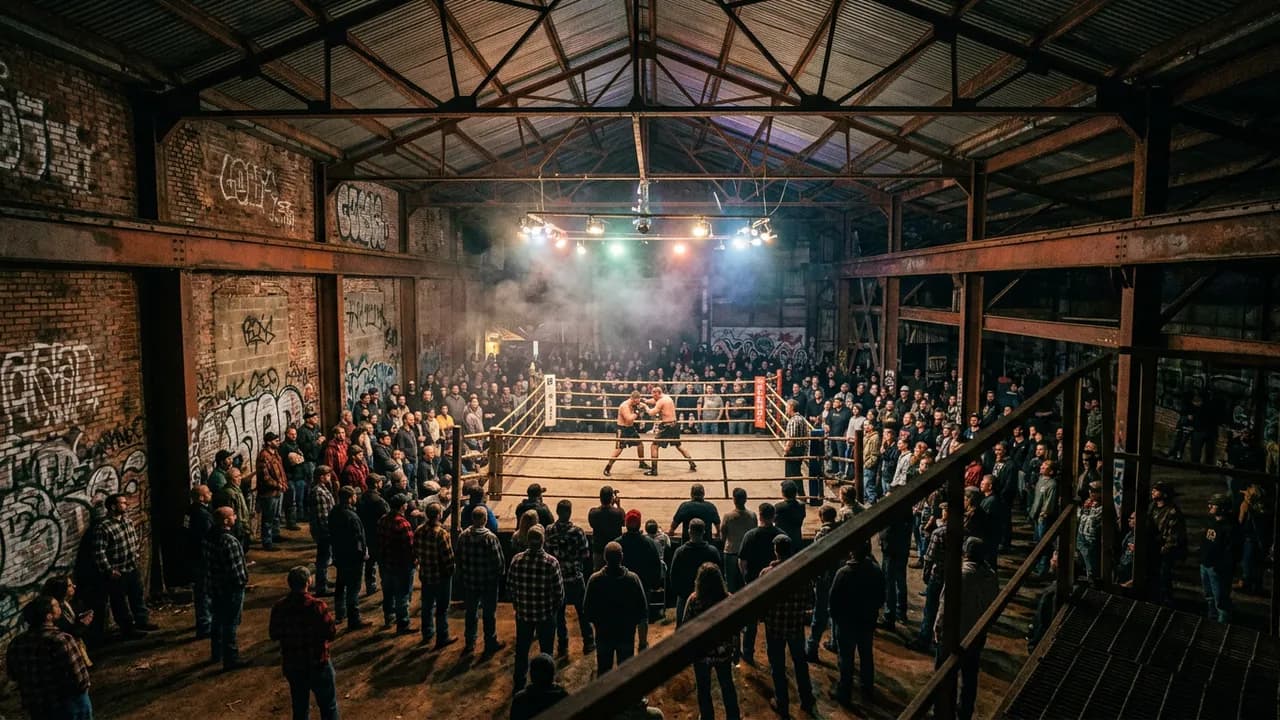
West Virginia is the only state in America where the act of putting on boxing gloves and punching your neighbor in the face qualifies as a beloved community tradition. That is not an exaggeration. It is a description of what happens every time Rough N' Rowdy rolls into one of the small coal towns that dot the southern half of the state, sets up a ring, and invites anyone between 18 and 35 to sign up for three one-minute rounds of sanctioned chaos.
The events draw thousands of spectators in towns with populations that barely crack four digits. Miners show up straight from the shafts, their faces still dusted gray. Entire families pack the bleachers to watch their sons, brothers, and cousins trade leather with childhood friends and lifelong rivals. The winners walk away with a trophy, a jacket, and a check for a thousand dollars -- roughly equivalent to a few weeks of underground work in the local mines. The losers walk away with bruises and a story. Everyone walks away with something that small-town Appalachia has in increasingly short supply: a reason to feel alive.
This is Rough N' Rowdy country. And its roots go deeper than any coal seam.
The Appalachian Fighting Tradition
Fighting in Appalachia did not begin with Rough N' Rowdy. It did not begin with boxing. It predates the coal industry, the railroads, and the state of West Virginia itself.
The historical precedent is a brutal tradition known as Rough and Tumble, sometimes called Gouging, which flourished in the backcountry of the American South from the 18th through the 19th century. Rough and Tumble was not boxing and it was not wrestling -- it was something closer to mutual assault. The ultimate objective was to gouge out your opponent's eye, though any form of maiming was considered acceptable. There were virtually no rules. Biting, scratching, and eye-gouging were not prohibited -- they were the point.
The men who fought in Rough and Tumble were backwoods farmers and frontiersmen, common in the swamp and mountain communities of Virginia, the Carolinas, and what would eventually become West Virginia. Winning was a source of pride in the local community. The fighters were not professional athletes. They were neighbors, and the fights served as entertainment, conflict resolution, and social hierarchy all at once.
When the coal industry arrived in southern West Virginia in the late 19th and early 20th centuries, it brought a new population of miners who carried on the fighting tradition in a different form. Mining camps were isolated, rough, and populated by men accustomed to hard physical labor and limited entertainment options. Boxing became a fixture of camp life -- sometimes organized by mining companies as a morale-building exercise, sometimes organized informally by the miners themselves. The fights were raw, rules were flexible, and the audiences were captive.
This is the cultural soil in which Rough N' Rowdy grew. The tradition of neighbors fighting neighbors for pride, entertainment, and a small payday has been part of West Virginia life for centuries. What Christopher MacCorkle Smith did was not invent something new. He formalized something ancient.
Christopher MacCorkle Smith and the Birth of Rough N' Rowdy
The modern Rough N' Rowdy was born from a failed show and a stubborn promoter.
Christopher MacCorkle Smith was a former amateur boxer whose competitive career ended in the mid-1990s. At his wife Andrea's suggestion, he transitioned from fighting to promoting, attempting to organize amateur boxing tournaments that could draw paying crowds. The early attempts were rocky. Events in Richmond, Virginia and Charleston, West Virginia stumbled financially. The concept was sound -- give ordinary people the chance to box in front of a crowd -- but the execution in larger markets failed to generate the grassroots enthusiasm needed to fill seats.
Smith found his audience in 1997, when he brought a show to Williamson, a small coal town in Mingo County, deep in the heart of southern West Virginia. McDowell and Mingo counties were once the epicenter of American coal production. At its peak in the 1950s, McDowell County alone had 100,000 residents, and Williamson was a bustling downtown serving the surrounding mining communities. But the mines had been closing for decades, and by the late 1990s, the population had cratered. Four out of every five people had left. The economy was in ruins. The communities that remained were struggling to find a reason to hold together.
The event drew a capacity crowd of more than 3,000 people to the local armory.
Into this void stepped Smith with a boxing ring and an open invitation. The response was immediate and overwhelming. Dozens of eager participants signed up. Thousands of spectators showed up. The event drew a capacity crowd of more than 3,000 people to the local armory. In a town that had lost nearly everything, Rough N' Rowdy gave people something: a night of energy, spectacle, and community that the collapsing coal economy could no longer provide.
The formula was deceptively simple. Anyone could sign up, as long as they were between 18 and 35 and had never boxed professionally. Fighters passed a physical, then entered a single-elimination tournament. Bouts consisted of three one-minute rounds -- short enough that even an untrained fighter could survive, long enough that things got interesting. Sixteen-ounce gloves provided some protection. Headgear was available but not always required. A referee kept things from going completely sideways.
The events became annual traditions in towns across southern West Virginia. Williamson, Welch, Bluefield, Summersville, Huntington, Charleston -- Smith rotated the shows through coal country, and each one drew the same kind of response: packed bleachers, deafening crowds, and fighters who had been waiting all year for their three minutes of glory.
The Coal Country Connection
Understanding Rough N' Rowdy requires understanding what happened to the communities that host it.
The coal industry's decline in southern West Virginia is one of the most devastating economic collapses in modern American history. McDowell County, which once produced more coal than any county in the United States, saw its population drop from over 100,000 in the 1950s to under 20,000 by the 2010s. The towns that had been built around the mines -- company towns, many of them, where the mining company owned the houses, the stores, and the social infrastructure -- emptied out as the mines closed. What remained was poverty, unemployment, substance abuse, and a deep sense of abandonment.
In these communities, Rough N' Rowdy was not just entertainment. It was a lifeline. The events brought people together in a way that nothing else in the area could match. They provided a focal point for community pride. They gave young people -- particularly young men with limited prospects -- a way to channel physical aggression and competitive energy into something structured and communal rather than destructive and isolated.
The fighters at Rough N' Rowdy are not professional athletes. They are coal miners, gas station attendants, construction workers, restaurant employees, and unemployed young men looking for something to do. Some have boxing experience. Most do not. What they have is the willingness to step into a ring in front of their neighbors and throw punches for three minutes, and in the social economy of small-town Appalachia, that willingness is worth more than any trophy.
The prize money -- a thousand dollars for tournament winners -- is not symbolic. In a region where the median household income hovers around $25,000, a thousand dollars is meaningful. Fighters have described the check as equivalent to several weeks of mine wages. For some, it represents the largest single payday they have ever received. The money is not why they fight, but it is not irrelevant either.
Barstool Sports and the National Stage
In November 2017, Barstool Sports acquired the Rough N' Rowdy Brawl for an undisclosed sum, and the trajectory of the promotion changed permanently.
Barstool, the sports and pop culture media company founded by Dave Portnoy, recognized what Smith had built: a ready-made entertainment product with an authentic audience, a compelling format, and unlimited potential for content creation. Smith joined Barstool as president of a new division called Barstool Brawl, continuing to handle the day-to-day operations while Barstool provided the marketing muscle, media distribution, and pay-per-view infrastructure.
The results were immediate. The first Rough N' Rowdy event under Barstool's banner drew approximately 13,000 pay-per-view buys. By the second event in February 2018, that number had tripled to 41,000. At $29.99 per buy, the math was compelling. Barstool's audience -- predominantly young, male, and hungry for content that felt raw and authentic -- was a perfect match for the Rough N' Rowdy product.
The production values increased. Portnoy and Dan "Big Cat" Katz, two of Barstool's most popular personalities, provided commentary in a style that mixed genuine fight analysis with the kind of irreverent humor that defined the Barstool brand. Ring girls in elaborate costumes became a fixture. Fighter walkouts grew increasingly theatrical, with participants entering in everything from Confederate-flag robes to full trash-can suits to costumes that would not have been out of place at a WWE event.
The fights were still three rounds of barely controlled violence between people who had no business being in a boxing ring and did not care.
But beneath the spectacle, the core of Rough N' Rowdy remained what it had always been: ordinary people from working-class backgrounds fighting in front of their communities. Barstool amplified the product, but it did not change its nature. The coal miners still showed up with soot on their faces. The families still packed the bleachers. The fights were still three rounds of barely controlled violence between people who had no business being in a boxing ring and did not care.
The Events and Their Character
A Rough N' Rowdy event is a sensory experience that defies comparison with any other combat sports product. It is not boxing in the traditional sense. It is not MMA. It is closer to a county fair that happens to include a fighting tournament, or a WWE event where the violence is not scripted.
The fighters make their entrances to walkout music of their choosing, often accompanied by entourages of friends and family who serve as their cornermen and cheerleaders. The names are half the show: fighters compete under monikers like Big Dick Booty Daddy, Butterbean Jr., Trailer Park Barbie, and other appellations that sound like they were generated by a redneck wrestling name generator. The crowd knows the fighters -- in many cases, literally knows them, because they work at the same mine or drink at the same bar -- and the personal connections between the audience and the competitors create an energy that no professional promotion can replicate.
The fighting itself ranges from technically competent to hilariously inept. Some participants have genuine boxing skills and put on legitimate displays of pugilism. Others have clearly never thrown a punch in their lives and simply windmill at each other for three minutes while the crowd goes berserk. Both types of fights are equally entertaining in the Rough N' Rowdy context, because the entertainment value is not derived from technical excellence -- it is derived from the spectacle of real people doing something that most people would never have the courage to do.
Over 25 numbered events have been held since the Barstool acquisition, and the promotion has expanded beyond West Virginia to hold shows in other states, including Kentucky and beyond. But the West Virginia events remain the heart of the operation, and the coal country crowds remain the gold standard for Rough N' Rowdy atmosphere.
The Portnoy Factor and Pay-Per-View Challenges
The Barstool partnership brought Rough N' Rowdy to a national audience, but it also introduced the dynamics of corporate media into what had been a grassroots operation. Dave Portnoy's involvement meant that the promotion's fortunes were tied to the broader Barstool Sports ecosystem, with all the advantages and complications that entailed.
On the advantage side, Barstool's massive social media following -- tens of millions across platforms -- gave Rough N' Rowdy a promotional megaphone that dwarfed anything Smith could have built independently. The pay-per-view model generated significant revenue. The content machine churned out fighter profiles, training montages, and trash-talk videos that drove engagement between events.
On the complication side, the pay-per-view model created expectations for consistent growth that a niche amateur boxing product may struggle to sustain. By 2024, Portnoy publicly expressed concern about declining PPV numbers, stating that he wanted at least 20,000 buys per event and would consider ending the promotion if the numbers did not meet expectations. The bluntness was classic Portnoy, but the underlying business reality was genuine: the novelty factor that had driven early PPV success was fading, and the promotion needed to find new ways to sustain audience interest.
Whether Rough N' Rowdy can maintain its commercial viability under Barstool's ownership remains an open question. What is not in question is the cultural viability of the concept itself. The tradition of amateur fighting in coal country predates Barstool by at least a century and will outlast any corporate partnership. If the pay-per-view numbers decline and Portnoy walks away, someone else will set up a ring in a West Virginia armory and open the sign-up sheet. The demand is not manufactured. It is endemic.
The West Virginia Fighting Identity
West Virginia's relationship with fighting is not accidental. It is structural. The state's geography -- mountainous, isolated, divided into hollows and valleys that historically limited travel and communication -- created communities that were self-reliant by necessity. Physical toughness was not a virtue to be cultivated. It was a survival requirement. Mining demanded it. Farming demanded it. The terrain demanded it. And when men who spent their days in physically punishing labor needed entertainment or conflict resolution, fighting was the natural outlet.
When a coal miner steps into the ring at a Rough N' Rowdy event, he is not just fighting for a thousand dollars and a trophy.
The state's labor history reinforces this identity. The West Virginia Mine Wars of the early 20th century -- a series of violent confrontations between coal miners and mining companies -- were among the most significant labor conflicts in American history. The Battle of Blair Mountain in 1921 saw approximately 10,000 armed miners march against coal company agents and state militia in what remains the largest armed insurrection on American soil since the Civil War. West Virginians did not just work hard. They fought hard, literally, for their rights and their survival.
This history infuses Rough N' Rowdy with a significance that extends beyond spectacle. When a coal miner steps into the ring at a Rough N' Rowdy event, he is not just fighting for a thousand dollars and a trophy. He is participating in a tradition that connects him to generations of West Virginians who used their fists, their bodies, and their willingness to absorb punishment as currencies in a world that offered them few other forms of capital.
What West Virginia Means to the Movement
West Virginia proves that underground fighting is not just an urban phenomenon. It is not confined to backyards in Miami or parking lots in Los Angeles or warehouse districts in Manchester. It thrives wherever there are people with physical courage, limited entertainment options, and a cultural framework that values toughness and competitive spirit. The mountains of Appalachia have all of these in abundance.
Rough N' Rowdy is the state's most visible contribution to the broader underground fighting landscape, but it is not the only one. Informal boxing matches, unsanctioned bouts, and backyard scraps have been part of West Virginia life for as long as there have been people living in the hollows. The tradition predates any promotion, any brand, and any pay-per-view model. It will outlast them all.
What Christopher MacCorkle Smith accomplished was not the invention of fighting in West Virginia. It was the recognition that what was already happening in coal country had value -- cultural value, entertainment value, and economic value. He built a framework around something that his neighbors had been doing for generations, and in doing so, he gave the rest of the country a window into a fighting culture that is as old as the mountains themselves.
Related Reading
- Rough N' Rowdy -- Complete guide to the amateur boxing promotion born in West Virginia
- Streetbeefs -- Virginia's backyard fighting organization, the other major East Coast scene
- Underground Fighting in Harrisonburg -- Streetbeefs' hometown, just across the Virginia border
- How to Prepare for Your First Underground Fight -- Practical advice for first-time competitors
- Underground Fighting in the United States -- Country-level overview of American fighting culture
- The History of Bare Knuckle Boxing -- The broader tradition that Appalachian fighting connects to