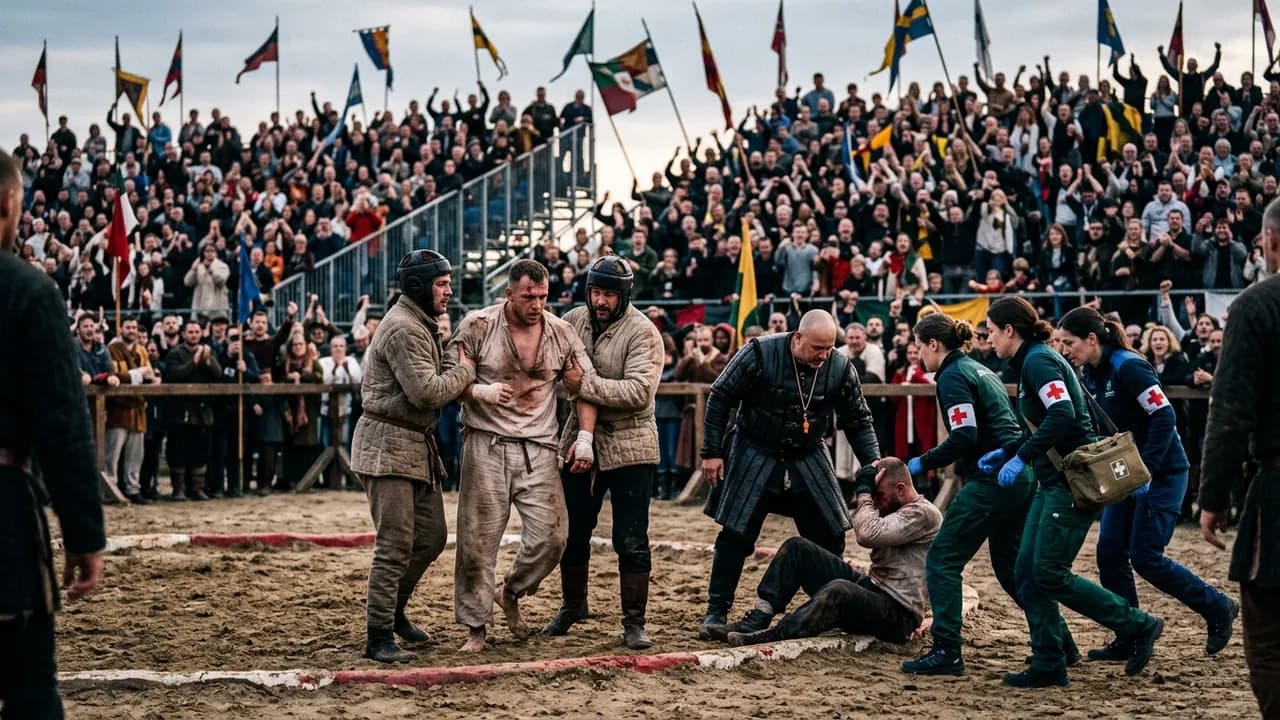
Calcio Storico Fiorentino is a 500-year-old sport played in Florence, Italy, that combines elements of rugby, soccer, wrestling, and bare knuckle fighting into what is frequently described as the most violent sport on Earth. Played annually in the Piazza Santa Croce, the game features 27 players per team fighting, tackling, punching, and elbowing each other on a sand-covered field in front of thousands of spectators.
It is not a reenactment. It is not a costume pageant. It is a live, full-contact competition where head-butting, choking, and punching are explicitly permitted and injuries requiring hospitalization are expected.
How old is Calcio Storico?
Calcio Storico dates to the 16th century, making it one of the oldest organized fighting sports still practiced in the world. The game has roots in ancient Roman ball games and was formalized in Renaissance Florence as a sport played by the city's aristocracy and later by its general population.
The most famous historical match took place on February 17, 1530, when Florentines staged a game in open defiance of the Holy Roman Emperor Charles V, whose troops were besieging the city. The match was a statement of civic pride and resistance -- a tradition that continues to inform the game's cultural significance.
Calcio Storico was revived in the 1930s by Mussolini's fascist government as part of a broader effort to celebrate Italian cultural traditions. The modern tournament has been played annually (with occasional interruptions) since that revival.
How does Calcio Storico work?
The basic format:
- Teams: 27 players per side.
- Field: A sand-covered pitch set up in the Piazza Santa Croce in Florence.
- Duration: 50 minutes per match.
- Objective: Score goals (called "cacce") by throwing or kicking the ball into the opposing team's goal, which spans the width of the field.
- No substitutions. If a player is injured, their team continues with fewer players.
- Fighting is integral. Players are permitted to fight opponents to create space, prevent scoring, or simply to establish physical dominance.
The game resembles a rugby match punctuated by organized brawls. At any given moment, some players are pursuing the ball while others are engaged in hand-to-hand combat with opponents. The two aspects of the game -- the ball game and the fighting -- are inseparable.
What are the rules of Calcio Storico?
The rules permit an extraordinary range of violence:
Allowed:
- Punching
- Head-butting
- Elbowing
- Choking
- Wrestling and takedowns
- Tackling
- Multiple players attacking one opponent
Prohibited:
- Sucker punches (attacks from behind without warning)
- Kicks to the head (added after incidents that caused severe injuries)
- Weapons of any kind
- Attacking a player who is already being fought by another teammate (in theory -- this rule is loosely enforced)
The rules have evolved over the centuries to reduce the most dangerous elements. The bans on sucker punches and kicks to the head were relatively recent additions, implemented after incidents that caused hospitalizations and public concern about the game's safety.
What are the four teams?
Calcio Storico is played between four teams representing historical neighborhoods of Florence:
- Santa Croce (Azzurri/Blues): From the neighborhood around the Basilica of Santa Croce, where the matches are played.
- Santo Spirito (Bianchi/Whites): From the Oltrarno district south of the Arno River.
- Santa Maria Novella (Rossi/Reds): From the area around the Santa Maria Novella train station and church.
- San Giovanni (Verdi/Greens): From the area around the Baptistery and Piazza del Duomo.
Each team draws its players exclusively from residents of its neighborhood. The neighborhood affiliations are deeply felt, and rivalries between the teams are genuine and sometimes intense.
When is Calcio Storico played?
The tournament takes place annually during the third week of June. Three matches are played:
- Two semifinal matches
- One final match, traditionally held on June 24 (the Feast of St. John the Baptist, Florence's patron saint)
The scheduling around Florence's patron saint's day underscores the event's religious and civic significance. Calcio Storico is not just a sport -- it is a cultural institution tied to Florentine identity.
Do players get paid?
No. Calcio Storico is strictly amateur. Players are not compensated financially for their participation. They compete for the honor of their neighborhood and for a prize that is deliberately modest: the winning team traditionally receives a Chianina steer (a breed of Italian cattle).
01 / Up next / Is Calcio Storico legal?
The amateur status is enforced. Professional fighters, professional athletes, and individuals with professional combat sports experience are generally excluded from participation, though the enforcement of this rule has been debated.
Is Calcio Storico legal?
Yes. Calcio Storico is legal because it is classified as a traditional cultural event rather than a combat sport. The city of Florence sanctions the annual tournament, and it is organized by an official committee that reports to the municipal government. This cultural designation shields the game from the Italian laws that would otherwise prohibit such violent activity.
However, the legal protection is conditional. In 2007, the tournament was suspended for a year after a 50-player brawl that resulted in multiple hospitalizations. The incident demonstrated that even a culturally sanctioned event can lose its protection if the violence exceeds what authorities and the public are willing to tolerate. The suspension led to rule changes designed to reduce the most extreme violence while preserving the game's essential character.
How dangerous is Calcio Storico?
Very dangerous. Injuries are expected and common:
- Broken bones (noses, ribs, hands, fingers) occur in virtually every match
- Concussions are frequent given the amount of head contact
- Dislocated joints from wrestling and tackling
- Facial lacerations from punches and elbows
- Hospitalizations after matches are routine
Fatalities have occurred across Calcio Storico's long history, though none in the modern era. The game's danger is not incidental -- it is fundamental to its identity. Players accept the risk as part of the tradition, and spectators attend knowing they will witness genuine violence.
Can tourists watch Calcio Storico?
Yes. The matches in Piazza Santa Croce are open to the public, and tickets are available for purchase. The event attracts significant tourist attention as one of Florence's most distinctive cultural offerings. Seating in the piazza is arranged around the sand field, and the atmosphere is intense, noisy, and emotionally charged.
Tickets for the final match on June 24 are the most sought-after and can sell out quickly. The semifinal matches are generally easier to attend.
How is Calcio Storico different from modern underground fighting?
Calcio Storico differs from modern underground fighting organizations in several fundamental ways:
- Legality: Calcio Storico is legally sanctioned and officially organized. Most underground fighting operates in legal gray areas.
- Team sport: Calcio Storico is a team game with 27 players per side. Underground fighting is individual combat.
- Ball game element: The objective is to score goals, not simply to defeat opponents in combat. Fighting is a means to an end, not the end itself.
- Cultural tradition: Calcio Storico is a 500-year-old cultural institution with civic and religious significance. Modern underground fighting organizations are commercial entertainment operations.
- Amateur: Players are unpaid and drawn from neighborhood residents. Many underground fighters seek professional advancement or audience recognition.
Despite these differences, Calcio Storico shares the essential appeal of underground fighting: real violence between real people, governed by codes of conduct that are understood by participants but foreign to outsiders.
Has Calcio Storico ever been banned?
Yes, temporarily. The most recent suspension was in 2007, when the tournament was canceled for one year after a 50-player brawl during a match spiraled beyond the game's already permissive rules. The brawl resulted in multiple hospitalizations and drew intense media coverage that embarrassed city officials.
The suspension prompted rule changes -- including the bans on sucker punches and kicks to the head -- and a renewed emphasis on the distinction between the fighting that is part of the game and the uncontrolled violence that threatens the game's continued existence.
Historically, Calcio Storico has been interrupted by wars, political upheaval, and periods of civic instability, but it has always returned. The game's 500-year survival demonstrates the depth of its cultural roots and the Florentine commitment to preserving a tradition that outsiders often find incomprehensible.
For more on the history of organized fighting, see our complete timeline of underground fighting or our underground fighting FAQ.