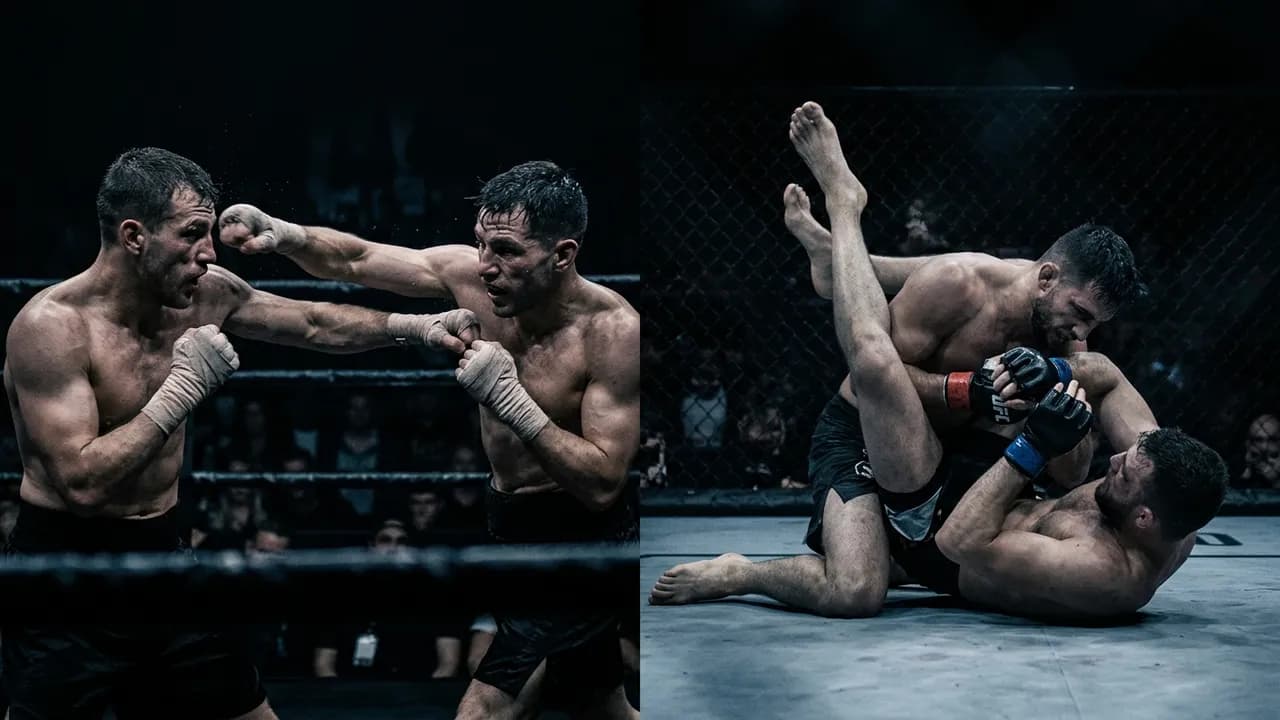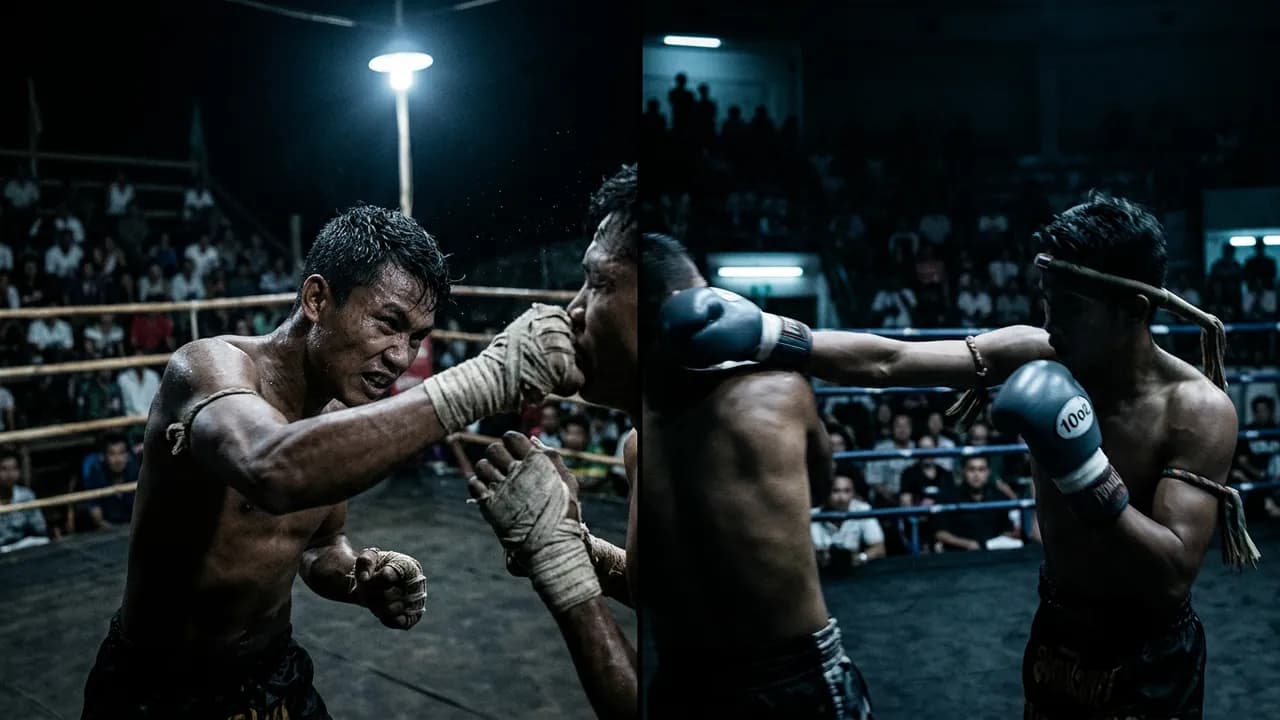
Southeast Asia has produced two of the most devastating striking arts in combat sports history. Muay Thai, Thailand's "Art of Eight Limbs," is a globally recognized sport with millions of practitioners, major stadium circuits, and a deep integration into modern MMA. Lethwei, Myanmar's "Art of Nine Limbs," remains far less known internationally but may be the more brutal of the two -- a bare knuckle fighting art where headbutts are legal and the only way to win is by knockout.
These two arts share geographic proximity, cultural significance, and a foundation of clinch-based striking. But their differences -- in rules, philosophy, and sheer violence -- are profound.
Quick Comparison
| Feature | Lethwei | Muay Thai |
|---|---|---|
| Country of Origin | Myanmar (Burma) | Thailand |
| Nickname | Art of Nine Limbs | Art of Eight Limbs |
| Limbs Used | Fists, elbows, knees, kicks, headbutt | Fists, elbows, knees, kicks |
| Gloves | Bare knuckle (hand wraps only) | Boxing gloves (8-10 oz) |
| Headbutts | Legal and central technique | Illegal |
| Decisions | Traditionally none -- draw if no KO | Judges' decision common |
| Cultural Status | National sport of Myanmar | National sport of Thailand |
| Global Reach | Limited but growing | Massive global following |
| Professional Circuit | Developing | Well-established (Lumpinee, Rajadamnern) |
| MMA Influence | Minimal crossover | Foundational striking art for MMA |
Historical Roots
Lethwei
Lethwei's origins stretch back over a thousand years in Myanmar, rooted in the martial traditions of the Burmese kingdoms. Historical records describe bare knuckle fighting competitions during the Pyu and Pagan eras, making Lethwei one of the oldest martial arts in continuous practice. The art was traditionally practiced in sand pits during festivals and religious celebrations, serving both as entertainment and as military training for Burmese warriors.
Unlike Muay Thai, which underwent significant modernization in the 20th century, Lethwei has retained much of its traditional character. The use of hand wraps instead of gloves, the inclusion of headbutts, and the traditional absence of judged decisions all connect modern Lethwei to its ancient roots. The sport experienced a resurgence in the 2010s, driven partly by international fighters seeking to test themselves in Myanmar's rings.
Muay Thai
Muay Thai evolved from Muay Boran (ancient boxing), the battlefield martial art of the Siamese military. The art became formalized as a sport in the early 20th century, with the establishment of rules, weight classes, and the iconic Bangkok stadiums -- Lumpinee and Rajadamnern -- that remain the pinnacle of the sport today.
The introduction of boxing gloves in the 1920s was a pivotal modernization that separated Muay Thai from its bare knuckle origins and from Lethwei. Gloves allowed fighters to throw with more power to the head while reducing cuts, facilitating longer fights and the development of the technical striking game that defines modern Muay Thai.
The Nine Limbs vs The Eight
The "limbs" distinction is the most famous difference between these arts.
Muay Thai -- Eight Limbs
Muay Thai uses eight points of contact:
- Left fist
- Right fist
- Left elbow
- Right elbow
- Left knee
- Right knee
- Left shin/foot
- Right shin/foot
This arsenal makes Muay Thai one of the most complete striking arts in existence. The integration of all eight limbs -- particularly the devastating elbow and knee strikes -- makes Thai fighters dangerous at every range.
Lethwei -- Nine Limbs
Lethwei adds a ninth weapon: the head.
Headbutts are not just legal in Lethwei -- they are a central technique. Fighters use headbutts in the clinch, in close-range exchanges, and even as entry techniques to close distance. A well-timed headbutt to the forehead, nose, or orbital area can end a fight instantly. The technique is particularly dangerous because the skull's frontal bone is one of the hardest surfaces on the human body, while the targets -- nose, cheekbones, orbital bones -- are among the most fragile.
The inclusion of headbutts changes the entire dynamic of clinch fighting. In Muay Thai, the clinch is a dominant position from which to deliver knees and elbows. In Lethwei, the clinch is even more dangerous because headbutts add another devastating weapon to an already lethal range.
Rules Deep Dive
Lethwei Rules
- Bare knuckle -- fighters wear cotton or gauze hand wraps only, no gloves
- Headbutts legal -- to all areas except the back of the head
- All strikes legal -- punches, kicks, knees, elbows, headbutts
- Clinch work extensive and encouraged
- Traditional rules: No judges' decisions -- if neither fighter is knocked out, the fight is a draw
- Modern modification: Some international events now use judges, but traditionalists reject this
- Injury timeout: A fighter who is knocked down or cut can receive a two-minute timeout to recover, called by their corner once per fight
- Five rounds, three minutes each with two-minute rest periods
The no-decision rule is the most philosophically distinctive aspect of Lethwei. It enshrines the principle that a fight should be settled definitively -- by knockout -- or not at all. This eliminates the controversial judging that plagues boxing and Muay Thai but also means that many Lethwei fights end in draws when evenly matched fighters cannot finish each other.
Muay Thai Rules
- Boxing gloves (8 oz for professional bouts, 10 oz for larger weight classes)
- No headbutts -- considered a foul
- All other strikes legal -- punches, kicks, knees, elbows
- Clinch work legal and central to the art
- Five rounds, three minutes each with two-minute rest periods
- Judges' decision if no stoppage -- scored on effectiveness, dominance, and damage
- 10-point must system in most sanctioned bouts
Fighting Styles and Techniques
Striking Differences
| Technique | Lethwei | Muay Thai |
|---|---|---|
| Punching | Less emphasized due to hand injury risk | More common, gloves protect hands |
| Elbows | Devastating -- bare-skinned contact | Devastating -- gloves do not cover elbows |
| Knees | Central weapon in clinch | Central weapon in clinch |
| Kicks | Powerful but less technical emphasis | Highly refined -- the roundhouse is signature |
| Headbutts | Signature technique, clinch weapon | Illegal |
| Clinch | Aggressive, headbutt-enhanced | Technical, knee-and-elbow-focused |
| Sweeps/Trips | Legal and common | Legal and scored |
The absence of gloves in Lethwei creates a different punching economy. Bare knuckle fighters must be more selective with their punches to avoid breaking their hands, which shifts emphasis toward elbows, knees, kicks, and headbutts. Muay Thai's gloves allow more liberal punching, though punches are traditionally less valued in Thai scoring than kicks, knees, and elbows.
Clinch Dynamics
The clinch is where these two arts diverge most dramatically. Both arts emphasize the clinch as a dominant position, but the available weapons differ:
05 / Up next / Cultural Significance
Muay Thai clinch: Double collar tie, single collar tie, body lock -- delivering knees to the body and head, elbows at close range, sweeps and trips for scoring
Lethwei clinch: All of the above plus headbutts -- which changes defensive positioning, makes the clinch more dangerous for both fighters, and rewards aggression in close quarters
Cultural Significance
Lethwei in Myanmar
Lethwei holds the status of national sport in Myanmar, though it competes for cultural attention with football (soccer) and chinlone (a traditional sport). Lethwei fights are fixtures at festivals, religious celebrations, and national holidays. The sport is deeply intertwined with Myanmar's ethnic identity, particularly among the Bamar majority and various ethnic minorities who maintain their own fighting traditions.
Prominent Lethwei champions like Dave Leduc (a Canadian who became one of the most successful foreign Lethwei fighters), Too Too, and Tun Tun Min are national celebrities. The sport's profile has been affected by Myanmar's political instability since the 2021 military coup, which has complicated international events and media coverage.
Muay Thai in Thailand
Muay Thai's cultural significance in Thailand is immense and institutionalized. The sport is woven into Thai national identity, military tradition, and religious practice. Young boys from rural provinces train at Muay Thai camps from childhood, and success in the ring provides one of the few reliable paths out of poverty.
The sport's two great stadiums -- Lumpinee and Rajadamnern in Bangkok -- are sacred institutions. Winning a stadium title is the highest achievement in Muay Thai and confers lifelong respect. Muay Thai has also been successfully exported worldwide, with millions of practitioners in Europe, the Americas, and Asia.
Global Reach and MMA Crossover
This is where the gap between the two arts is widest.
Muay Thai is one of the foundational striking arts of MMA. Virtually every elite MMA fighter has significant Muay Thai training. The art's emphasis on clinch fighting, knee strikes, and the powerful roundhouse kick has made it indispensable in the modern MMA toolkit. Fighters like Anderson Silva, Jose Aldo, Joanna Jedrzejczyk, and Valentina Shevchenko built legendary MMA careers on Muay Thai foundations.
Lethwei has had minimal crossover into MMA, primarily because headbutts are illegal in all major MMA promotions and bare knuckle techniques require significant modification for gloved competition. Some Lethwei fighters have competed in MMA and bare knuckle boxing organizations, but the art has not achieved the systematic integration into MMA training that Muay Thai enjoys.
However, Lethwei's growing international profile -- driven by social media and the efforts of fighters like Dave Leduc to promote the sport globally -- is slowly expanding its reach. Several BKFC and bare knuckle fighters have cited Lethwei as an influence, particularly its bare knuckle striking and clinch techniques.
Which Is More Dangerous?
Lethwei is more dangerous by virtually every measure:
- Bare knuckle strikes produce more cuts and facial injuries
- Headbutts add a devastating weapon that no other sanctioned combat sport allows
- The traditional no-decision rule incentivizes going for the knockout at all costs
- The injury timeout system, while providing recovery time, also allows fighters to continue after damage that would stop fights in other sports
- Less regulatory infrastructure means less consistent medical oversight
Muay Thai is undeniably dangerous -- it is a full-contact combat sport -- but its gloves, established commissions, judging systems, and extensive regulatory framework provide significantly more safety infrastructure than Lethwei.
The Verdict
Lethwei and Muay Thai are sibling arts separated by a border and a pair of gloves. Muay Thai is the globally recognized, commercially successful, MMA-integrated striking art that has earned its place as one of the world's great combat sports. Lethwei is the wilder, more dangerous, less known cousin -- an art that has preserved traditions other sports abandoned in the name of safety and commercialization.
If you want to study a striking art with global applicability, world-class training infrastructure, and competitive opportunities at every level, Muay Thai is the clear choice. If you want to understand what striking combat looked like before modern regulation, or if you are drawn to the purity of a sport where the only way to win is to finish your opponent, Lethwei offers something no other martial art can match.
For more striking art comparisons, see our Bare Knuckle Fighting vs MMA comparison. For organizational profiles, visit our pages on BKFC and other bare knuckle promotions.
Watch and Learn More
YouTube Channels
- BKFC Official -- Modern bare knuckle combat for comparison
Read More on UNSANCTIONED FIGHTS
- Dambe vs Lethwei vs Bare Knuckle -- How lethwei compares to other ungloved traditions
- Bare Knuckle vs MMA -- The modern combat sports comparison
- Underground vs Sanctioned Fighting -- Where traditional arts fit in the spectrum
- All Underground Fighting Organizations Ranked -- Every org ranked from 23 to 1