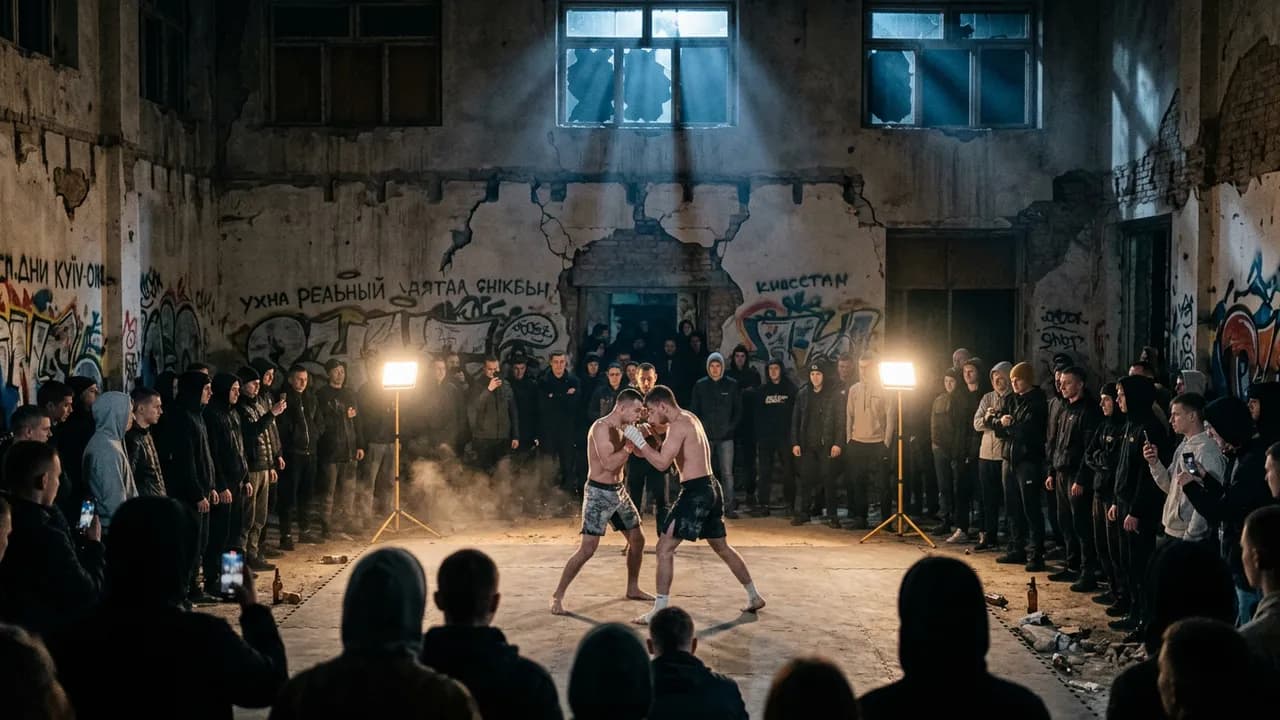
Kyiv's fight scene was born fast, burned bright, and was snuffed out by war.
In less than 18 months, Mahatch Fighting Championship staged nine events in the Ukrainian capital, hosted 237 bare-knuckle bouts, attracted a former UFC fighter and an Olympic silver medalist to the same card, filled the Palace of Sports with 2,000 fans, and built a YouTube audience of hundreds of thousands. The promotion introduced Ukraine to formalized bare-knuckle fighting at exactly the moment the format was exploding globally, and for a brief window, Kyiv looked like it might become the Eastern European capital of gloveless combat.
Then, on February 24, 2022, Russia launched a full-scale invasion of Ukraine, and everything stopped.
The story of underground fighting in Kyiv is a story about what happens when combat sports culture meets geopolitical catastrophe. It is also a story about the traditions, toughness, and ambition that made Kyiv fertile ground for bare-knuckle fighting in the first place -- and about whether those qualities can survive the destruction of the world that produced them.
Pre-War Fighting Culture
Ukraine has a deep and varied combat sports heritage. The Soviet Union invested heavily in boxing and wrestling programs across its constituent republics, and Ukraine produced some of the most decorated fighters in Olympic history. The Klitschko brothers -- Vitali and Wladimir -- are the most famous, but the talent pipeline extended far beyond two heavyweight champions. Vasyl Lomachenko, Oleksandr Usyk, and Denys Berinchyk all came through the Ukrainian amateur boxing system, which continued to produce world-class talent long after independence in 1991.
But formal boxing and wrestling represent only part of Ukraine's fighting culture. In the streets, parks, and industrial spaces of Kyiv and other major Ukrainian cities, informal fighting has a long history. The post-Soviet period was marked by the same kind of street fighting culture that emerged across the former Eastern Bloc -- fueled by economic instability, organized crime, and a culture that placed high value on physical toughness. Ukraine's street fighting scene was never as formalized as Russia's Strelka or Top Dog FC, but the raw material -- fighters, audiences, and a cultural appetite for combat -- was always present.
Kyiv, as the capital and largest city, was the natural center of gravity for any attempt to formalize this underground energy. With a metropolitan population of nearly four million, a vibrant nightlife and entertainment scene, and a young, internet-savvy population hungry for content, the city had everything a combat sports promoter could want. What it lacked, until 2020, was someone willing to build the platform.
The Birth of Mahatch FC
The idea for Mahatch Fighting Championship crystallized in January 2020, when co-founder Andriy Limontov saw broadcasts of the Bare Knuckle Fighting Championship in the United States and recognized an untapped market. Ukraine had the fighters. It had the audience. It had the cultural appetite for raw, unfiltered combat. What it did not have was a promotion that could package all of that into a product.
Limontov set about building one. The format he developed was deliberately distinct from both Western bare-knuckle organizations like BKFC and Russian promotions like Top Dog. Mahatch fighters competed without gloves in a ring made of sandbags -- a visual signature that evoked the underground fights of 20th-century America while giving the promotion a uniquely Ukrainian identity. The dress code was mandatory jeans and sneakers, reinforcing the street-fighting aesthetic. Bouts consisted of three two-minute rounds with a strict set of rules: no ground fighting, no elbows, clinch strikes permitted, and a ten-second count after knockdowns. Draws were possible.
The result was a product that looked and felt different from everything else in the global bare-knuckle landscape. Where BKFC aimed for professional polish, and Top Dog leaned into the spectacle of raw power, Mahatch FC occupied a middle ground -- organized enough to be legitimate, raw enough to be authentic.
The Palace of Sports
Mahatch FC held events at several Kyiv venues, but its most significant location was the Palace of Sports, a Soviet-era arena in the heart of the city that became synonymous with the promotion's biggest nights.
Built in 1960, the Palace of Sports was one of the iconic venues of Soviet athletic culture -- a cavernous, utilitarian structure designed to host everything from ice hockey to gymnastics to political rallies. By the time Mahatch FC arrived, the building had been renovated and modernized, but it retained the imposing scale and austere grandeur of its Cold War origins. The contrast between the venue's institutional architecture and the raw, gloveless fighting taking place inside it was part of the appeal.
The production team used dim lighting and sawdust-filled bags as ring barriers to create an ambiance deliberately reminiscent of early American underground fighting.
The atmosphere at the Palace of Sports during Mahatch events was, by multiple accounts, electric. The production team used dim lighting and sawdust-filled bags as ring barriers to create an ambiance deliberately reminiscent of early American underground fighting. Fans crowded around the sandbag ring, close enough to feel the impact of punches and hear the breathing of fighters. There was no barrier between the audience and the action -- a design choice that heightened the intensity for both fighters and spectators.
The Lobov vs. Berinchyk card in July 2021 -- Mahatch FC 5 -- drew over 2,000 fans to the Palace of Sports and represented the promotion's commercial and cultural peak. Having a former UFC fighter (Artem Lobov) face an Olympic silver medalist (Denys Berinchyk) in a bare-knuckle bout gave the event crossover appeal that extended far beyond the usual bare-knuckle audience. The fight was streamed internationally via TrillerTV (then FITE TV), putting Kyiv's fight scene on the global map.
Berinchyk won by fifth-round TKO, and Lobov retired from combat sports after the bout. But the result mattered less than the statement: Kyiv could stage bare-knuckle events at a level that competed with promotions anywhere in the world.
Parimatch and the Business Model
Mahatch FC did not operate on a shoestring budget. The promotion was backed by Parimatch, one of Ukraine's largest betting companies, through its PM Club loyalty program. The sponsorship provided more than just a logo on the ring posts. Parimatch's involvement gave Mahatch access to professional marketing, event production, and media distribution infrastructure that would have been impossible for an independent startup to replicate.
The PM Club branding was integrated into every aspect of the Mahatch experience. The Federation of Fist Fights, an organizational body created in conjunction with Mahatch, formalized the rules and competitive structure under the PM Club umbrella. The betting company's resources allowed the promotion to book larger venues, invest in higher-quality production, and attract bigger names to its cards.
This corporate backing was both the engine of Mahatch's rapid growth and, ultimately, a factor in its demise. When the war began and the Ukrainian government's attention turned to ferreting out companies with perceived Russian ties, Parimatch found itself in the crosshairs.
The War and Its Aftermath
Russia's full-scale invasion of Ukraine on February 24, 2022 ended Mahatch FC's operations almost overnight. The last event -- Mahatch FC 9 -- took place on February 19, 2022, just five days before the invasion, at Terminal Mall in Brovary, a suburb northeast of Kyiv. The event featured 13 fights and introduced the promotion's first championship belts. No one in attendance could have known that they were watching the final Mahatch card.
When the invasion began, Kyiv was thrust into a battle for survival. The Battle of Kyiv, which raged from late February through early April 2022, saw Russian forces push to within miles of the city center before being repelled by a combination of Ukrainian military resistance and logistical failures. The Palace of Sports, the cultural landmarks, the entertainment venues -- all of it became secondary to the existential question of whether the city would remain Ukrainian at all.
The war's impact on Mahatch FC was both direct and indirect. On the direct side, fighters, staff, and fans were scattered by the conflict. Many joined the Ukrainian armed forces or territorial defense units. Training facilities were disrupted. The entire entertainment and events industry in Kyiv ground to a halt as the city endured air raids, curfews, and infrastructure attacks.
On the indirect side, the Ukrainian government's wartime crackdown on companies with alleged Russian connections caught Parimatch in its net. In 2022, President Zelenskyy signed sanctions targeting several gambling companies, including Parimatch, which was banned from operating in Ukraine for 50 years. The company suspended its Ukrainian operations, and with it went the financial infrastructure that had made Mahatch FC viable. No sponsor, no promotion.
Parimatch had actually responded to the invasion by withdrawing its franchise from Russia, allocating 30 million hryvnias for Ukrainian defense supplies, and publicly supporting the Ukrainian war effort. But the sanctions were rooted in concerns about the company's corporate structure and pre-war Russian ties, and the wartime political environment left no room for nuance.
The Broader Ukrainian Fight Scene
Mahatch FC was the most prominent, but it was not the only expression of fighting culture in Kyiv and across Ukraine. The country's strong amateur boxing tradition continued to produce world-class talent even as the professional entertainment side of combat sports struggled. Ukrainian fighters competed internationally in boxing, MMA, and kickboxing, often punching above the country's weight in terms of talent production relative to population.
Ukrainian fighters who once competed for trophies and YouTube views now apply their skills in a context where the stakes are measured in sovereignty and survival.
The war has also reshaped the meaning of fighting culture in Ukraine in ways that transcend sport. Military training, hand-to-hand combat skills, and physical toughness have taken on life-or-death significance for a population engaged in an existential conflict. Ukrainian fighters who once competed for trophies and YouTube views now apply their skills in a context where the stakes are measured in sovereignty and survival.
Several combat sports figures have joined the Ukrainian armed forces or played active roles in the defense effort. The line between sport fighter and actual combatant has blurred in ways that no other country's fight scene has experienced in the modern era. For Kyiv's fighting community, the war did not end their culture -- it absorbed it.
Can Mahatch Return?
The question of whether Mahatch FC or a successor promotion can revive bare-knuckle fighting in Kyiv depends on factors that extend far beyond the sport itself. The war must end, or at least stabilize to a degree that allows entertainment events to resume without the constant threat of missile strikes and power outages. A new financial sponsor would need to replace Parimatch, which is unlikely to return to the Ukrainian market in any foreseeable timeframe. And the fighters, many of whom have been physically and psychologically transformed by years of war, would need to find the desire and ability to return to sport combat.
None of these conditions are impossible. Ukraine has demonstrated remarkable resilience, and the cultural appetite for combat sports that made Mahatch viable in the first place has not disappeared -- it has, if anything, been deepened by the experience of war. The infrastructure of the promotion -- the rules, the format, the brand -- still exists. What is missing is the peace and stability that would allow it to operate.
If and when that stability returns, Kyiv has every reason to reclaim its place in the global bare-knuckle landscape. The city has the fighters, the audience, the venues, and the fighting DNA. What it needs is an end to the conditions that have made sport a luxury its people cannot currently afford.
What Kyiv Represents
Kyiv's brief but intense run as a bare-knuckle capital illustrates both the universality of fighting culture and its fragility. Mahatch FC proved that the appetite for raw, gloveless combat is not confined to the United States or the United Kingdom. It exists wherever there are fighters willing to throw bare fists and audiences willing to watch. In less than two years, a Ukrainian startup promotion achieved a level of production quality, fighter talent, and international visibility that took some Western promotions a decade to build.
But Kyiv also represents the reality that fighting culture does not exist in a vacuum. It is shaped by the political, economic, and military conditions of the society that produces it. When those conditions collapse, the culture collapses with them -- or transforms into something far more serious than sport.
The sandbag ring at the Palace of Sports sits empty. The fighters who once competed there are engaged in a different kind of combat. And the city that hosted 237 bare-knuckle bouts in under two years now counts its victories in terms of missile interceptions and territorial defense.
Kyiv's fight scene is not dead. It is on hold. And when it returns, it will carry scars that no other fighting city in the world can match.
Related Reading
- Mahatch Fighting Championship -- Complete guide to Ukraine's bare-knuckle promotion
- Artem Lobov -- The former UFC fighter who headlined Mahatch FC's biggest event
- Top Dog Fighting Championship -- Russia's bare-knuckle promotion and Mahatch's regional counterpart
- Underground Fighting in Moscow -- How Moscow's fight scene compares to Kyiv's
- BKFC -- The American promotion that inspired Mahatch FC's creation
- Underground Fighting in Ukraine -- Country-level overview of Ukrainian fighting culture