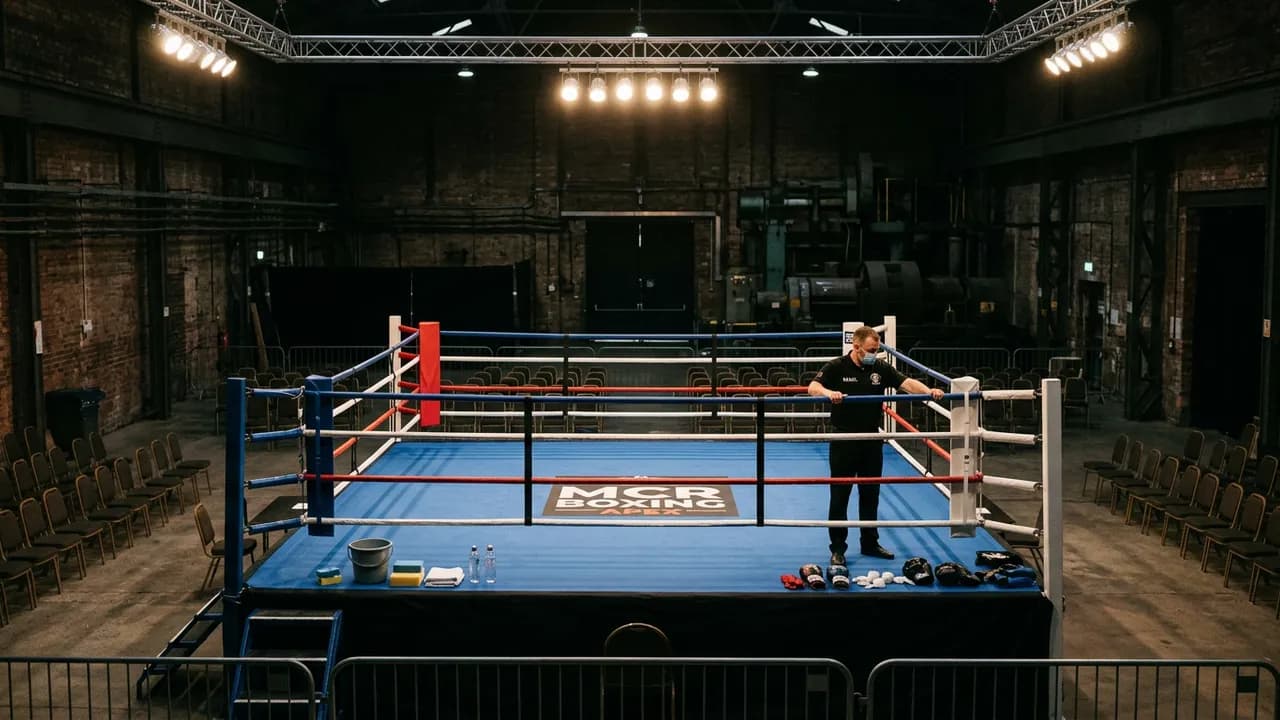
Manchester has always been a fighting city. The boxing tradition runs deep -- from the gyms of Moss Side to the arenas that have hosted world championship fights. But beneath the sanctioned surface, Manchester developed an underground fighting scene that was rougher, rawer, and more democratic than anything the British Boxing Board of Control would have permitted.
King of the Ring was at the center of that scene. The promotion staged events across Manchester and the broader North of England, providing a platform for fighters who fell outside the sanctioned system -- those who lacked amateur pedigrees, those who had been denied boxing licenses, those who simply wanted to fight without the bureaucratic overhead of official competition. KOTR gave them a ring, an opponent, and an audience.
The fighters who built KOTR's Manchester scene in its early days created something that extended well beyond the individual events. They built a community, a tradition, and a pipeline that would influence underground fighting across the UK. This is where those originals are now.
The Manchester Gym Fighters: Trained but Unsanctioned
Manchester's network of boxing and MMA gyms provided KOTR with fighters who had genuine technical skill but lacked the credentials or inclination to compete through sanctioned channels. These gym fighters -- men who trained daily, sparred regularly, and had competitive ambitions -- found in KOTR an outlet that the official system denied them.
Some had been refused boxing licenses for medical reasons. Others had criminal records that disqualified them from sanctioned competition. A few simply preferred the atmosphere of KOTR events to the sterile formality of amateur boxing tournaments. Whatever the reason, they brought a level of skill to KOTR cards that elevated the promotion above the pure street fighting spectacle that some audiences expected.
As of 2026, many of these gym fighters have transitioned to coaching and training roles within Manchester's combat sports community. Their KOTR experience -- fighting in high-pressure, low-structure environments -- gave them a perspective that gym-only coaches lack. They understand what happens when the bell rings in front of a hostile crowd, and they pass that understanding to the next generation of Manchester fighters.
Several have also continued to compete in various formats -- white-collar boxing events, charity bouts, and the occasional KOTR or similar underground card. The fighting bug, once contracted, is not easily cured, and Manchester's gym culture provides ample opportunities for aging fighters to scratch the itch.
The Street Fighters: Manchester's Hardest Men
Alongside the gym-trained competitors, early KOTR events featured fighters whose training was the street itself. Manchester's reputation for hardness -- earned across centuries of industrial working-class culture -- produced men who could fight not because they had been taught but because they had no alternative. Fighting was a survival skill, and KOTR provided a context where that skill could be exercised without the legal consequences of a street altercation.
These street fighters brought a different energy to KOTR cards. Their technique was often rough, their conditioning was unpredictable, and their approach to combat was informed by the realities of street violence rather than the abstractions of gym training. But they were tough in ways that gym fighters sometimes were not. They had been hit before -- not in sparring, but in anger -- and the experience of absorbing genuine hostile intent gave them a baseline of composure under fire that is difficult to replicate in any training environment.
Where are these street fighters now? Manchester's working-class communities have absorbed them back. Some have found stability through employment, family, and the gradual domestication that age imposes. Others continue to inhabit the margins -- the same economic and social conditions that produced their fighting skills remain operative in 2026. A few have cycled through the criminal justice system, their KOTR careers a brief bright spot in lives defined by harder struggles.
Remdizz: Manchester's Underground Star
Remdizz emerged from the Manchester KOTR scene as one of the promotion's most recognizable fighters. Combining striking ability with a charismatic presence that translated well to the camera, Remdizz became a draw for KOTR events and built a following that extended beyond the Manchester fight community.
His fighting style reflected the KOTR environment -- aggressive, forward-moving, designed to create exciting exchanges rather than cautious, point-accumulating performances. In a promotion where audience reaction mattered as much as the result, Remdizz understood that entertainment and effectiveness were not mutually exclusive.
As of 2026, Remdizz has maintained a presence in the UK underground fighting community.
As of 2026, Remdizz has maintained a presence in the UK underground fighting community. His KOTR career established a brand that has sustained itself through social media, personal appearances, and continued involvement in the combat sports scene. Whether competing, commentating, or simply showing up to support the next generation of KOTR fighters, he remains one of the most visible alumni of Manchester's underground era.
The Door Staff: Bouncers in the Ring
A significant contingent of early KOTR fighters came from Manchester's nightclub and pub security industry. Door work in Manchester has always been a profession that attracts fighters -- the job requires physical presence, the willingness to engage in confrontation, and the ability to handle violent situations with at least some degree of composure. KOTR provided these professionals with a competitive outlet that complemented their day jobs.
The door staff fighters were typically large, physically imposing, and experienced in the kind of short, intense confrontations that KOTR matches resembled. They were accustomed to dealing with aggressive, intoxicated individuals in confined spaces, and the KOTR ring was simply a more formalized version of what they dealt with on a Saturday night.
Many of these fighters have remained in the security industry, their KOTR credentials serving as informal qualifications that carry weight in Manchester's door scene. Others have moved into security management, gym ownership, or personal training. The crossover between door work and underground fighting remains strong in Manchester, as both activities draw from the same pool of physically capable, confrontation-tolerant individuals.
The Youth Pipeline: From KOTR to Careers
One of KOTR's most significant contributions to Manchester's fighting culture was its role as an entry point for young fighters who would go on to legitimate careers. Several fighters who competed at early KOTR events were in their late teens or early twenties, still developing their skills and searching for competitive opportunities. KOTR gave them ring time that the sanctioned amateur system might not have provided -- or might have provided more slowly.
Some of these young fighters used their KOTR experience as motivation to pursue formal training, joining established gyms and entering the amateur boxing or MMA system. The underground experience gave them confidence and a baseline of competitive composure, while the formal training gave them the technical foundation they needed to progress.
As of 2026, several former KOTR competitors have built professional fighting careers in boxing and MMA, competing on regional and national cards across the UK. Their KOTR origins are not always acknowledged in their official biographies -- the association with underground fighting can be a liability in the sanctioned world -- but the experience is there, woven into the foundation of their fighting identities.
Manchester's Changing Landscape
Like Oakland and its East Bay Rats scene, Manchester's underground fighting community exists within a city that has undergone dramatic transformation. The regeneration of Manchester's city center and surrounding areas -- accelerated by investment, development, and the broader gentrification trend affecting major UK cities -- has displaced some of the communities that sustained KOTR's early events.
The venues where early KOTR events were staged have, in some cases, been demolished or repurposed. The neighborhoods that produced the fighters have been reshaped by rising property values and shifting demographics. The raw, working-class culture that gave KOTR its identity is not extinct, but it has been pushed to the periphery by economic forces that value property over community.
Former KOTR fighters navigating this changing landscape have had varied experiences. Those who adapted to the new economy -- finding employment in Manchester's growing service and technology sectors -- have integrated into the city's new identity. Those who did not have been pushed outward, to satellite towns and cheaper neighborhoods, carrying their Manchester fighting identity into places that did not produce it.
The KOTR Legacy in Manchester
King of the Ring gave Manchester's fighting community something it had always had informally but never had officially: a stage. The gym fighters, the street fighters, the door staff, and the young hopefuls all had a place to compete, to test themselves, and to be recognized for the fighting abilities that their daily lives demanded but rarely celebrated.
The Manchester originals who built KOTR's reputation did not do it for money or fame. They did it because Manchester is a fighting city, and fighters fight. The promotion gave that impulse a structure, an audience, and a record. The fights that were staged in those early events are preserved on video, capturing a moment in Manchester's cultural history that might otherwise have gone undocumented.
Wherever the KOTR Manchester originals are now -- coaching in gyms, working doors, raising families, or still competing -- they carry the distinction of having been part of something that defined a city's underground identity. Manchester fights. It always has. KOTR gave that truth a name and a ring.
Watch: KOTR Manchester Fight Clips
The underground boxing events that gave Manchester's unsanctioned fighters a stage.
- King of the Ring -- Best Fights Compilation -- The hardest-hitting moments from KOTR events across Manchester and the North of England.
- KOTR Manchester -- Underground Boxing Night -- Full atmosphere from a KOTR event showing the gym fighters, street fighters, and door staff who built the scene.
- Remdizz -- KOTR Fight Highlights -- Manchester's most recognizable KOTR fighter, combining striking ability with the charisma that made him a draw.
- Manchester Underground Fighting Scene -- How KOTR fits into Manchester's deep boxing tradition, from Moss Side gyms to warehouse rings.
- KOTR Knockouts -- Manchester's Hardest Hitters -- The most devastating finishes from the promotion that proved Manchester fighters could compete in any format.
- Vice -- King of the Ring Manchester Documentary -- Vice's coverage of the Manchester underground fighting scene and the youth culture KOTR has transformed.
For more on King of the Ring's history, see our KOTR organization profile. For the broader UK bare knuckle story, read Where Are They Now: BKB Pioneers.