BKFC Rules: Rounds, Wraps, Toe-the-Line & Weight Classes
Bare Knuckle Fighting Championship is the world's largest bare-knuckle fighting promotion and the only one that operates under the full oversight of state athletic commissions in the United States. Founded in 2018 in Philadelphia, BKFC hosted the first legal bare-knuckle boxing event in the United States since 1889 -- a gap of 129 years. Today, the promotion stages events across the United States, the United Kingdom, and Mexico, with Conor McGregor's sports management company becoming a part-owner in 2024.
What makes BKFC significant in the underground and alternative fighting landscape is not what it allows but how it regulates what it allows. Every BKFC event is sanctioned by a state or national athletic commission. Every fighter undergoes pre-fight medical screening. A ringside physician has the authority to stop any fight at any time. This regulatory infrastructure is what separates BKFC from organizations like KOTS, Strelka, or Streetbeefs, even though all of them put fighters in front of each other to exchange blows.
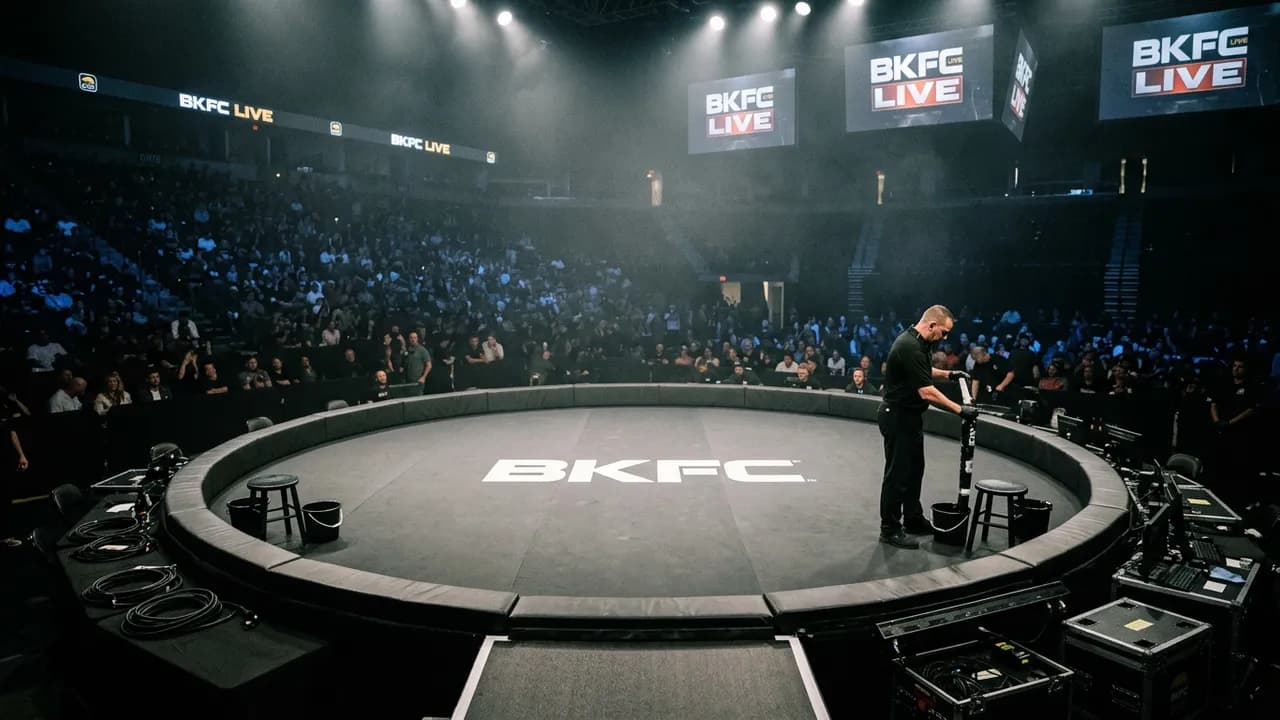
The Circular Pit
BKFC fights take place in a boxing ring, but the organization's visual identity is built around what it calls the "pit" -- a circular fighting area within the ring that emphasizes the face-to-face nature of bare-knuckle combat. The ring itself follows standard boxing ring specifications with ropes, corner posts, and a canvas floor, but the circular marking in the center is where the action begins.
The circular design is both functional and symbolic. It visually references the prize rings of the 18th and 19th centuries, when bare-knuckle boxing was fought in roped-off circles on grass. It also reinforces the spectacle: fighters start close together in the center of the pit, which guarantees immediate action and eliminates the cautious circling that can characterize the opening minutes of gloved boxing matches.
The "Toe the Line" Start
BKFC's most distinctive procedural rule is its starting position. At the beginning of each round, two lines are marked three feet apart in the center of the ring. Each fighter places their front foot on their respective line, and the referee calls "knuckle up" to begin.
This tradition is directly borrowed from the London Prize Ring era of bare-knuckle boxing, where fighters had to "come to scratch" -- a line marked in the center of the ring -- at the start of each round. A fighter who could not make it to the scratch line was declared the loser. BKFC's toe-the-line rule serves a similar purpose: it ensures that fighters begin each round in close proximity, which produces immediate exchanges and rewards fighters who are willing to stand and trade.
The three-foot starting distance is remarkably close. In a standard boxing match, fighters begin at the center of the ring and must close distance before they can throw punches. In BKFC, fighters are within punching range from the first second. The opening exchange of a BKFC round often begins before the referee's hand has fully dropped.
Round Structure
Standard Bouts
- 5 rounds of 2 minutes each
- One-minute rest between rounds
Championship Bouts
- 5 rounds of 2 minutes each
- One-minute rest between rounds
BKFC uses the same format for both standard and championship bouts: five rounds of two minutes. This is shorter than a standard professional boxing match (typically 10 or 12 rounds of three minutes) but longer than the formats used by Top Dog (3 rounds of 2 minutes for regular bouts) or Rough N Rowdy (3 rounds of 1 minute).
The two-minute round length is calibrated to the realities of bare-knuckle fighting. Without the padding of gloves, every punch that lands carries more concussive force relative to its speed. Cuts open faster. Knockouts arrive with less warning. Two-minute rounds keep the total fight duration shorter than traditional boxing, reflecting the fact that bare-knuckle bouts produce accumulated damage more quickly.
Hand Protection: Exposed Knuckles
BKFC's hand wrapping rules are precise and specific.
Permitted:
- Wrapping and taping of the wrist
- Wrapping and taping of the thumb
- Wrapping and taping of the mid-hand (the area between the wrist and the knuckles)
Prohibited:
- No gauze, tape, or wrapping material of any kind may extend within one inch (25mm) of the knuckle line
- The knuckles themselves must be fully exposed and bare
This means BKFC fighters have structural support for their wrists and the mid-hand but strike with their bare knuckles. The one-inch rule is enforced during hand wrapping, which is supervised by officials before every fight. The wrapping is inspected and approved before gloves would be applied in conventional boxing -- except in BKFC, there are no gloves.
04 / Up next / Allowed and Banned Techniques
This is a different standard from Top Dog and Mahatch, where fighters compete with completely bare hands -- no wraps, no tape, nothing. The BKFC approach provides wrist stability while maintaining the bare-knuckle striking surface. It is a regulated compromise between the full protection of boxing gloves and the total exposure of a true bare-hand fight.
Allowed and Banned Techniques
BKFC's ruleset is essentially boxing with bare knuckles. The technique restrictions are straightforward:
Allowed:
- Closed-fist punches
- Punches from the waist to the top of the head (all legal targets in boxing)
Banned:
- All kicks and knee strikes
- Elbow strikes
- Headbutts
- Grappling, wrestling, and takedowns
- Stalling in the clinch (fighters may punch their way out, but the referee breaks a clinch after a three-second lull)
- Strikes to the back of the head
- Strikes below the belt
- Rabbit punches
- Spinning backfists
BKFC's short leash on the clinch is a key distinction from Top Dog, which explicitly allows punching, shoulder strikes, and dirty boxing in the clinch. In BKFC, a fighter may punch his way out of a clinch, but if the action stalls for three seconds the referee separates the fighters and restarts them. This keeps BKFC fights as clean stand-up boxing exchanges and prevents the grinding, physical style of fighting that dominates Top Dog.
Weight Classes: 10 Male, 3 Female
BKFC operates the most comprehensive weight class system in bare-knuckle fighting.
Male Divisions (10)
| Division | Weight Limit |
|---|---|
| Flyweight | 125 lbs |
| Bantamweight | 135 lbs |
| Featherweight | 145 lbs |
| Lightweight | 155 lbs |
| Welterweight | 165 lbs |
| Middleweight | 175 lbs |
| Light Heavyweight | 185 lbs |
| Cruiserweight | 205 lbs |
| Ironweight | 225 lbs |
| Heavyweight | Over 225 lbs (no upper limit) |
Female Divisions (3)
| Division | Weight Limit |
|---|---|
| Strawweight | 115 lbs |
| Flyweight | 125 lbs |
| Featherweight | 145 lbs |
Note that BKFC's male weight classes use slightly different limits than standard boxing or MMA weight classes at several divisions (for example, BKFC Welterweight is 165 lbs vs. 170 lbs in the UFC). These adjustments reflect the specific competitive landscape of bare-knuckle fighting. Ironweight, added in July 2026, sits between cruiserweight and heavyweight; before it existed, heavyweight began at 206 lbs.
BKFC ran twelve weight classes (nine male, three female) until July 2026, when Ironweight made it thirteen. Strelka and KOTS use no formal weight classes at all. BKFC's system allows fighters to compete against opponents of very similar size, which reduces mismatches and creates meaningful championship pictures at each weight.
For a complete weight class comparison across all organizations, see our weight class guide.
Judging and Scoring
When a BKFC fight goes the full five rounds without a knockout, technical knockout, or disqualification, the bout goes to the judges' scorecards. BKFC uses the 10-point must system, the same scoring framework used in professional boxing and MMA worldwide. Three judges score each round, awarding 10 points to the winner of the round and 9 or fewer to the loser. The fighter with the most total points across all rounds wins the decision.
Decisions can be unanimous (all three judges agree), split (two judges favor one fighter, one favors the other), or majority (two judges favor one fighter, one scores it a draw).
Mandatory Equipment
BKFC fighters are required to wear:
- Groin protector with cup (male fighters)
- Mouthpiece
- Boxing trunks (not street clothes, unlike Top Dog or Mahatch)
- Boxing or wrestling shoes
The equipment requirements are consistent with state athletic commission standards for combat sports. The mouthpiece and groin protector are safety essentials. The boxing trunks and shoes are performance gear -- lighter, more flexible, and more breathable than the jeans and sneakers mandated by Top Dog.
Medical Requirements: Full Commission Oversight
BKFC's medical protocols are the most comprehensive in bare-knuckle fighting:
- Ringside physician mandatory at every event, with authority to stop any fight at any time
- Pre-fight medical screening required for every fighter
- Post-fight medical examination for all competitors
- Drug testing as required by the sanctioning commission
- Suspension protocols for fighters who suffer knockouts or significant damage (mandatory medical suspensions prevent a fighter from competing again until cleared by a physician)
This level of medical oversight is identical to what is required for professional boxing and MMA in the United States. The ringside physician's authority to stop a fight supersedes the referee's judgment, the fighters' wishes, and the promotion's commercial interests. If the doctor says the fight is over, the fight is over.
State Athletic Commission Regulation
Every BKFC event in the United States is sanctioned by the state athletic commission in the jurisdiction where it takes place. This means:
- Rules are enforced by state-appointed officials, not just the promotion's own referees
- Fighters must be licensed by the commission
- Results are officially recorded
- Commission inspectors oversee hand wrapping, glove checks (or in this case, the absence of gloves), and ring conditions
- The commission can fine or suspend fighters, referees, or the promotion for rules violations
- The promotion must carry insurance for the fighters
The Association of Boxing Commissions approved unified bare-knuckle boxing rules in 2024, providing a standardized framework that state commissions can adopt. This regulatory harmonization is moving bare-knuckle boxing toward the same cross-state consistency that professional boxing and MMA achieved in earlier decades.
How BKFC Compares
BKFC sits at the top of the safety and regulation spectrum in the bare-knuckle and underground fighting world. It offers the most comprehensive weight class system, the most stringent medical protocols, and the only externally regulated ruleset in bare-knuckle fighting. What it does not offer is the raw, anything-goes intensity of organizations like KOTS or the grassroots accessibility of Strelka or Streetbeefs.
For fighters, BKFC represents the professional tier of bare-knuckle competition. For viewers, it offers the visceral impact of ungloved punches within a framework designed to prevent the worst outcomes. For the sport itself, it represents the argument that bare-knuckle fighting can be regulated, mainstream, and commercially viable.
For the full history of BKFC and the bare-knuckle revival, see our BKFC organization page and our history of bare knuckle boxing. For a side-by-side comparison with other organizations, see our rules comparison guide.