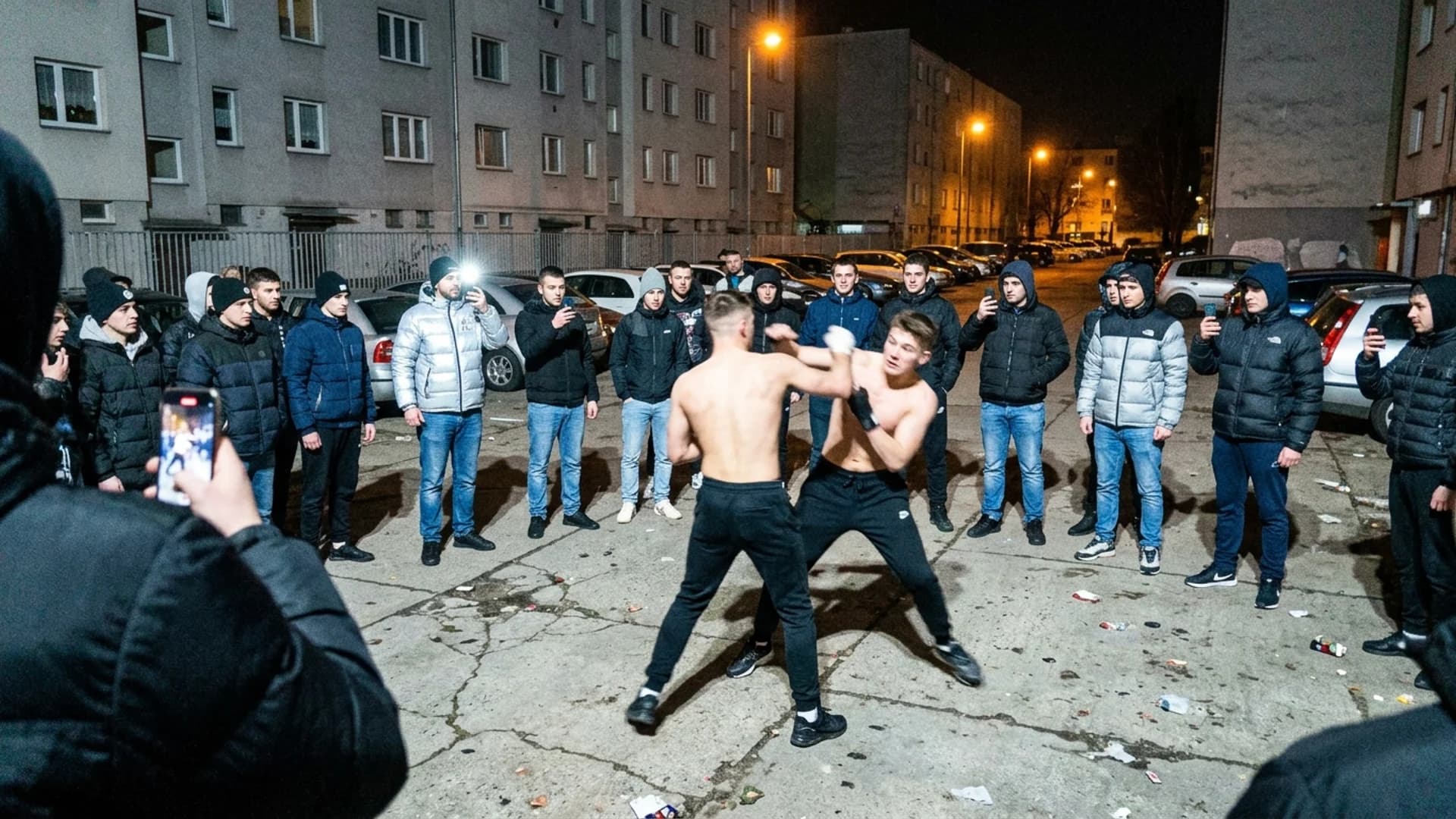
King of the Streets pays prize money to the winner of each bout only. The loser walks away with nothing. The promotion has never published a purse structure, and its organizers, the anonymous Hype Crew, do not disclose figures, so every reported amount is unconfirmed. What is documented is the model itself: a winner-takes-prize format on concrete, with no guaranteed show money.
King of the Streets, known as KOTS, has run unsanctioned bare-knuckle bouts out of Gothenburg, Sweden since 2013. It is one of the most-watched underground fighting channels in Europe, built on a stark visual signature: no ring ropes, no gloves, no rounds, no time limits, fights staged on the bare concrete of disused warehouses. That same starkness extends to its money. There is no commission filing, no athletic-board disclosure, and no press release that puts a number on what a KOTS winner takes home.
Pay Structure
The KOTS model is winner-takes-prize. Two fighters agree to a bout, they fight under the KOTS ruleset of no rounds and no time limits, and the prize money goes to whoever wins. There is no documented "show money," the guaranteed appearance fee that regulated promotions pay regardless of result. If a KOTS report of guaranteed pay exists, it has not been verified by the promotion.
This matters because it changes the math for a fighter completely. In a commission-regulated promotion such as BKFC, even a losing fighter on a prelim collects a base purse, often in the $2,500 to $5,000 range. A KOTS fighter who loses collects nothing for stepping onto the concrete. The risk profile is therefore far steeper: bare knuckles, no medicals on public record, and zero floor on the downside.
What Winners Earn
Here the honest answer is that the figure is undisclosed. KOTS has not published a winner's purse, and the Hype Crew's anonymity means there is no spokesperson putting numbers on record. Several points are worth stating plainly rather than guessing at:
- No official figure exists. Any specific dollar or krona amount circulating online is unconfirmed and not sourced to the promotion.
- The prize is bout-specific. Because matchups are arranged individually, the prize for a marquee grudge match almost certainly differs from a debut bout, but the spread is not documented.
- Production money is separate. KOTS earns from its large video audience. Whether, and how much, of that flows to fighters beyond the announced prize is not disclosed.
The cleanest summary: a KOTS winner earns a prize the promotion chooses not to publish, and a KOTS loser earns nothing.
How KOTS Pay Compares
Placing KOTS against its peers shows how unusual the winner-takes-prize model is, even inside the underground scene.
| Organization | Pay model | Loser earns | Figures published? |
|---|---|---|---|
| King of the Streets | Prize to winner only | Nothing | No |
| Streetbeefs | No pay at all | Nothing | N/A — pays no one |
| Top Dog FC | Purse-based | Yes (reportedly) | No official scale |
| BKFC | Flat purse, no win bonus | Yes (full purse) | Partially, via commissions |
Two things stand out. First, KOTS is harsher on the loser than a regulated promotion, where even a defeat carries a floor. Second, it is still more transactional than Streetbeefs, which pays its fighters nothing by design as the basis for operating legally in Virginia. KOTS at least rewards the winner; it simply does not say how much.
Sponsorship and Other Income
For a KOTS fighter, the prize is rarely the whole picture, and may not be the largest part of it. The promotion's reach gives recognizable fighters a platform, and several documented income paths sit outside the bout itself:
- Personal audience. A fighter who becomes a recurring KOTS name can build a social following and monetize it directly, independent of the promotion.
- Reputation in the wider bare-knuckle scene. A strong KOTS run can serve as a credential, opening bouts at other European promotions where pay terms may differ.
- Local sponsorship. Gyms, apparel makers, and combat-sport brands sometimes attach to visible underground fighters, though KOTS does not publish any sponsorship program.
None of these are guaranteed, and none are published as official KOTS revenue streams. They are the practical ways a fighter on the European underground circuit turns visibility into income when the prize money itself is undisclosed and the loser's share is zero.
Why the Secrecy
The opacity is not an accident; it is structural. KOTS operates in a legal grey zone. Unsanctioned bare-knuckle fighting sits outside Sweden's regulated combat-sport framework, and the organizers protect themselves through anonymity. Publishing a pay scale would create a paper trail and invite the regulatory and legal scrutiny the Hype Crew has avoided since 2013. The same logic that keeps the organizers faceless keeps the purse figures unpublished. For an encyclopedia of the underground scene, the absence of numbers is itself the finding, not a gap to be filled with invention.
For how the bouts actually run, the KOTS rules page covers the no-rounds, no-time-limit format that shapes the winner-takes-prize economics.
If you want the fighters who built the promotion's reputation, see the best KOTS fighters of all time. For how the bouts actually run, the KOTS rules page covers the no-rounds, no-time-limit format that shapes the winner-takes-prize economics.
How the Ruleset Shapes the Money
The winner-takes-prize model is not separable from the way KOTS bouts are fought. With no rounds and no time limits, a fight ends when one competitor can no longer continue. There is no decision, no judges' scorecard, and no draw to split a prize over. That structure forces a binary outcome, which is exactly what a winner-takes-prize purse needs: one fighter is unambiguously the winner, and the prize follows. A round-based, judged format would complicate that, because a close decision could leave both fighters feeling they earned the payout. KOTS sidesteps the problem by making the result definitive and the reward conditional on it.
It also raises the stakes in a way that a guaranteed purse never could. Because the loser earns nothing, every bout is, in financial terms, all-or-nothing. A fighter who gets stopped on the concrete has spent a training camp, taken real damage with bare knuckles, and walked away with no money. That asymmetry is part of what gives KOTS footage its intensity, and it is also why drawing conclusions about "average pay" is meaningless here. There is no average when half the participants in any given bout, by definition, earn zero.
What We Can and Cannot Say About KOTS Pay
For clarity, here is the line between documented and undocumented:
Documented:
- KOTS rewards the winner of a bout.
- The loser of a bout earns nothing.
- The promotion was founded in 2013 in Gothenburg and is run by the anonymous Hype Crew.
- Bouts use no rounds and no time limits, on bare concrete.
Not documented (any figure is unconfirmed):
- The amount of the winner's prize.
- Whether prizes differ by bout, and by how much.
- Whether any guaranteed appearance fee exists.
- How much of the promotion's video revenue, if any, reaches fighters.
Holding that line is the point of this page. In a niche this opaque, a number presented with false confidence is worse than an honest "undisclosed."
Frequently Asked Questions
How much do King of the Streets fighters make?
The exact amount is undisclosed. KOTS pays prize money to the winner of each bout and nothing to the loser, but the promotion has never published a purse figure. Any specific number circulating online is unconfirmed.
Do KOTS fighters get paid if they lose?
No. Under the winner-takes-prize model, only the winner of a bout collects. A fighter who loses earns nothing for competing, and there is no documented guaranteed appearance fee.
Does KOTS pay show money or a guaranteed purse?
There is no documented show money. Unlike commission-regulated promotions such as BKFC, where even a losing prelim fighter collects a base purse, KOTS has no published guaranteed pay.
Is KOTS prize money paid in cash?
The promotion does not disclose its payment method. Given that KOTS operates outside Sweden's sanctioned combat-sport framework and its organizers stay anonymous, payment details are not published.
Why doesn't KOTS publish fighter pay?
KOTS runs unsanctioned bouts in a legal grey zone, and its anonymous Hype Crew avoids creating records that invite regulatory scrutiny. Withholding pay figures is consistent with that secrecy.