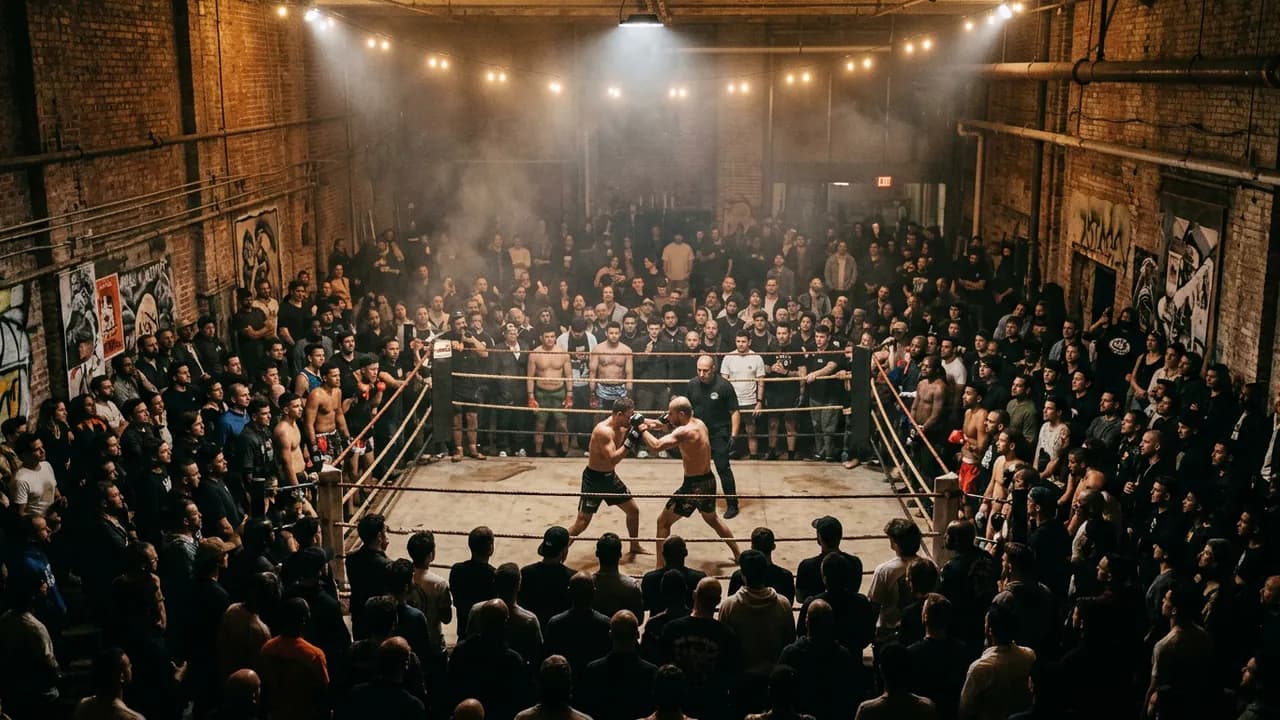
On a warm evening in August 2016, in a warehouse somewhere in the Bronx, the Underground Combat League held its final show. There was no announcement beforehand. No farewell tour. Peter Storm, the man who had founded the UCL in 2003 and kept it running through 13 years of police evasion, location changes, and legal grey areas, simply decided it was time. New York had legalized professional mixed martial arts three months earlier. The reason the UCL existed had evaporated.
For 13 years, the UCL was the only MMA game in New York City. When New York State banned professional mixed martial arts in 1997 -- making it the last state in the country to do so -- Storm refused to accept it. He built an unsanctioned vale tudo fighting league that operated in secret locations across the five boroughs: basements, warehouses, abandoned buildings, and occasionally rented event spaces where the proprietors were willing to look the other way.
The fighters who passed through the UCL's makeshift rings were not the kind who left detailed records behind. There were no official rankings, no sanctioned bout histories, and no television cameras. But these men and women kept the art of mixed martial arts alive in America's largest city during a period when the government said it could not exist there. This is what happened to them.
Peter Storm: The Quiet Retirement of an Underground Legend
Peter Storm is the most important person in the history of New York mixed martial arts who most MMA fans have never heard of. While Dana White was lobbying Albany politicians and UFC lobbyists were spending millions trying to overturn the state ban on professional MMA, Storm was actually doing it -- running unsanctioned fights in the streets and basements of the Bronx.
The UCL operated on an invitation-only basis. "You had to know Peter or he had to know you" was the standard description. Locations were communicated via text message, often changing at the last minute if Storm suspected police attention. Spectators and fighters alike arrived at locations disclosed only hours before the event. Celebrities were rumored to attend discreetly.
Since closing the UCL in 2016, Storm has maintained a remarkably low profile. He continues to teach martial arts in New York City, but the man who defied state law for 13 years has not launched any new fighting ventures. He has given occasional interviews reflecting on the UCL's legacy, but he has not sought the spotlight. In a world where every former promoter seems to be launching a podcast or a comeback organization, Storm's restraint is notable.
He remains one of the underground fighting scene's most respected figures, a man who chose principle over profit and who shut down his operation the moment its mission was accomplished.
The Fighters Who Had Nowhere Else to Go
Understanding the UCL fighters requires understanding why the UCL existed. New York's ban on professional MMA created a vacuum. Fighters living in the five boroughs or the surrounding tri-state area who wanted to compete in mixed martial arts had two options: travel out of state to find sanctioned events, or fight in the UCL.
Many chose Storm's league. The fighters were a diverse cross-section of New York City itself -- amateur martial artists, former boxers, street fighters looking for structure, gym rats who wanted to test themselves, and a smattering of semi-professionals who used the UCL to stay sharp while the legal landscape sorted itself out.
The format was vale tudo -- Portuguese for "anything goes." Rules were minimal. Fighters competed with limited protective equipment in environments that bore no resemblance to a sanctioned athletic commission event. The floor might be concrete. The "ring" might be a circle of spectators. Medical personnel, if present at all, were informal.
This was not a development league for future UFC fighters. This was survival fighting for a community that had been told by the state that their sport did not deserve to exist.
The Transition to Legal MMA
When Governor Andrew Cuomo signed Senate Bill S5949B on April 14, 2016, legalizing professional mixed martial arts in New York, it was treated as a triumph for the UFC and for the sport's mainstream advocates. The UFC immediately booked Madison Square Garden for UFC 205 in November 2016, headlined by Conor McGregor vs. Eddie Alvarez. The event was a blockbuster.
On the other hand, the UCL had been their community, their proving ground, and their identity.
For the UCL fighters, legalization was more complicated. On one hand, they could now compete in sanctioned events without traveling out of state. On the other hand, the UCL had been their community, their proving ground, and their identity. The transition from an invitation-only underground league to the structured world of state athletic commissions, medicals, licensing, and official records was not seamless for everyone.
Some UCL veterans applied for amateur or professional MMA licenses and entered the regional circuit in New York and New Jersey. A handful had the skills and records to attract attention from larger promotions. Most, however, found that the unsanctioned experience on their resumes carried little weight with matchmakers and promoters who operated in the sanctioned world.
The Fighters Who Disappeared
The UCL did not keep public records. Fights were not uploaded to YouTube in the organization's early years, and even when video evidence did emerge, it was sporadic and often low quality. This means that an entire generation of New York City mixed martial artists competed for over a decade with virtually no documentation of their efforts.
For many UCL fighters, the closure of the league in 2016 marked the end of their competitive careers. Without the UCL, there was no convenient, local outlet for their skills. Sanctioned amateur MMA required licensing, medicals, and registration -- barriers that the UCL had deliberately avoided. Professional MMA required even more.
Some of these fighters returned to their gyms and continued training recreationally. Others simply stopped. The UCL had been their arena, and when it closed, they walked away from fighting entirely. There is no database to track them, no social media trail to follow, and no promoter who maintained relationships after the doors shut.
This is perhaps the most poignant aspect of the UCL's legacy. An entire generation of fighters competed in the shadows, proved themselves in conditions that would terrify sanctioned athletes, and left no official record of their existence.
The Gym Scene That Survived
While the UCL itself did not survive legalization, the martial arts gym culture that sustained it in New York City very much did. The gyms where UCL fighters trained -- scattered across the Bronx, Brooklyn, Manhattan, and Queens -- continued to operate and in many cases thrived once legal MMA arrived.
Coaches who had quietly supported the UCL by training fighters for unsanctioned bouts could now openly promote their fighters in sanctioned events. The technical knowledge that had been developed in the underground was suddenly applicable in the legal world. New York's regional MMA scene, which barely existed before 2016, exploded in the years that followed, and the foundation for that explosion was built in large part by the same people who had kept MMA alive through the UCL.
Several New York-based gyms that had produced UCL fighters became feeder systems for regional promotions like Cage Fury Fighting Championships (CFFC), Ring of Combat, and Lou Neglia's Ring of Combat series. The connection is rarely acknowledged publicly, but the lineage is clear.
What the UCL Meant for the Underground Scene
The Underground Combat League was different from other underground fighting organizations in one critical respect: it existed out of necessity, not novelty. Streetbeefs was founded to prevent street violence. King of the Streets was founded for the thrill of no-rules combat. The UCL was founded because the government had made it illegal for people in New York to compete in the sport they loved.
That distinction matters because it shapes how we understand the fighters who competed there. UCL fighters were not seeking an underground experience. They were seeking the only experience available. Many of them would have gladly competed in sanctioned events if the option had existed. The underground was not romantic for them -- it was the only door that was open.
When legalization arrived, the UCL fighters who could transition to the sanctioned world did so willingly. They were not leaving the underground because they had outgrown it. They were leaving because the barrier that had forced them underground in the first place had been removed.
Peter Storm's Legacy in 2026
A decade after the UCL's final show, Peter Storm's contribution to New York combat sports remains largely unrecognized by the mainstream MMA media. The UFC celebrated the legalization of MMA in New York as a victory for lobbying and political activism. It was. But the sport survived in New York because Peter Storm refused to let it die.
For 13 years, the UCL was the underground railroad of New York MMA.
For 13 years, the UCL was the underground railroad of New York MMA. It kept the art form alive, gave fighters a place to compete, and maintained a community that the state had tried to disband. When legalization finally came, the infrastructure Storm had built -- the gym relationships, the fighter networks, the audience that had been attending underground shows for over a decade -- provided the foundation that New York's legal MMA scene was built upon.
Storm does not appear to seek credit for any of this. He taught martial arts before the UCL, during the UCL, and after the UCL. The fighting was the point, not the fame.
The UCL fighters are scattered now. Some are coaching in New York gyms. Some are competing on regional cards. Most have returned to civilian life, carrying the knowledge that they fought in America's most infamous unsanctioned fighting league during its most notorious era.
They do not have records. They do not have Wikipedia pages. But they have something that no sanctioned fighter can claim: they fought when fighting was illegal, in a city that told them they could not, for a promoter who told the city to go to hell.
Watch: Underground Combat League Footage
Rare footage from the 13-year underground MMA league that kept the sport alive in New York City when the government banned it.
- UCL -- Underground Combat League Fight Footage -- Rare video from Peter Storm's invitation-only vale tudo events in New York City basements and warehouses.
- Peter Storm Interview -- Running the UCL -- The founder of the UCL discussing 13 years of evading police, changing locations, and keeping MMA alive in NYC.
- UCL -- New York's Underground Fighting League -- Documentary coverage of the secret fighting events that operated across the five boroughs from 2003 to 2016.
- UFC 205 at Madison Square Garden -- The End of the Ban -- The first legal MMA event in New York, the moment that made the UCL's mission complete and led Storm to close the doors.
- New York MMA Before Legalization -- How the UCL and underground fighting filled the void during New York's 19-year ban on professional mixed martial arts.
For more on Peter Storm and the UCL, see our Underground Fighting Legends profile. For the fighters who moved into the sanctioned bare knuckle world, see Early BKFC Fighters.