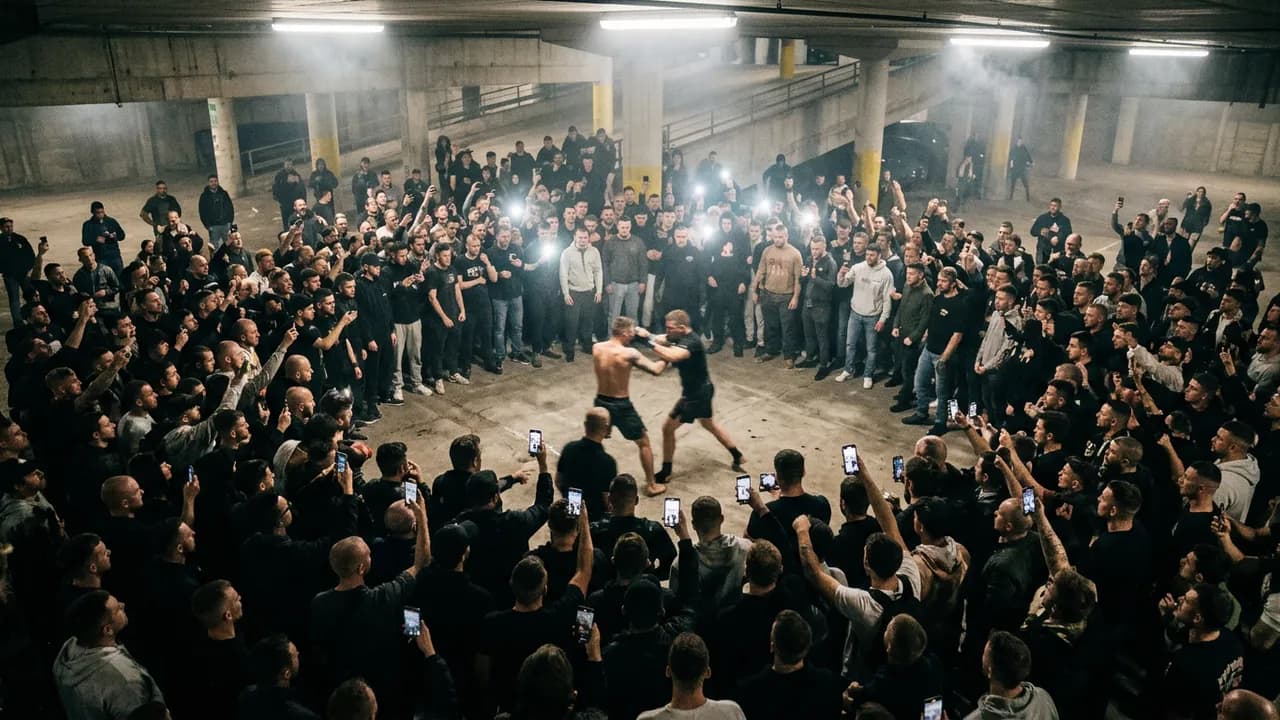
King of the Streets emerged from Denmark with a format that stripped fighting down to its most elemental form. No gloves. No rounds in the traditional sense. No weight classes. Two people in a confined space, throwing hands until one of them could not continue. The Danish promotion built its brand on this brutal simplicity, and the fighters who showed up for those early events knew exactly what they were signing up for.
The first generation of KOTS fighters came from every conceivable background -- street fighters, gym veterans, MMA hopefuls, and a few genuine unknowns who simply wanted to test themselves in the most unforgiving format available. What united them was a willingness to fight under conditions that most sanctioned combat sports considered unthinkable.
Some of those original fighters became underground celebrities. Others fought once and vanished. This is where they ended up.
Simon Henriksen: The Quiet Technician
Simon Henriksen was not the loudest personality on early KOTS cards, but he was one of the most effective fighters. In a format that rewarded raw aggression, Henriksen brought a measured, technical approach that often caught opponents off guard. He could box, he could brawl, and he had the defensive awareness to survive the kind of chaotic exchanges that the KOTS format inevitably produces.
Henriksen's fights were studies in controlled violence. Where other KOTS competitors charged forward and hoped for the best, Henriksen picked his shots, managed distance, and exploited openings with a patience that suggested formal training. His performances earned respect from the KOTS community and demonstrated that skill could triumph over pure aggression even in a no-rules environment.
As of 2026, Henriksen has maintained a presence in the Scandinavian combat sports scene. His KOTS career established him as a credible fighter in one of the toughest formats available, and that reputation has carried forward into his post-KOTS endeavors. Whether training others or competing in different formats, the technical foundation he displayed in the KOTS ring has remained his defining characteristic.
M16: The Name That Defined KOTS Violence
M16 was the fighter who embodied what King of the Streets was selling. Aggressive, relentless, and willing to absorb extraordinary punishment in order to deliver his own, M16 became one of the promotion's most recognizable figures through sheer force of will.
The fighting name was not subtle, and neither was the fighting style. M16 came forward in straight lines, threw heavy punches, and dared opponents to stand in front of him. In the KOTS format, where rounds are short and the pace is frantic, this approach was devastatingly effective. Opponents who tried to outbox him found themselves overwhelmed by the pressure. Opponents who tried to match his aggression found themselves outgunned.
M16's highlight reel from early KOTS events became some of the most-shared content from the promotion's YouTube channel. His fights generated the kind of visceral reactions that drive view counts -- gasps, replays, comment section debates about whether what they had just witnessed was brave or insane.
Post-KOTS, M16's trajectory has followed a path common to underground fighters who build their reputation on intensity rather than technique. The physical toll of fighting without gloves, without weight classes, and without the protective infrastructure of sanctioned competition accumulates quickly. M16's later appearances showed a fighter dealing with the consequences of his style -- damaged hands, accumulated head trauma, and the gradual erosion of the physical tools that made him dangerous in the first place.
Axel Ghost: The Enigmatic Hitter
Axel Ghost brought an aura to KOTS events that few fighters could match. Part of it was the name. Part of it was the demeanor -- calm, almost detached, as if the violence about to unfold was merely a professional obligation rather than an emotional experience. But most of it was the punching power.
Ghost hit hard. In a format where exposed knuckles make every clean punch potentially fight-ending, his power was a legitimate weapon of mass destruction. Opponents who took clean shots from Ghost did not recover gracefully. They folded, stumbled, or simply stopped moving -- the kind of instant stoppages that make bare knuckle fighting simultaneously horrifying and impossible to look away from.
His early KOTS career was defined by these moments of sudden, decisive violence. Ghost did not need to win rounds or accumulate points. He needed one clean shot, and the format gave him ample opportunity to find it.
As of 2026, Ghost has largely stepped back from active competition.
As of 2026, Ghost has largely stepped back from active competition. The bare knuckle world is not kind to aging fighters, and the style that made Ghost famous -- patient, power-based, dependent on timing and hand speed -- is among the first to deteriorate as the body ages. His KOTS legacy, however, remains intact as one of the hardest single-shot punchers the promotion has ever featured.
The Danish Street Fighting Pipeline
Early KOTS fighters were drawn from a surprisingly deep pool of Danish and Scandinavian combat sports talent. Denmark's martial arts culture -- encompassing boxing, kickboxing, MMA, and wrestling -- provided KOTS with fighters who had genuine technical backgrounds. This was not a promotion pulling people off the street. Many of its early competitors had years of gym training and, in some cases, professional fighting experience.
What KOTS offered that the sanctioned world did not was a format that stripped away the safety mechanisms. No judges' scorecards to fall back on. No referee standing ready to stop the action at the first sign of trouble. No gloves to protect the hands or cushion the impact. Fighters who were comfortable in this environment revealed something about themselves that a boxing ring or MMA cage could not expose.
Several early KOTS fighters went on to compete in other European underground promotions, carrying their KOTS experience into formats like Strelka, Top Dog FC, and various UK bare knuckle events. The cross-pollination between European underground promotions created a circuit of sorts -- a fighter could build a reputation in KOTS, test himself in Strelka's sand circle, and then compete in a Top Dog warehouse, all within a few months.
The Ones Who Disappeared
For every Simon Henriksen or M16, there were five fighters who appeared on one or two early KOTS cards and were never seen again. This is the nature of underground fighting. There are no contracts binding fighters to promotions. There are no development deals or option clauses. A fighter shows up, competes, and decides whether to come back.
Many chose not to. The KOTS format is extraordinarily demanding -- physically, psychologically, and in terms of recovery time. Bare knuckle fights produce hand injuries that can take months to heal properly. Facial lacerations are common. The absence of weight classes means that a 180-pound fighter might find himself across from someone with a 40-pound advantage. For fighters who were testing the waters rather than building careers, one KOTS experience was sufficient data to conclude that the format was not for them.
Some of these one-and-done fighters returned to sanctioned competition. Others left fighting entirely. A few have surfaced on social media over the years, occasionally referencing their KOTS experience with a mixture of pride and disbelief that they actually did it.
KOTS in the European Underground Ecosystem
King of the Streets occupies a distinctive position in the European underground fighting landscape. Unlike Top Dog FC, which invested heavily in production value and YouTube optimization, or Strelka, which built its brand on the iconic sand circle format, KOTS kept things raw. The production was functional rather than cinematic. The focus was on the fighting itself, not the packaging.
This approach attracted a specific type of fighter -- one who wanted to test himself in the purest possible format without the distractions of theatrical presentation. The early KOTS roster reflected this self-selection: serious fighters who respected the format and approached it with the gravity it deserved.
The promotion's influence on the broader European underground scene has been significant. KOTS demonstrated that there was an audience for no-rules fighting in Scandinavia, a region not traditionally associated with underground combat sports. Its success opened doors for other Scandinavian promotions and contributed to the growing acceptance of bare knuckle and underground fighting across Northern Europe.
Legacy of the First Generation
The original KOTS fighters proved something that the combat sports world was still debating when the promotion launched: that bare knuckle, no-weight-class fighting could be organized, marketed, and sustained as an ongoing operation rather than a one-off spectacle.
Simon Henriksen showed that technique matters in any format. M16 demonstrated that pure aggression has its own kind of beauty. Axel Ghost proved that one-punch power is the great equalizer. Together with the dozens of other fighters who competed on those early cards, they built a promotion that endures.
Wherever the original KOTS fighters are now -- still training, retired, coaching, or simply living their lives -- they carry the distinction of having fought in one of the rawest formats in modern combat sports history. In an era of increasing regulation and safety protocols, KOTS offered something primal. The fighters who answered that call deserve to be remembered for it.
Watch: KOTS Fighter Highlights
The no-rules, no-weight-class fighting that made King of the Streets one of Europe's most unforgiving underground promotions.
- King of the Streets Official Channel -- The official KOTS YouTube channel featuring bare knuckle fights from Denmark's most raw underground promotion.
- KOTS Best Knockouts Compilation -- The most devastating finishes from King of the Streets events, where exposed knuckles make every punch fight-ending.
- M16 -- KOTS Fight Highlights -- The fighter who embodied KOTS violence, walking forward and throwing bombs until opponents broke.
- Simon Henriksen vs Top KOTS Opponents -- The quiet technician who proved skill could beat aggression even in a no-rules format.
- Axel Ghost -- One Punch Power in KOTS -- The enigmatic hitter whose single-shot knockout power made him one of the most feared fighters in the promotion.
- KOTS -- What Bare Knuckle Fighting Looks Like in Denmark -- An introduction to the Danish underground scene and the format that strips fighting to its most elemental form.
For more on King of the Streets, see our KOTS organization profile. For profiles of individual KOTS fighters, visit Simon Henriksen, M16, and Axel Ghost.