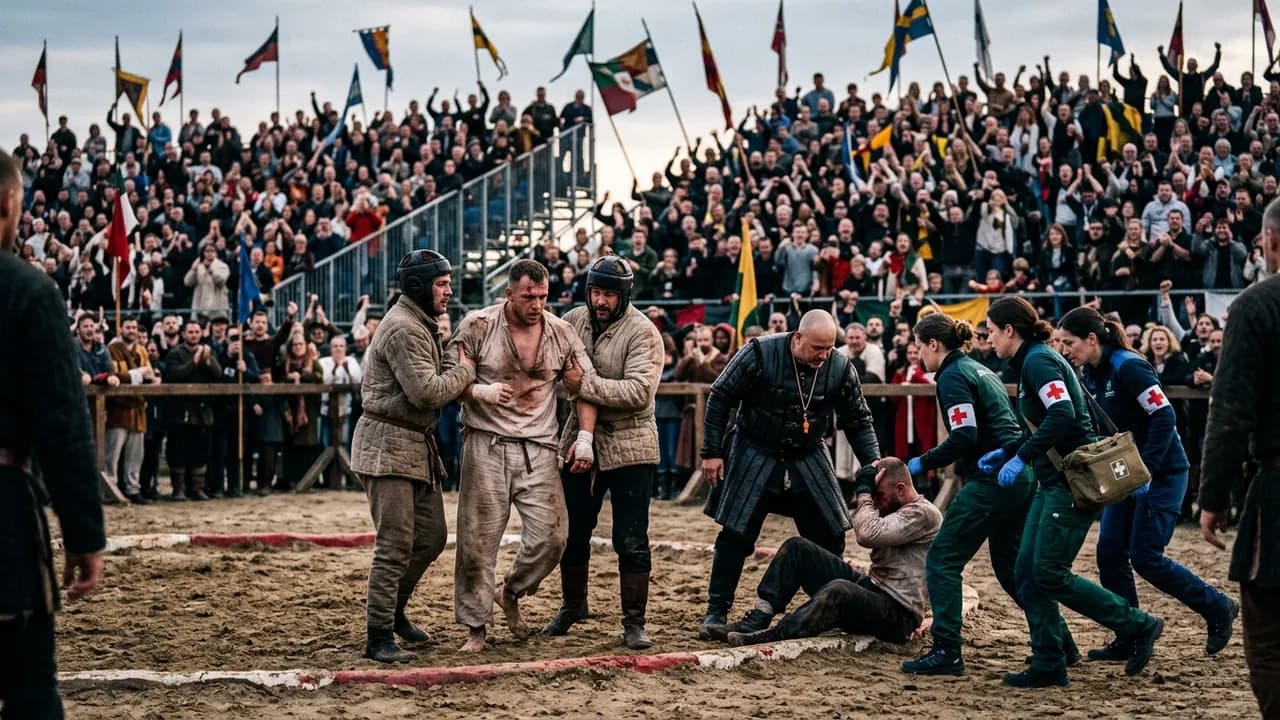
Calcio Storico is not underground fighting in the conventional sense. It is older than that. Far older. The game -- part rugby, part soccer, part bare knuckle boxing, part organized chaos -- has been played in Florence, Italy, since the 16th century. Every June, in the Piazza Santa Croce, four teams representing Florence's historic quarters compete in a tournament that makes every other combat sport look civilized by comparison.
Twenty-seven players per side. A sand-covered pitch. A ball that must be placed in the opposing team's net. And between the goals: almost anything goes. Punching, kicking, wrestling, choking -- the rules prohibit sucker punches and kicks to the head, but enforce little else. The result is fifty minutes of continuous, team-based violence that produces injuries ranging from broken noses to torn ligaments to the occasional fractured skull.
The players who compete in Calcio Storico are not paid professionals. They are Florentines -- men born in the city's quarters who represent their neighborhoods with a pride and ferocity that has survived half a millennium of history. The legends of this sport occupy a unique position in the fighting world: revered locally, virtually unknown globally. This is where some of them are now.
The Quartiere Champions: Heroes of the Neighborhoods
Each of Florence's four quarters -- Santa Croce (Azzurri/Blues), Santa Maria Novella (Rossi/Reds), Santo Spirito (Bianchi/Whites), and San Giovanni (Verdi/Greens) -- has produced legendary players whose names are spoken with reverence in the streets where they grew up. These are not household names outside of Florence. Inside the city, they are royalty.
The greatest Calcio Storico players typically competed for a decade or more, starting in their late teens or early twenties and continuing until their bodies could no longer absorb the punishment that the game demands. During their active years, they were the most visible representatives of their quarters -- celebrities in a city that takes neighborhood identity as seriously as any place on earth.
After retirement from the game, these players are absorbed back into Florentine life. They run businesses in their quarters, work in the trades, or simply live as respected members of their communities. The local fame they earned on the sand pitch does not translate into wealth or national celebrity. It translates into something more intimate: the knowledge that their neighbors saw them fight for the quarter and will remember it for the rest of their lives.
The Calcianti: Life After the Sand
The players of Calcio Storico are called "calcianti," and their post-playing lives reflect the diverse backgrounds from which the game draws its participants. Unlike professional athletes in mainstream sports, calcianti have always maintained careers outside of the game. There are no contracts, no salaries, and no off-season training facilities. Players hold regular jobs and train for the tournament in the months leading up to the June matches.
Former calcianti can be found throughout Florence's workforce. They are construction workers, restaurateurs, mechanics, shopkeepers, and civil servants. Their Calcio Storico careers are a part of their identities -- often the most dramatic and physically demanding part -- but they are not the whole of their identities. The game is played for the quarter, not for personal advancement.
This dual existence means that "retirement" from Calcio Storico is not the life-altering transition that it is in professional sports. A calciante who stops playing simply continues the life he was already living, minus the annual ritual of violence in the Piazza Santa Croce. The adjustment is physical -- the body no longer takes the punishment -- but the social and economic impact is minimal.
The Fighters: Calcio Storico's Combat Specialists
Within each Calcio Storico team, certain players are designated as fighters rather than ball handlers. Their role is explicitly martial: to neutralize opposing players through physical combat so that their teammates can advance the ball. These fighters are the closest thing Calcio Storico has to traditional combat sports athletes, and their skills often reflect formal training in boxing, wrestling, or MMA.
The legendary fighters of Calcio Storico are the players most likely to have crossed paths with the broader fighting world. Some have trained in boxing gyms and MMA facilities alongside competitive fighters. Others have competed in amateur boxing or regional MMA events. The crossover is natural: the skills that make a great Calcio Storico fighter -- striking power, wrestling ability, pain tolerance, aggression -- are the same skills that combat sports reward.
A few have competed in bare knuckle or MMA events outside of Italy, though these crossover appearances have been the exception rather than the rule.
Former Calcio Storico fighters have occasionally been recruited by combat sports promotions looking to capitalize on their reputation for toughness. A few have competed in bare knuckle or MMA events outside of Italy, though these crossover appearances have been the exception rather than the rule. Most former fighters prefer to keep their fighting within the tradition that produced it, viewing Calcio Storico as something fundamentally different from commercial combat sports.
The Injuries: What Calcio Storico Takes
Calcio Storico legends carry their history in their bodies. The game inflicts a specific pattern of damage that reflects its unique combination of combat and athletics. Knee and ankle injuries from the sand surface are endemic. Hand and wrist fractures from bare knuckle striking are common. Concussions from punches, kicks, and collisions are frequent. The cumulative effect of a decade or more of annual tournaments is a body that functions but protests.
Former players speak openly about the physical toll. Some walk with visible limps. Others have restricted range of motion in joints that were damaged on the sand. The chronic pain of post-Calcio Storico life is accepted as part of the bargain -- the price of representing the quarter in a game that has been played this way for five hundred years.
Medical care for Calcio Storico injuries has improved significantly over the decades. Modern tournaments include medical staff and emergency services that would have been unimaginable in earlier eras. But the game itself has not been softened. The same impacts, the same bare knuckle strikes, and the same full-contact collisions that injured players in the 17th century continue to injure players in the 21st.
The Controversies: Bans, Suspensions, and Exile
Calcio Storico has a history of incidents that have resulted in individual players being banned from the tournament. In 2006, the tournament was suspended entirely after a match degenerated into a mass brawl that exceeded even Calcio Storico's generous definition of acceptable violence. The suspension lasted until 2008, and the incident led to rule reforms that attempted -- with limited success -- to distinguish between the game's inherent violence and gratuitous brutality.
Players who were banned or suspended from the tournament experienced a form of exile that is difficult to understand outside of Florentine culture. To be denied the right to represent your quarter in the Piazza Santa Croce is not merely a sporting penalty. It is a social one -- a public statement that you crossed a line in a game that barely acknowledges lines exist.
Former banned players have had various post-ban trajectories. Some served their suspensions and returned to the game, their reputations complicated but not destroyed. Others accepted permanent exile and withdrew from the Calcio Storico community entirely. A few became coaches or advisors to their quarter's teams, contributing their knowledge without stepping onto the sand.
The Next Generation: Legends as Mentors
The most enduring contribution of Calcio Storico legends is the role they play in transmitting the tradition to the next generation. In a game without professional coaching structures or formal academies, knowledge is passed down through direct mentorship -- older players teaching younger ones the unwritten rules, the tactical principles, and the psychological preparation that the game demands.
Former legends who serve as mentors occupy a position of significant influence within their quarters. They select which young men will represent the team. They teach the fighting techniques that are specific to Calcio Storico's unique format. They instill the neighborhood pride that transforms an athletic competition into something closer to a cultural ritual.
This mentorship function ensures that Calcio Storico legends are never truly retired. Their playing careers end, but their influence on the game continues through every player they train and every match they help prepare. The tradition survives because the men who lived it pass it on.
A Sport That Outlasts Its Players
Calcio Storico has survived wars, plagues, political upheaval, and five centuries of history. It will outlast every player who has ever stepped onto the sand in the Piazza Santa Croce. The legends of the game know this. They know that their individual contributions -- however dramatic, however celebrated in their neighborhoods -- are small chapters in a story that began long before them and will continue long after.
07 / Up next / Watch: Calcio Storico Match Footage
This perspective gives Calcio Storico legends a relationship with their sport that is fundamentally different from fighters in modern promotions. A BKFC champion builds a personal brand. A Calcio Storico legend builds a quarter's tradition. The former is measured in followers and purses. The latter is measured in centuries.
Wherever the legends of Calcio Storico are now -- limping through the streets of their quarters, mentoring the next generation, or simply watching the June tournament from the stands with the satisfaction of men who have done their part -- they belong to something older and larger than any individual career. That belonging is the truest legacy any fighter can claim.
Watch: Calcio Storico Match Footage
Florence's brutal 500-year-old sport captured on film -- 27 vs 27 on the sand of the Piazza Santa Croce.
- Calcio Storico -- Full Match Highlights -- Complete highlights from the annual tournament in Florence's Piazza Santa Croce, showing the full chaos of the 54-player format.
- Calcio Storico 2023 Final -- Azzurri vs Rossi -- The most recent major tournament final between Florence's historic quarters, featuring the game's signature combination of rugby, boxing, and war.
- What Is Calcio Storico? The Most Violent Sport in the World -- An introduction to the rules (or lack thereof), history, and cultural significance of Florence's ancient fighting sport.
- Calcio Storico -- The Fighters (Calcianti) -- Profiles of the combat specialists whose role is to neutralize opponents through bare knuckle striking and wrestling.
- Calcio Storico Best Fights and Knockouts -- The most brutal individual confrontations within the team format, where punching, kicking, and wrestling are all permitted.
- Inside Florence's Calcio Storico -- Vice Documentary -- An in-depth documentary exploring the neighborhood pride, ancient traditions, and modern violence of the Piazza Santa Croce.
For more on Calcio Storico's history and rules, see our Calcio Storico organization profile. For another unique fighting tradition, read Where Are They Now: Women Who Pioneered Underground Fighting.