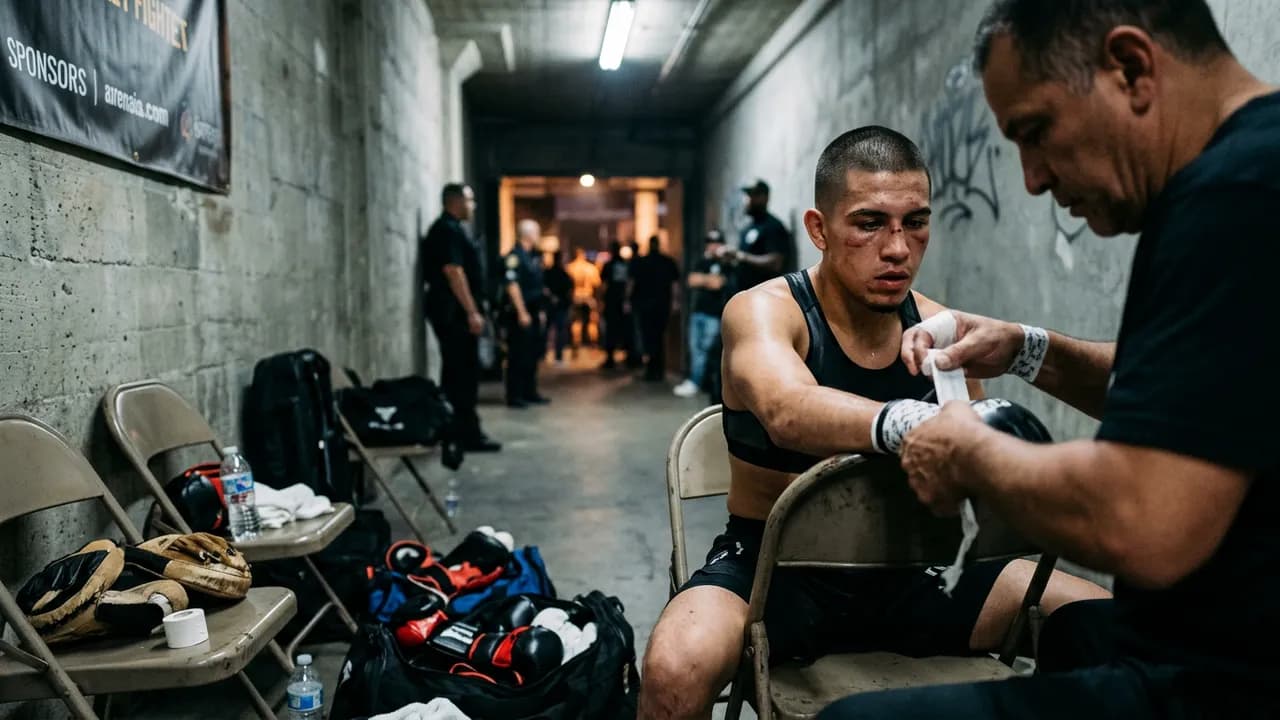
Backyard Squabbles was never just about fighting. When the promotion emerged from the streets of Los Angeles with its "Guns Down, Squabble Up" philosophy, it carried a social mission that elevated it beyond spectacle. In a city where gang violence had claimed generations of young lives, Backyard Squabbles offered an alternative: settle your disputes with fists instead of firearms. Fight, shake hands, walk away alive.
The fighters who built Backyard Squabbles came from the neighborhoods that the promotion was trying to save -- South Central, Compton, Watts, Inglewood, and communities across LA County where gun violence was not an abstraction but a daily reality. They fought in backyards, parking lots, and open spaces with cameras rolling and crowds pressing in. The fights were raw. The emotions were real. And the underlying message -- that violence could be redirected into something survivable -- gave the promotion a moral weight that pure entertainment operations lack.
This is where those fighters are now.
Albert "Black Blade" Marion: The Face of the Movement
Albert "Black Blade" Marion became Backyard Squabbles' most visible fighter -- not just for his fighting ability, but for his embodiment of the promotion's ethos. Marion was a competitor who understood that Backyard Squabbles was bigger than any individual fight. His performances were fierce but disciplined, aggressive but controlled. He fought to win, but he also fought to demonstrate that winning a fist fight was preferable to the alternative that waited on the streets outside the yard.
Black Blade's fighting style combined street-honed instincts with enough technical polish to suggest formal training. He was dangerous on his feet, composed under pressure, and possessed the kind of charisma that made him a natural ambassador for the Backyard Squabbles brand. His fights generated significant view counts on social media platforms, and his reputation within LA's underground fighting community grew with each appearance.
As of 2026, Marion has maintained his connection to the Backyard Squabbles community and the broader LA fighting scene. His role has evolved from active competitor to advocate and mentor, using the platform that his fighting career built to amplify the "Guns Down, Squabble Up" message to new audiences. Whether or not he continues to compete, his contribution to the movement extends well beyond his fight record.
Hector "Aztec Warrior" Herrera: LA's Underground Warrior
Hector "Aztec Warrior" Herrera brought a different energy to Backyard Squabbles -- one rooted in cultural pride and a fighting spirit that drew from both Mexican boxing tradition and the street fighting culture of LA's Latino communities. The Aztec Warrior moniker was not just a fighting name. It was a statement of identity, connecting his backyard battles to a warrior tradition that predated the city, the state, and the country.
Herrera's fighting style reflected this dual heritage. His boxing fundamentals -- likely developed in one of LA's many Mexican-style boxing gyms -- gave him a technical foundation, while his street experience gave him the adaptability and toughness that the Backyard Squabbles format demanded. He could box when boxing was called for and brawl when brawling was unavoidable.
As of 2026, Herrera has continued to be involved in LA's combat sports community. His Backyard Squabbles career established him as a recognized figure in the city's underground scene, and that recognition has opened doors to training, coaching, and the kind of community engagement that keeps fighters connected to the neighborhoods that produced them.
The Gang Intervention Connection
Backyard Squabbles' "Guns Down, Squabble Up" philosophy aligned it with LA's broader gang intervention movement -- the network of organizations, activists, and former gang members working to reduce gun violence in the city's most affected communities. Some Backyard Squabbles fighters were themselves active in gang intervention work, using the promotion as a tool for deescalation and conflict resolution.
These fighters occupied a unique position. They were violent enough to be credible -- no one in the communities they served would dismiss a Backyard Squabbles fighter as soft or naive. But they were also disciplined enough to model an alternative -- proving that aggression could be expressed without lethal weapons and that disputes could be resolved without body counts.
Former Backyard Squabbles fighters who were involved in gang intervention work have, in many cases, continued that work in 2026. The promotion gave them a platform and a narrative -- "we settle it with hands, not guns" -- that resonated in communities where traditional anti-violence messaging often fell flat. The credibility they earned in the yard translated into credibility on the streets, and they leveraged both to save lives.
The Social Media Stars: YouTube to the Streets
Backyard Squabbles built its audience through social media, primarily YouTube and Instagram. The promotion's video content -- professionally shot, well-edited, and narratively structured -- attracted millions of views and built a national audience for what was essentially a local LA phenomenon. The fighters who appeared in these videos became social media celebrities, their clips shared, commented on, and compiled into highlight reels that circulated across platforms.
A few transitioned to content creation, building channels and brands around their fighting personas.
Some of these social media stars leveraged their visibility into broader careers. A few transitioned to content creation, building channels and brands around their fighting personas. Others attracted attention from professional promotions -- regional MMA organizations, boxing promoters, and bare knuckle operations that saw in Backyard Squabbles fighters a combination of talent and built-in audience.
The transition from social media fame to professional fighting career has been uneven. Fighters with genuine technical skill sometimes succeeded in sanctioned competition. Others found that the controlled chaos of a backyard fight and the structured environment of a sanctioned bout require fundamentally different skill sets. The ones who treated Backyard Squabbles as a stepping stone rather than a destination had the best outcomes.
The Community Impact: More Than Fighting
The most significant legacy of Backyard Squabbles alumni may not be their fight records but their community impact. In neighborhoods where violence was endemic, the promotion created spaces where conflict could be expressed physically without the permanence of gunfire. Every fight that ended with a handshake instead of a shooting was a small victory for the communities that hosted these events.
Former fighters speak about Backyard Squabbles in terms that extend beyond personal achievement. They talk about the people who did not get shot. The disputes that were settled in the yard instead of on the block. The young men who came to watch and left with a different understanding of what toughness looks like -- not the cowardice of pulling a trigger from a passing car, but the courage of standing face to face with an opponent and resolving the conflict with your own hands.
This community impact is impossible to quantify. There are no statistics for shootings that did not happen, for lives that were not lost, for cycles of retaliation that were not triggered. But the fighters who made Backyard Squabbles what it was believe -- with good reason -- that the promotion saved lives. That belief is itself a form of legacy that transcends any fight record.
The LA Underground Ecosystem
Backyard Squabbles existed within a broader LA underground fighting ecosystem that includes boxing gyms, MMA facilities, informal backyard operations, and a street fighting culture that reflects the city's diverse communities. Fighters who competed in Backyard Squabbles often had connections to this broader ecosystem -- training in gyms, competing in other informal events, and maintaining relationships across the city's various fighting communities.
As of 2026, this ecosystem continues to operate. New promotions have emerged alongside Backyard Squabbles, and the pipeline from backyard to gym to professional competition is more established than ever. Former Backyard Squabbles fighters who entered this pipeline have emerged at various points along it: some as professional fighters, some as trainers, some as promoters, and some as the coaches who prepare the next generation of LA fighters for whatever format they choose.
The city's underground fighting culture is resilient, sustained by the same conditions that created it -- economic inequality, community tension, and the universal human desire to know what you are made of. Backyard Squabbles gave that desire a name, a format, and a moral framework. The alumni who carried that framework forward have ensured that "Guns Down, Squabble Up" is more than a slogan. It is a legacy.
Where the Movement Goes From Here
The "Guns Down, Squabble Up" philosophy that Backyard Squabbles popularized has spread beyond LA. Similar promotions and movements have emerged in other cities, each adapting the core message to their local context. The idea that organized fighting can serve as violence prevention -- an idea that Streetbeefs pioneered in Virginia and Backyard Squabbles amplified in California -- has become a recognizable framework in communities affected by gun violence.
The alumni of Backyard Squabbles who are still active in this movement carry it forward with the authority of people who lived it. They fought. They survived. They demonstrated an alternative. And wherever they are now -- still fighting, coaching, advocating, or simply living in the neighborhoods they helped make safer -- they represent proof that the concept works.
Not every Backyard Squabbles fighter became a professional. Not every fight ended cleanly. Not every participant was transformed by the experience. But the cumulative effect of hundreds of fights resolved with fists instead of guns, in a city where the alternative was always available and always tempting, is a legacy that no fight record can capture.
Watch: Backyard Squabbles Fight Clips
LA's "Guns Down, Squabble Up" movement captured on camera -- the fights that offered an alternative to gun violence.
- Backyard Squabbles -- Best Fights Compilation -- The most intense bouts from LA's underground fighting movement, featuring fighters from South Central, Compton, and Watts.
- Black Blade (Albert Marion) -- Backyard Squabbles Highlights -- The face of the Backyard Squabbles movement demonstrating the controlled aggression that made him the promotion's ambassador.
- Aztec Warrior (Hector Herrera) -- BS Fight Footage -- Mexican boxing tradition meets LA street culture in the backyard ring.
- "Guns Down, Squabble Up" -- Backyard Squabbles Documentary -- How the promotion's anti-gun violence mission transformed neighborhoods across Los Angeles.
- Backyard Squabbles vs Streetbeefs -- Two Movements Compared -- How LA and Virginia built parallel movements using fists instead of firearms to settle disputes.
- LA Underground Fighting Scene -- The broader ecosystem of backyard fighting in Los Angeles that produced the Backyard Squabbles movement.
For more on Backyard Squabbles' history and mission, see our Backyard Squabbles organization profile. For the Virginia counterpart of the "fists not guns" movement, read Where Are They Now: Notable Streetbeefs Fighters.