King of the Ring is the UK's fastest-growing grassroots fighting brand, operating out of Manchester under the motto "Put Down the Knife, Use Your Left and Right." Founded in 2021 by a former Muay Thai fighter known as Remdizz, KOTR started in a back garden with a homemade ring and has grown into a social media phenomenon with millions of views across YouTube and TikTok. Its mission is explicit and urgent: counter youth knife violence, which has risen by approximately 200% in Manchester in recent years, by providing a controlled environment where disputes can be settled with fists instead of blades.
KOTR's rules reflect this mission. They are simple, accessible, and designed to minimize serious injury while still providing a genuine competitive experience. Understanding the format explains why KOTR has resonated so powerfully in a city where young men are killing each other with knives.
The Ring: Foam-Wrapped Fence Posts
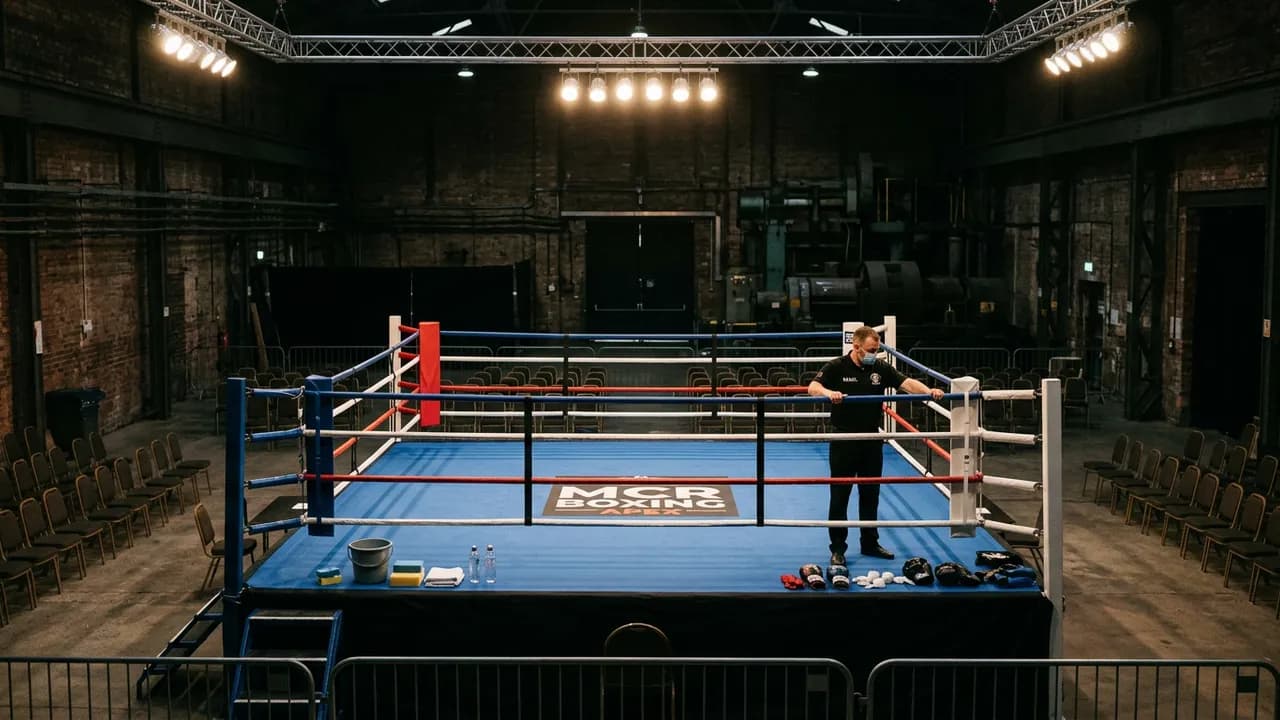
KOTR's original ring was constructed from fence posts wrapped in foam padding and connected with construction tape or rope. This improvised setup -- clearly homemade, visibly rough around the edges -- became part of the brand's identity. The ring looked like something assembled in a garden because it was assembled in a garden.
As KOTR has grown, the ring has been upgraded to more professional outdoor configurations, but the aesthetic remains deliberately informal. The ring is set up outdoors at rotating secret locations around Manchester, with postcodes sent to attendees by text message in the days before an event. The exact location is not disclosed publicly in advance.
The foam wrapping on the ring posts serves a functional safety purpose. In professional boxing, ring posts are padded to prevent injury when a fighter is pushed into them. KOTR's foam wrapping achieves the same goal with improvised materials. A fighter driven back into a foam-wrapped fence post absorbs less impact than one driven into an unpadded metal post, which could cause cuts, bruising, or structural injuries.
The outdoor setting means fights take place on whatever surface is available at the chosen location -- typically grass or hard ground. The ring provides a defined fighting area, which is important: unlike KOTS, where spectators form the boundary and the fighting space is amorphous, KOTR fighters compete within a clearly marked enclosure.
Round Structure: 3 Rounds x 1 Minute
KOTR fights follow a standard format:
- 3 rounds
- 1 minute per round
- Brief rest periods between rounds
The one-minute round is the shortest standard round length in any major fighting organization. For comparison:
| Organization | Round Length | Number of Rounds |
|---|---|---|
| KOTR | 1 minute | 3 |
| Rough N Rowdy | 1 minute | 3 |
| BKFC | 2 minutes | 5 |
| Top Dog | 2 minutes | 3 (regular) / 5 (championship) |
| Professional Boxing | 3 minutes | 4-12 |
The short round length is a deliberate design choice that serves multiple purposes. First, it keeps fights brief, which reduces the total damage absorbed by fighters. A three-round, one-minute-per-round bout means a maximum of three minutes of fighting time -- less than a single round in professional boxing or MMA. Second, it accommodates fighters with limited conditioning. Many KOTR participants are not trained athletes. They are young men from Manchester's communities who may have never been in a structured fight before. A one-minute round is long enough to produce action but short enough that poor cardio does not become dangerously relevant. Third, it creates an urgent, high-energy format where fighters know they have limited time to make an impression.
The three-minute total fight time means that KOTR fights are overwhelmingly decided by aggression and volume rather than strategy and technical precision. There is no time for a long-term game plan. The fighter who throws more punches and pushes the pace typically wins.
Boxing Gloves
KOTR fighters wear standard-size boxing gloves. This is a significant safety measure that differentiates KOTR from bare-knuckle organizations like KOTS, Top Dog, BKFC, and Mahatch.
Boxing gloves distribute the force of impact across a larger surface area, which reduces the likelihood of cuts and facial fractures compared to bare-knuckle strikes. They also protect the fighter's hands from fractures, which means fighters can throw with more power and less concern about breaking their metacarpals on an opponent's skull.
03 / Up next / Allowed Techniques: Primarily Boxing
The use of boxing gloves aligns KOTR with organizations like Rough N Rowdy and Streetbeefs (which uses boxing gloves for boxing-format fights) and positions it closer to the regulated end of the underground fighting spectrum. A KOTR bout looks and functions more like an amateur boxing match than a street fight, which is consistent with the organization's goal of providing a controlled alternative to knife violence.
Allowed Techniques: Primarily Boxing
KOTR fights operate under primarily boxing rules:
Allowed:
- Punches to standard boxing targets (waist to top of head)
- Standing fighting only
Banned:
- Kicks
- Knees
- Elbows
- Headbutts
- Ground fighting
- Grappling and wrestling
The emphasis on standing boxing with gloves makes KOTR one of the most technique-restricted organizations in the underground fighting landscape. This is intentional. The organization is not trying to create the most permissive or exciting ruleset -- it is trying to create the safest possible environment in which young men can settle disputes and prove themselves physically. Boxing rules with gloves achieve that goal more effectively than a bare-knuckle MMA format.
Some KOTR events feature variations depending on fighter agreement -- the organization has demonstrated flexibility in accommodating different matchups -- but the core format is boxing.
Weight Classes: Informal Matching
KOTR does not use formal weight classes. Fighters are matched by the promoter, Remdizz, based on his assessment of competitive parity. Factors considered include approximate size, apparent fitness level, and any known fighting experience.
This informal matching is common across grassroots fighting organizations (see also Streetbeefs and Strelka) and reflects the practical realities of running an event without the administrative infrastructure of a professional promotion. Formal weight classes require scales, weigh-in protocols, and enough fighters at each weight to create competitive matchups. For a grassroots organization operating in back gardens and at undisclosed outdoor locations, informal matching by the promoter is the practical alternative.
The quality of matching depends on the promoter's judgment and the available pool of fighters at any given event. Mismatches can occur, but the short round length and boxing-glove format limit the consequences of significant size or skill disparities.
Medical and Safety Provisions
KOTR does not have formal medical staff at events. Basic first aid is available, but there is no ringside physician, no pre-fight medical screening, and no post-fight medical examination. Fighters compete at their own risk.
This places KOTR alongside Streetbeefs on the safety spectrum -- below BKFC (mandatory ringside physician), Strelka (medical worker required by Russian law), and Rough N Rowdy (full state athletic commission oversight), but above KOTS (no safety infrastructure whatsoever, fights on concrete).
The mitigating factors are the boxing gloves, the short rounds, and the boxing-only ruleset. A three-minute boxing match with gloves on grass produces less dangerous impacts than a bare-knuckle fight on concrete with no rounds and no time limit. The format is designed to be accessible and safe enough that young men will choose it over a knife, and the safety measures -- while informal -- reflect that purpose.
Location and Secrecy
KOTR events take place at rotating locations around Manchester. The exact address is not announced publicly in advance. Instead, postcodes are sent by text message to registered attendees in the days leading up to the event. This system serves multiple purposes: it creates exclusivity and anticipation, it prevents uninvited disruptions, and it provides a degree of operational security for an organization that operates in a legal gray area.
The events have been held in gardens, parks, and other outdoor spaces. The specific venue changes from event to event, which prevents any single location from being associated with the organization in a way that could attract unwanted attention from authorities.
The Anti-Knife-Crime Mission
KOTR's rules cannot be understood in isolation from its social mission. Manchester has experienced a sharp increase in knife violence, particularly among young men. KOTR explicitly positions itself as an intervention: a place where disputes that might otherwise escalate to bladed weapons can be resolved with fists, gloves, and a one-minute round.
This is not just marketing. The motto "Put Down the Knife, Use Your Left and Right" is the organization's public-facing identity, and KOTR has received sympathetic coverage from Channel 4 and Vice, both of which framed the organization as a community response to a genuine social crisis.
The rules -- the short rounds, the boxing gloves, the boxing-only format -- are all calibrated to serve this mission.
The rules -- the short rounds, the boxing gloves, the boxing-only format -- are all calibrated to serve this mission. A young man who is considering carrying a knife to settle a dispute needs an alternative that is credible (it must feel like a real fight), accessible (it must not require gym memberships, licensing, or fees), and survivable (it must not create injuries that are worse than the street violence it replaces). KOTR's format is designed to meet all three criteria.
KOTR on Social Media
KOTR's reach extends far beyond Manchester through its YouTube channel and TikTok presence (@kotr_uk). Individual fight videos regularly generate hundreds of thousands or millions of views, making KOTR one of the most-watched grassroots fighting brands in the UK. The social media presence serves as both a distribution platform for fight content and a recruitment tool for new fighters and events.
The organization maintains a presence on Instagram (@kotr_manny) and X/Twitter (@kotr_manny), where event announcements, fighter callouts, and community engagement drive the brand forward.
How KOTR Compares
KOTR occupies a specific niche in the underground fighting landscape: it is a gloved boxing organization with short rounds, operating outdoors at secret locations, with a social mission that gives it cultural legitimacy beyond the fights themselves. Its closest analogue in the United States is Streetbeefs, which shares the anti-violence philosophy, the grassroots format, and the YouTube distribution model. Its closest analogue in terms of fight format is Rough N Rowdy, which also features short-round amateur boxing, though Rough N Rowdy is fully sanctioned and commercialized.
What KOTR is not is a bare-knuckle organization, an MMA promotion, or a no-rules fight club. Its identity is built on being the controlled, accessible, survivable alternative to street violence -- and its rules reflect that identity at every level.
For the full history and profile of King of the Ring, see our KOTR organization page. For a side-by-side rules comparison with other organizations, see our rules comparison guide.