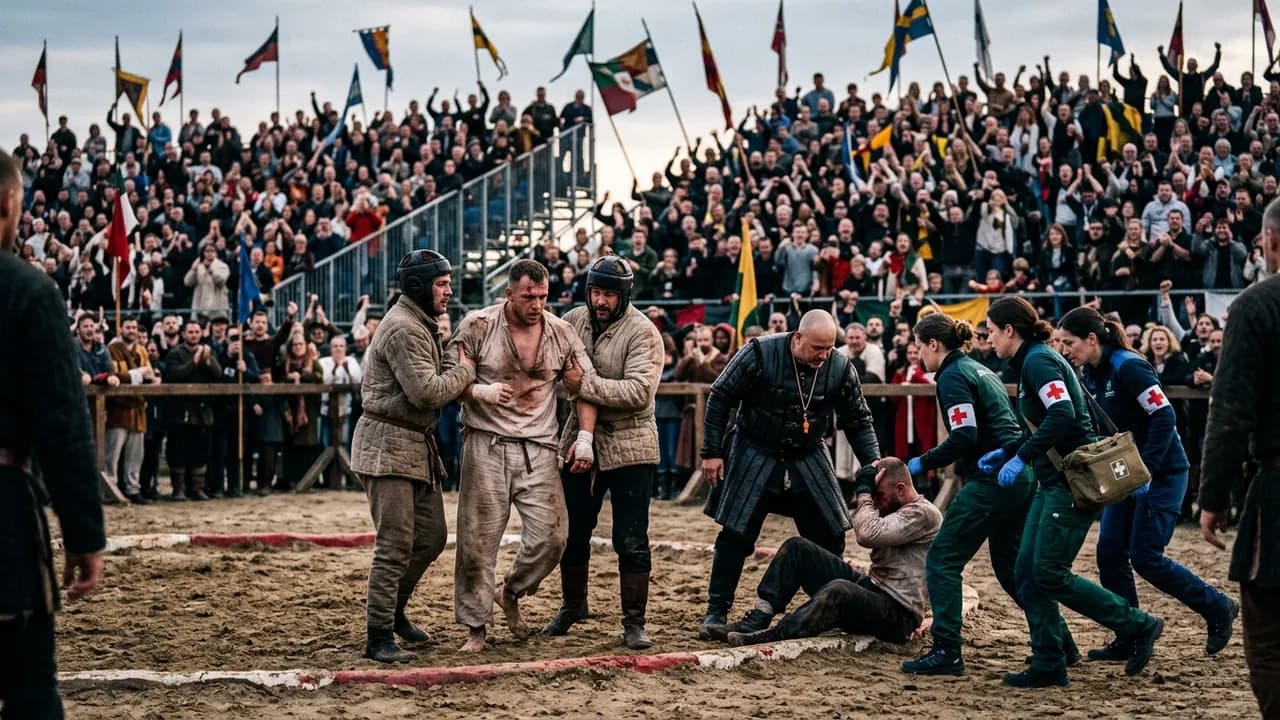
Calcio Storico Fiorentino -- literally "historic football of Florence" -- is the oldest organized fighting competition on this site and arguably the oldest in the world that is still actively played. Originating in 16th-century Florence, revived by Benito Mussolini in the 1930s, and played annually to this day in the Piazza Santa Croce, Calcio Storico is a team combat sport that combines elements of rugby, boxing, wrestling, and warfare into 50 minutes of sanctioned violence on a sand pitch.
It is not underground fighting in the modern sense. It is not a promotion with a YouTube channel and a Telegram recruitment pipeline. It is a centuries-old Florentine tradition with deep civic, cultural, and historical roots. But its rules -- or more accurately, the things its rules allow -- place it squarely in the conversation about the most violent organized fighting on Earth. In Calcio Storico, head-butting, punching, elbowing, and choking are all legal. There are no substitutions. There is no protective equipment. And the 54 men on the sand pitch (27 per team) compete not for prize money but for the honor of their historic Florentine neighborhood.
The Four Teams: Florence's Historic Neighborhoods
Calcio Storico is contested by four teams, each representing one of Florence's historic neighborhoods (quartieri). The teams and their colors are:
| Team | Neighborhood | Color |
|---|---|---|
| Azzurri | Santa Croce | Blue |
| Bianchi | Santo Spirito | White |
| Rossi | Santa Maria Novella | Red |
| Verdi | San Giovanni | Green |
The rivalries between these teams are not artificial promotional constructs. They are centuries old, rooted in neighborhood identity, civic pride, and generational loyalty. Players represent the neighborhood where they were born or have lived for a significant period. The team allegiance is a matter of local identity, not athletic recruitment.
Each year, the four teams compete in a brief tournament: three matches played during the third week of June. The format is a semifinal round followed by a final, with the winning team earning the right to claim a Chianina cow -- the traditional prize -- and, more importantly, bragging rights for their neighborhood until the next tournament.
The Pitch: Sand in the Piazza
Calcio Storico is played on a sand-covered pitch approximately 100 meters long and 50 meters wide, constructed temporarily in the Piazza Santa Croce in the heart of Florence. The pitch is bordered by wooden barriers, and spectators watch from surrounding grandstands.
The sand surface serves multiple functions. It cushions falls, which is critical in a sport where players are regularly tackled, thrown, and knocked down. It slows movement, making sprinting less effective and rewarding strength and power over speed. And it creates a visually distinctive playing surface that signals immediately that this is not football, not rugby, and not any other modern sport.
The sand is deep enough to absorb impact but firm enough to run on. Players sink slightly with each step, which changes the biomechanics of movement and makes the game more physically exhausting than it would be on grass or turf. Over 50 minutes of continuous play on sand, with no substitutions, the physical toll is enormous.
Team Composition: 27 Players Per Side
Each team fields 27 players, organized into four positional groups:
| Position | Number | Role |
|---|---|---|
| Datori indietro | 3 | Goalkeepers / last line of defense |
| Datori innanzi | 5 | Backs / defensive line |
| Sconciatori | 5 | Midfielders / support |
| Corridori | 15 (originally 4 in historical rules) | Forwards / attacking players |
| Capitano | 1 (included in the above) | Team captain |
| Alfiere | 1 (included in the above) | Standard bearer |
The 27-player team size is vastly larger than any other organized fighting event. For comparison, an MMA fight is one-on-one. Even the largest team combat sport in the mainstream -- rugby union -- fields 15 players per side. Calcio Storico puts 54 total players on a sand pitch simultaneously, which creates a chaotic, multidirectional combat environment unlike anything else in organized fighting.
Match Duration: 50 Minutes
A Calcio Storico match lasts 50 minutes of continuous play. There is no halftime. There are no timeouts. There are no substitutions. Play begins and continues for the full 50 minutes unless stopped by the referee for exceptional circumstances.
No substitutions is one of the most consequential rules in the sport. If a player is injured and cannot continue, their team plays shorthanded for the remainder of the match. If multiple players are injured or expelled, the numerical disadvantage compounds. A team that starts with 27 players might finish with 20 or fewer, depending on the violence of the match. This creates a tactical dimension: some teams deliberately target opposing players for injury early in the match, hoping to create a numerical advantage that pays off as the game progresses.
The Objective: Scoring Cacce
The goal of Calcio Storico is to score "cacce" (roughly equivalent to goals or tries) by throwing, kicking, or carrying the ball into the opposing team's net. The net spans the full width of the pitch at each end. A ball that goes into the net scores a caccia. The team with the most cacce at the end of 50 minutes wins.
05 / Up next / Allowed Techniques: Legal Violence
If a team misses -- the ball goes over the net rather than into it -- the opposing team is awarded a half-caccia. This penalty for inaccuracy adds a tactical element: a wild shot at goal can actually benefit the opposing team.
The ball is roughly the size of a modern football (soccer ball) and is advanced through a combination of carrying, passing, kicking, and fighting. There is no restriction on how the ball can be moved. Players can throw it, kick it, run with it, or punch their way through the opposition to create space for a teammate.
Allowed Techniques: Legal Violence
This is where Calcio Storico earns its place alongside organizations like KOTS in the conversation about extreme fighting. The following techniques are legal:
Allowed:
- Punching (closed fist and open hand)
- Head-butting
- Elbowing
- Choking
- Wrestling and tackling
- Tripping
- Shoulder charges
- Body tackles at full speed
- Holding and restraining opponents
Banned:
- Kicks to the head (of a downed opponent)
- Sucker punches (striking a player who is not facing you or not engaged)
- Attacking a player who is already engaged in a fight with another player (2-on-1 is prohibited)
- Attacking the goalkeepers in certain circumstances
The ban on sucker punches and 2-on-1 attacks is the single most important rule in Calcio Storico. It imposes a code of honor on the violence: you can hit someone, but they must know it is coming. You can fight someone, but you cannot gang up on them. These restrictions transform the sport from a brawl into a structured combat environment where individual confrontations occur within a larger team framework.
A player who violates these rules can be expelled from the match, which penalizes their team numerically. Expulsions are enforced by referees (known as the "Maestro di Campo" and supporting officials) who patrol the pitch.
No Protective Equipment
Calcio Storico players do not wear protective equipment. There are no helmets, no pads, no gloves, no mouthguards (though some players choose to wear them), and no shin guards. Players typically compete in team-colored shirts and shorts, with some wearing knee-length breeches in traditional style.
The absence of equipment means that every punch, elbow, headbutt, and tackle lands on unprotected flesh and bone. Injuries are common and expected. Broken noses, split lips, black eyes, and bruised ribs are standard outcomes. More serious injuries -- broken bones, concussions, torn ligaments -- occur with enough frequency that the tournament has been suspended in the past due to excessive violence.
The 2007 Suspension and Aftermath
In 2007, Calcio Storico was suspended for one year after a match degenerated into a mass brawl involving approximately 50 players. The incident exceeded even the sport's tolerant standard for violence and prompted Florence's city government to halt the tournament.
The suspension demonstrated that Calcio Storico does have limits, even if those limits are extremely broad. The tournament resumed with slightly stricter enforcement and a renewed emphasis on the rules against sucker punches and gang-ups. The 2007 incident remains a reference point for discussions about whether the sport's level of violence is sustainable.
Strictly Amateur, Strictly Unpaid
Calcio Storico players are strictly amateur. They receive no payment, no appearance fees, and no prize money. The winning team receives a Chianina cow (a breed of Tuscan cattle) and neighborhood bragging rights. Players compete for honor, tradition, and the identity of their quartiere.
This amateur status is fundamental to the sport's character. Professionalizing Calcio Storico would transform it from a civic tradition into a commercial enterprise, which would fundamentally alter the motivations of its participants. The players fight for their neighborhood, not for a paycheck, and this distinction is central to the sport's cultural legitimacy in Florence.
Annual Schedule
Calcio Storico follows a fixed annual schedule:
- Three matches in the third week of June
- Two semifinal matches determine which teams advance
- One final match determines the champion
- All matches take place in the Piazza Santa Croce
The tournament is part of the broader celebrations for the Feast of San Giovanni (St. John the Baptist), the patron saint of Florence, on June 24th. The final is traditionally played on or near this date.
The limited schedule -- three matches per year -- means that each match carries enormous weight. There are no regular seasons, no league tables, and no second chances. A team that loses its semifinal is eliminated for the entire year.
How Calcio Storico Compares
Calcio Storico is unlike anything else on this site. It is a team sport, not an individual combat format. It has a ball and a scoring system, not rounds and a referee stoppage. It is 500 years old, not a product of the YouTube era.
But the techniques it allows -- punching, elbowing, headbutting, choking, all without protective equipment, on a sand pitch, for 50 continuous minutes with no substitutions -- make it one of the most violent organized sporting events in the world. The total amount of physical violence absorbed by participants in a single Calcio Storico match likely exceeds what occurs in a full evening of fights at any individual organization covered on this site, simply because of the number of participants and the duration.
Calcio Storico is a reminder that what we call "underground fighting" is not new. Organized violence with rules, traditions, and cultural significance has existed for centuries. The organizations on this site -- KOTS, Streetbeefs, BKFC, Strelka -- are the modern inheritors of a tradition that the men of Florence have been practicing since the Renaissance.
For more context on how Calcio Storico fits into the broader history of organized fighting, see our timeline of underground fighting. For a rules comparison with modern organizations, see our rules comparison guide.