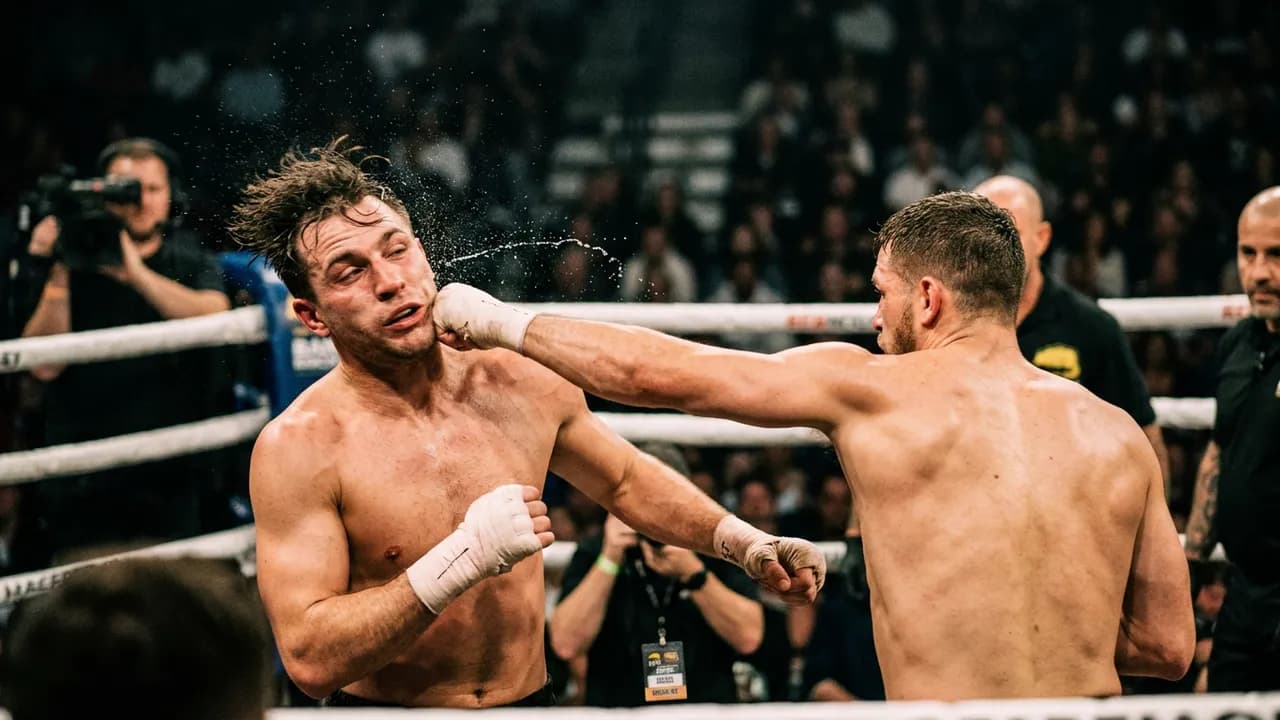
Most combat-sports reporting on Bare Knuckle Fighting Championship's corporate side stops at a sentence: Triller owns it, Conor McGregor bought in, the promotion is worth about $400 million. The first and third parts of that sentence have both been complicated by documents Triller has filed with the US Securities and Exchange Commission since late 2024, and almost none of it has been explained to the people who actually watch the fights.
This page walks through what Triller Group Inc. has told regulators about its relationship with BKFC, using the company's own filings. Where those filings are ambiguous, or simply silent, that is said plainly rather than filled in.
The one-line version
On 26 January 2026, Triller filed a Form 8-K stating that its audit committee had concluded BKFC "should be deconsolidated in the Company's consolidated financial statements" from 15 October 2024, the date on which AGBA Group Holding Limited is treated as having acquired it. In accounting terms, Triller was saying that BKFC had never belonged in its group accounts at all.
That date needs one piece of context, because it is not when BKFC was first bought. The promotion was already inside the privately held Triller business, which announced in February 2022 that it had taken a majority stake. 15 October 2024 is the day AGBA Group Holding Limited completed its merger with Triller Corp and renamed itself Triller Group Inc., which is the point at which BKFC sat inside a Nasdaq-listed group with public reporting duties. The filings call that the Acquisition Date, and it is the date the deconsolidation runs back to.
The filing was made under Item 8.01, Other Events. That detail matters, because Item 8.01 is a general disclosure item rather than the non-reliance item companies use when they formally withdraw previously issued figures. Some early coverage blurred the two.
What deconsolidation actually means
Consolidation is the accounting rule that decides whose revenue appears in whose accounts. Under ASC 810, the US standard on the subject, a parent company folds a subsidiary's revenue, costs, assets and liabilities into its own only if it controls that subsidiary. Control has a specific meaning here: the power to direct the activities that most significantly affect the subsidiary's economic performance. Owning more than half the shares is evidence of control. It is not proof of it.
Triller's conclusion, in its own words:
"While the Company held a majority equity interest in BKFC from the Acquisition Date, it lost the control over the BKFC and no longer possessed the power to direct the activities or key decisions that most significantly impacted BKFC's economic performance, as required for consolidation under ASC 810, Consolidation."
The consequence is that BKFC stops being a subsidiary in Triller's books and becomes an investment. The 8-K states the company "has accounted its investment in BKFC at cost under ASC 321, from the Acquisition Date, rather than consolidating BKFC as a subsidiary." ASC 321 covers equity investments held without control or significant influence. Under its measurement alternative such a holding sits on the balance sheet at cost, less any impairment and adjusted for observable price changes, instead of being broken out line by line.
Translated for a fight audience: BKFC's ticket sales, pay-per-view income, purses and liabilities were pulled back out of Triller's group numbers, retroactively, and replaced with a single line item representing a shareholding. Nothing about that entry changes who books the fights. It changes who has to report them.
The timeline
| Date | Event |
|---|---|
| 15 Oct 2024 | AGBA Group Holding Limited completes its merger with Triller Corp, renames itself Triller Group Inc. and takes BKFC into a listed group; the filings call this the Acquisition Date |
| 26 Nov 2024 | Yorkville (YA II PN, Ltd.) commences proceedings in New York seeking $35,546,302.19 |
| 19 May 2025 | Yorkville's first summary judgment motion is denied; the case is converted to a plenary action |
| 20 Jun 2025 | Yorkville forecloses on pledged collateral; 3,000,000 BKFC shares transfer to Yorkville |
| 1 Jul 2025 | Amendments to BKFC's certificate of incorporation and stockholders agreement take effect, removing Triller's board designation rights |
| 26 Dec 2025 | Nasdaq Hearings Panel notifies Triller it will be delisted for missed filings; trading suspended from the open on 30 December 2025 |
| 26 Jan 2026 | Deconsolidation 8-K and FY2024 Form 10-K filed the same day; the three overdue 2025 quarterly reports follow on 27 January |
| 17 Feb & 14 Apr 2026 | Amended quarterly reports filed |
| 24 Mar 2026 | Nasdaq Listing Council modifies the delisting decision, conditional on the FY2025 10-K being filed on time |
| 14 Apr 2026 | FY2025 Form 10-K filed; Triller states it is "now current in all of its SEC periodic reporting obligations" |
| 17 Apr 2026 | Trading in Triller's securities resumes on Nasdaq |
| 3 Aug 2026 | Nasdaq confirms Triller has regained compliance with the $1.00 minimum bid price rule |
The Yorkville foreclosure
The event that sits underneath the accounting is a debt default.
Yorkville is YA II PN, Ltd., a Cayman Islands exempted limited partnership that had extended convertible financing to Triller, including a $25 million advance under an agreement dated 28 June 2024, on which the company received roughly $23.35 million net in early July. Part of the security for that arrangement was a pledge of BKFC stock by Triller Hold Co LLC.
Triller's FY2025 annual report describes what happened next:
"On June 20, 2025, Yorkville effected a foreclosure under the Triller Pledge Agreement... Although the Company has not received a formal notice of foreclosure from Yorkville, the Company became aware through a transfer agent statement that 3,000,000 shares of common stock of BKFC, previously pledged by Triller Hold Co LLC as collateral, were transferred to Yorkville on June 20, 2025."
Read that twice. Triller says it discovered that a block of BKFC had left its hands by reading a statement from a transfer agent.
The filing quantifies the block precisely. Those 3,000,000 shares "represented a 17.66% ownership interest in BKFC as specifically pledged to Yorkville as of June 20, 2025", and as a direct result "the Company's beneficial ownership in BKFC became 38.13%".
The part that mattered more than the accounting
Eleven days later, BKFC's remaining majority shareholders acted. Per the same filing, they "approved amendments to BKFC's certificate of incorporation and its Stockholders Agreement, which included the removal of the Company's board designation rights." Those amendments took effect on 1 July 2025.
Board designation rights are the practical instrument of control in a private company. They are how a shareholder puts its own people around the table where budgets, matchmaking spend, broadcast deals and executive appointments get decided. Losing them is the substantive change. The deconsolidation is the accounting system catching up to it, roughly seven months later and backdated a further fifteen months to October 2024.
The litigation
The dispute is live. The case is YA II PN, LTD. v. Triller Group Inc.; Triller Corp.; Triller Hold Co LLC; Convoy Global Holdings Limited, Index No. 659314/2024, in the Supreme Court of the State of New York, Commercial Division. Yorkville began it on 26 November 2024 with a motion for summary judgment in lieu of complaint, seeking $35,546,302.19 plus interest, costs and fees. That first motion failed. On 19 May 2025 the court held that Yorkville's right to payment turned on a detailed reading of several intertwined documents and converted the matter into a plenary action. Yorkville filed a notice of appeal on 28 May 2025 and a fresh summary judgment motion on 1 July 2025, once the note's 28 June 2025 maturity date had passed.
In discovery responses dated 3 December 2025, Yorkville put the outstanding figure at "approximately $38.1 million" after crediting the value of the BKFC shares, and said it "continues to accrue additional damages with each passing day". No trial date has been set. Triller says it "intends to defend itself vigorously" and that it is contesting the foreclosure itself.
One temptation should be resisted here. That $38.1 million figure does not let anyone back out what Yorkville thinks a 17.66% slice of BKFC is worth. The filings do not disclose the credit applied to the shares, and interest was accruing at the same time. The arithmetic is not available, and anyone publishing an implied BKFC valuation from it is guessing.
The restatement, and where it stands now
Coverage from early 2026 described a pending restatement of Triller's accounts. That was accurate at the time. It is out of date now.
Triller filed its FY2024 annual report on 26 January 2026, roughly ten months after it was due, brought its three overdue 2025 quarterly reports current the following day, amended all three in February and April, and filed its FY2025 annual report on 14 April 2026, at which point it stated it was "now current in all of its SEC periodic reporting obligations". The correction has been made rather than promised.
What has not been resolved is the control weakness that produced the error. The FY2025 annual report discloses:
"We have identified a material weakness in our internal control over financial reporting relating to the accounting treatment for our investment in Bare Knuckle Fighting Championships, Inc. ('BKFC'). Specifically, we lacked accounting personnel with the appropriate level of knowledge and experience to assess whether the Company continued to exercise significant influence over BKFC following certain changes in our ownership interest, resulting in the incorrect consolidation of BKFC's results in our financial statements rather than accounting for the investment at cost less impairment under ASC 321."
Management concluded that internal control over financial reporting "was not effective as of December 31, 2025". Remediation listed includes bringing in external subject-matter experts, training finance staff and strengthening review procedures. Triller also changed auditors during the year, moving from WWC, P.C. to Enrome LLP.
The parent's condition
The financial state of the company that used to consolidate BKFC is relevant context, and it is bleak. From the FY2025 annual report:
"there is substantial doubt about our ability to continue as a going concern. For the year ended December 31, 2025, we reported a net loss of approximately $174.5 million and net cash outflows from operating activities of approximately $25.9 million. As of December 31, 2025, we had a working capital deficit of approximately $346.0 million, an accumulated deficit of approximately $1,378.2 million, and a stockholders' deficit of approximately $328.1 million."
Group revenue for FY2025 was reported at $21.6 million against $27.5 million the prior year. Because deconsolidation runs back to the acquisition date, neither figure contains BKFC.
The listing question needs setting out properly, because it is often reported at one end or the other. Triller was in fact delisted. Having missed the FY2024 annual report and three 2025 quarterly reports, it was told by a Nasdaq Hearings Panel on 26 December 2025 that its shares would be delisted and that trading would be suspended from the open of business on 30 December 2025. The FY2025 annual report puts it in the company's own words, as a risk-factor heading: "Our shares were delisted from Nasdaq, and while we are seeking to resume trading on Nasdaq, there can be no assurance that our shares will be reinstated." Triller appealed to the Nasdaq Listing and Hearing Review Council on 9 January 2026. On 24 March 2026 the Council modified the Panel's decision, conditional on the FY2025 10-K being filed by 31 March 2026 or within the Rule 12b-25 extension. The filing was made on 14 April, and trading resumed on 17 April 2026.
The separate problem was the share price. An 8-K filed on 7 August 2026 records that Nasdaq notified the company on 3 August 2026 that it had "timely evidenced compliance with the $1.00 bid price requirement and all other applicable criteria for continued listing". The Hearings Panel has retained jurisdiction. Triller is therefore listed and compliant as of August 2026, under continuing oversight, having spent roughly three and a half months of that year off the exchange.
More BKFC stock is sitting behind defaulted debt
The Yorkville pledge was not the only one. Triller's quarterly report filed on 13 August 2026 describes an exchangeable note of roughly $5.4 million issued in October 2024 to Giant Wisdom Ventures Limited, "secured by a pledge of 5,000,000 shares of common stock of BKFC owned by the Company", and $15.5 million of loans from the same lender dated 21 March 2025 "secured by a pledge of 1,400,000 shares of common stock of BKFC owned by the Company". Both are described as unrepaid and in default of settlement.
That is the live risk worth watching. Further blocks of BKFC equity are collateral on borrowings that have not been repaid, which means the ownership picture disclosed today is not necessarily the one that holds next year.
What about the $400 million?
The figure appears in nearly every write-up of BKFC, so it is worth tracing.
It originates with an April 2024 Rolling Stone feature by Stayton Bonner. Forbes repeated it on 23 December 2024 under the headline "David Feldman Built BKFC From Almost Bankrupt To $400 Million", and attributed it openly rather than verifying it: "According to an April 2024 feature by Stayton Bonner of Rolling Stone, the Bare Knuckle Fighting Championship is worth $400M." No funding round, transaction price, audited figure or third-party appraisal has been published to support it, and nothing resembling it appears in any Triller filing.
That does not make it wrong. It makes it a press estimate that has been repeated until it reads like a disclosure. Set against a parent carrying a $346.0 million working capital deficit that has moved its stake to a passive cost-basis line, the gap between the two pictures is the actual story. Our breakdown of how BKFC reached a $400 million valuation covers the growth case; this page covers what has been filed.
What it means for fighters, cards and fans
Four things follow from the documents, and no more than four.
Nothing in the deconsolidation stops BKFC promoting. Removing a subsidiary from a parent's accounts is a reporting decision. BKFC has continued to run events through 2025 and 2026, David Feldman remains president, and the promotion was named as a partner in a FOX Nation series announced in July 2026. Conor McGregor remains a part-owner, though no filing quantifies his stake.
The public window into BKFC's numbers has closed, and it was never open for long. Whatever BKFC figures reached the public record through the listed group did so in quarterly reports that have since been amended to take them out again. No audited annual report of Triller Group has ever carried BKFC as a consolidated business. BKFC is private and has no standalone reporting obligation of its own, so anyone claiming to know the promotion's current revenue, attendance economics or profitability is working from estimates. That includes claims about how much of the purse structure fighters actually see.
Governance at BKFC changed on 1 July 2025, and the direction was away from Triller. Whoever holds the other shares now sets the board. The filings do not identify them.
Ownership may move again. Millions of BKFC shares sit as collateral on defaulted facilities, and the Yorkville foreclosure is being contested in court. A further transfer would not require a public announcement from BKFC, which is private.
For context on why a fight promotion's ownership structure is worth following at all, see how underground and bare-knuckle organisations actually generate revenue, and our profile of BKFC as a promotion.
What the filings do not tell us
Setting out the limits is part of the job here.
- Who holds the rest of BKFC. Taking the filings' own figures at the date of the transfer, roughly 44% was accounted for by neither Triller's 38.13% nor the 17.66% block that moved to Yorkville. The holders are not identified anywhere in the filings.
- Whether Yorkville still holds the 3,000,000 shares. The filings record the transfer, not what happened afterwards.
- Conor McGregor's percentage. He is described consistently as a part-owner. No filing puts a number on it.
- BKFC's current revenue or profitability. BKFC is not an SEC reporting company. Its entire own filing record consists of three Form D notices of exempt securities offerings, two in 2022 and one in August 2024, none of which carry financial statements.
- What BKFC is worth. Triller's investment note lists investees anonymously, and the entries cannot be matched to BKFC with confidence. Any figure quoted today, including $400 million, is an estimate rather than a disclosure.
One further wrinkle for the fight-minded reader. Triller's own risk factors describe the sport in unvarnished terms, noting that "participants in BKFC do not wear any padding or gloves, which may result in increased numbers of injuries, including, among others, maxillofacial fractures and dental avulsions", and flagging litigation risk from long-term neurocognitive claims. Even as an accounting footnote, BKFC was a legal-exposure paragraph.
Sources: Triller Group Inc. filings with the US Securities and Exchange Commission (CIK 0001769624), including the Form 8-K dated 26 January 2026, the Form 10-K for the year ended 31 December 2025 filed 14 April 2026, the Form 10-Q filed 13 August 2026, and the Form 8-K dated 7 August 2026.
Related reading: Who Owns BKFC? · How Conor McGregor's BKFC Ownership Changed the Promotion · BKFC Major Events