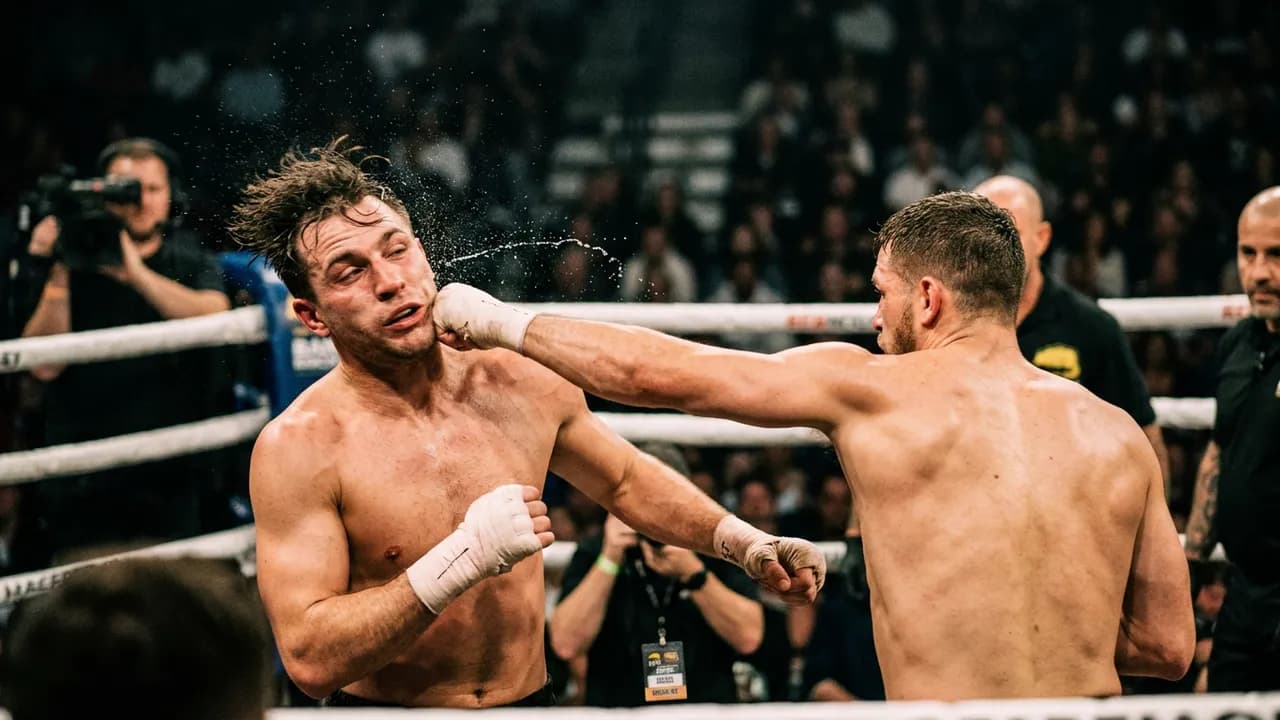
Slap fighting has been argued about since Power Slap reached American television in January 2023, mostly on instinct. The published record is thinner than either side of the argument implies, and it is also more specific. As of August 2026 we can identify two peer-reviewed papers that examine the sport directly, one formal position statement from the American neurosurgical profession, and a regulatory picture in which two US states are confirmed to have sanctioned events and one has prohibited them by commission rule. This page sets out each of those documents with its full citation, what it actually measured, and what it cannot support.
The JAMA Surgery Research Letter
Lavadi RS, Kumar RP, Kann MR, Shah MJ, Hamilton DK, Maroon JC, Agarwal N. Video Analysis of Concussion Among Slap Fighting Athletes. JAMA Surg. 2024;159(12):1435–1436. doi:10.1001/jamasurg.2024.2605
The authors are from the Department of Neurological Surgery at the University of Pittsburgh School of Medicine; senior author Nitin Agarwal is additionally affiliated with UPMC and the VA Pittsburgh Healthcare System. Joseph Maroon, a co-author, is a long-standing figure in sports concussion medicine.
One point of format matters and is almost universally misreported: this is a research letter, not a full original investigation. Research letters are peer-reviewed but short, carry no extended methods section, and sit lower in the evidence hierarchy than a full paper. Coverage that calls it "a JAMA study" is overstating its weight. It remains the only quantitative dataset on the sport that we have been able to identify.
Method
The team retrospectively reviewed publicly available online footage, specifically the outcomes of legal and illegal slaps from Power Slap's season 1 and main events 2 to 5, and scored each strike for recognised visible signs of concussion, with definitions modified to fit the slap-fighting format. Four reviewers observed the footage; the paper states that "agreement between both reviewers was required to account for a visible sign of concussion", and interrater reliability was assessed using Cohen's kappa statistics. Only one sign was needed for a strike to be counted.
The signs assessed were motor incoordination, being slow to get up, a blank or vacant look, second impact, loss of responsiveness or consciousness, impact seizure, clutching the head or face, visible facial injury, vomiting, and amnesia.
Every reported number
| Measure | Result |
|---|---|
| Fights analysed | 78 |
| Slaps analysed | 333 |
| Sequences analysed | 139 |
| Contestants | 56 |
| Contestants with at least one concussive sign | 44 of 56 (78.6%) |
| Slaps producing a concussive sign | 97 of 333 (29.1%) |
| Sequences producing a concussive sign | 72 of 139 (51.8%) |
| Instances of second impact | 20 |
| Sequences with a concussive sign in which that contestant lost | 54 of 72 (75.0%) |
| Offensive fouls that produced a concussive sign | 13 of 56 fouls (23.2%) |
| Offensive fouls that produced a second impact | 2 of 20 (10.0%) |
Note the denominators. The 78.6% figure counts contestants; the 29.1% counts individual slaps; the 51.8% and the 75.0% count sequences; and the 23.2% counts offensive fouls, of which there were 56, coincidentally the same number as contestants.
The most frequently recorded signs were motor incoordination, slowness to get up, and a blank or vacant look. The authors concluded that "slap fighting may be a more grievous combat sport than previously assumed, and strategies to prevent neurological demise among its participants should be pursued."
Disclosures, which any careful citation should carry: Maroon reported serving as a neurosurgical consultant to the Pittsburgh Steelers, a member of the NFL Head and Spine Committee, and a medical consultant to World Wrestling Entertainment. Agarwal disclosed personal fees from Thieme Medical Publishers and Springer International Publishing outside the submitted work. No other disclosures were reported.
What 78.6% Means, and What It Does Not
This is where most secondary coverage goes wrong, and getting it right is the difference between a citable page and a misleading one.
The study measured visible signs of concussion observed on broadcast video. No athlete was examined. No one was imaged. No concussion was clinically diagnosed. The correct sentence is that 78.6% of competitors showed at least one visible sign of concussion. The incorrect sentences — all of which appeared in mainstream write-ups — are that 78.6% "suffered concussions", "showed signs of brain injury", or "sustained brain damage."
First, the denominators are events, not people-years, so nothing in the paper produces an injury rate comparable with the figures quoted for boxing or MMA.
The authors named their own limits: a small sample, and video review as "a subjective means of assessment." A vacant stare or a delayed stand-up is meaningful circumstantial evidence. It is not a diagnosis, and the study makes no claim to be one.
Two further boundaries follow from the design. First, the denominators are events, not people-years, so nothing in the paper produces an injury rate comparable with the figures quoted for boxing or MMA. Second, the study is cross-sectional: it observed a single televised season and cannot say anything about what happens to those 56 people over the following decade.
The Cureus Case Report: One Jaw, Two Operations
Guerra C, Edison C, Jang S, Oliver JJ. Power Slap Competitions as a Novel Mechanism of Traumatic Injury. Cureus. 2025;17(10):e93842. doi:10.7759/cureus.93842. Published 4 October 2025.
All four authors are in the Department of Emergency Medicine at Madigan Army Medical Center in Tacoma, Washington. They present it as "the first documented case of a patient presenting after an unofficial and unsanctioned bout of Power Slap fighting", which is a narrower claim than being the first documented slap-fighting injury in the literature.
The detail that most coverage drops is the one that changes the meaning: this was not a licensed Power Slap event. The authors are explicit that the bout was unofficial and unsanctioned. That makes it a case about imitation risk outside regulated events, which is a different story from an injury at a licensed show.
The patient was a 20-year-old US Army service member who reported on follow-up that he had sustained multiple prior impacts to the jaw. Imaging showed a comminuted fracture at the angle of the left mandible and subluxation of several teeth on the left mandible, with moderate trismus. An old right mandibular fracture, at the anterior body adjacent to the mental foramen, was also identified.
He underwent open reduction and internal fixation. The initial result was good anatomic reduction but poor occlusal reduction, and persistent malocclusion required a revision procedure with plating of both mandibles. At two-month follow-up he had residual loss of sensation in the bilateral mandibular nerve distribution. His team stated that the loss of sensation "may eventually recover on the right, but it will likely be permanent on the left."
The authors also address equipment directly. Power Slap's safety protocols "require minimal protective gear, including mouthguards and cotton ear inserts", and the authors state that cotton ear inserts are "an insufficient method of barotrauma prevention and will not appropriately protect the tympanic membrane or inner ear." They note that in this format "all force is directed to the unprotected lower face, and the defender cannot evade or defend themselves", and recommend that emergency departments, "particularly those in military or rural settings", be equipped with protocols for evaluating facial trauma.
Evidence tier: n = 1. A case report is the lowest grade of clinical evidence. It demonstrates that an injury pattern is possible and worth watching for. It establishes no rate, no risk and no incidence, and anyone citing it as though it did is misusing it.
Where the Neurosurgeons Landed
On 25 June 2025 the American Association of Neurological Surgeons and the Congress of Neurological Surgeons issued a joint Position Statement on Slap Fighting. The two bodies "unequivocally denounce adult and pediatric participation in slap fighting" and state that "governing authorities should reconsider their recommendation to promote slap fighting – given the risk for permanent and devastating brain injury."
The statement asks health professionals in child-facing roles to encourage children not to participate, and flags heightened concern about reproducibility among children precisely because the sport needs almost no equipment. It cites the Lavadi research letter directly, including the 78.6% figure, and sets it against boxing and kickboxing epidemiology, stating that "prior longitudinal studies have also noted rates of concussion in boxing and kickboxing, which are lower when compared to the data on slap fighting."
This is the highest-authority medical document on the sport. It is a professional position rather than new data, but it is the point at which the specialty that treats these injuries put its name to a formal recommendation. The statement also notes that "one slap fighter died in 2021 due to a brain bleed", a reference to the Artur Walczak case.
Advocacy, and Where It Sits Relative to Evidence
Advocacy pressure predates the published data by roughly eighteen months, and it is worth separating from it.
- Brain Injury Association of America, 23 February 2023. The BIAA wrote to the Nevada Athletic Commission calling on it to end sanctioned slap fighting. This is frequently described online as a petition; it was a letter. Medical Director Emeritus Dr Gregory O'Shanick was quoted saying that "what is being portrayed for the public to witness first hand is a real time laboratory for sustaining a traumatic brain injury."
- Chris Nowinski, 19 January 2023. The day after Power Slap: Road to the Title premiered on TBS, the neuroscientist and Concussion Legacy Foundation co-founder posted footage of contestant Chris Kennedy going down on the opening slap from Chris Thomas, identifying the fencing posture, an involuntary arm position associated with significant traumatic brain injury. Deadline reported the clip passing 15 million views within days, and it set the tone of the public argument.
- Congressional and legislative pressure, including letters from members of Congress to broadcasters, is covered separately in our piece on slap fighting reaching congressional and regulatory attention.
None of this is evidence in the scientific sense. It is the profession and its allies reacting to what they were watching. The 2024 and 2025 papers are what turned that reaction into something citable.
The Counter-Argument, Stated Fairly
Power Slap and the commissions that licence it do not argue that the sport is harmless. Their argument is that a regulated format is safer than an unregulated one, and that the sport's medical requirements exceed what many amateur combat programmes impose.
A physical examination and a dilated eye examination must each be completed at least seven days before the athlete's first match of the calendar year.
Under Power Slap's published ruleset, competitors must wear a mouthguard and cotton inner-ear protectors, hair must be pulled clear of the striking zone, and fingernails must be trimmed and rounded. Each bout runs with three judges, two referees and a replay official, on a 10-point-must system that scores the striker's effectiveness and the defender's reaction and recovery. There is a 60-second recovery clock between strikes.
The medical requirements are the substantive part of the defence. Licensing requires blood work showing no HIV or hepatitis, dated no earlier than 30 days before the licence application, plus a brain MRI and a cerebral MRA performed within the five years immediately preceding it. A physical examination and a dilated eye examination must each be completed at least seven days before the athlete's first match of the calendar year. On site, promoters must field a supervising physician, a second physician or licensed physician assistant, three emergency medical technicians, three ambulances, a suture kit and an arrangement with at least one local hospital. Mandatory rest between bouts runs from six days after a match of three rounds or fewer to ten days after a match of more than six.
Nevada's stated basis for taking jurisdiction was statutory rather than medical. The commission determined that slap fighting involves blows that may reasonably be expected to inflict injury and therefore meets the definition of unarmed combat in NRS 467.0107. That is a finding about scope of authority, not an endorsement of the sport's safety, and it is the same route by which commissions absorbed mixed martial arts two decades earlier.
The critics' answer is the mechanism. Every element a trained fighter uses to reduce the force of a blow, from slipping and blocking to rolling with it, is removed by the rules. Screening protocols manage the consequences of head trauma; they do not reduce the trauma. Whether a competition engineered around clean, undefended head impacts can be made meaningfully safer without ceasing to be the thing that draws the audience is the question neither side has answered.
What Regulators Have Actually Done
Our full treatment of the legal map, including the states whose commissions have declined to act, is in which states have banned slap fighting. The short version, for the purpose of reading the medical record against the regulatory one, is that the map is smaller than the internet suggests. Only a handful of jurisdictions have taken a documented, dateable position.
| Jurisdiction | Position | Detail |
|---|---|---|
| Nevada | Sanctioned | NSAC voted unanimously on 18 October 2022 that slap fighting qualifies as unarmed combat under NRS 467.0107 and falls under its jurisdiction. Events have been licensed and regulated there since. |
| California | Sanctioned | CSAC approved sanctioning on a 6-0 vote at its meeting of 9 December 2023, reported as a conditional licence with rules to be written. |
| Alabama | Prohibited by commission rule | The Alabama Athletic Commission kept slap fighting illegal in October 2022, among the first US commissions to do so. |
| Michigan | Cannot sanction | Reported as unable to sanction the format unless the Unarmed Combat Commission promulgates rules of engagement under the state's Unarmed Combat Regulatory Act. Referred to a standing subcommittee for study. |
One widely repeated claim needs correcting. Alabama's Senate Bill 7 of the 2026 Regular Session, sponsored by Sen. Gerald Allen, would have written the prohibition into statute, authorised the Attorney General to bring civil action, and attached Class C felony exposure for certain knowing violations along with fines of up to $10,000 per violation. It was introduced on 13 January 2026 and was in committee on 21 January. It then went nowhere: its last recorded action was indefinitely postponed on 7 April 2026. Coverage from early 2026 announcing that Alabama had moved to permanently ban slap fighting is still circulating; as of August 2026 the statutory ban does not exist. The commission-level prohibition does.
Beyond those four, the position is genuinely unsettled. Texas, Tennessee and Florida were reported in 2023 as regulatory targets for the promotion, but we found no confirmation that any of them has sanctioned the format, and we are not going to publish a fifty-state table built on inference.
The Evidence Hierarchy, Plainly
| What people claim | What the record supports |
|---|---|
| "78% of slap fighters get concussed" | 78.6% showed at least one visible sign of concussion on video review. No diagnoses were made. |
| "Slap fighting causes CTE" | No published study has examined CTE in slap fighters. CTE is a post-mortem diagnosis, and no such finding has been reported in a slap competitor. |
| "Slap fighting has an injury rate of X" | No rate exists. Neither paper produces a denominator that supports one. |
| "A slap fight broke a man's jaw and left him with permanent nerve damage" | One documented case, in an unsanctioned amateur bout; the surgical team expected the deficit to be permanent on the left side only. |
| "Neurosurgeons have condemned the sport" | Accurate. AANS and CNS, joint position statement, 25 June 2025. |
| "It has been banned across the country" | Two states are confirmed to sanction it; one prohibits it by commission rule. Most have taken no documented position. |
What Would Actually Settle It
The gap in the literature is obvious and specific. What does not exist, and would change the argument in either direction:
- Prospective clinical assessment of competitors before and after bouts, rather than retrospective video scoring. This is the design the JAMA authors' own limitations section points towards.
- Instrumented impact data, measuring the linear and rotational acceleration an open-hand strike actually delivers to a stationary head. Every claim about slaps being worse than punches currently rests on mechanism, not measurement.
- Longitudinal follow-up of a defined cohort. Chronic outcomes cannot be inferred from a single televised season.
- Commission injury reporting. Nevada has licensed and regulated slap events since October 2022, which means post-event medical reporting exists somewhere in its files. No aggregate has been published, and we found no equivalent published data from California.
Until then, what the record supports is narrow but real: visible concussive signs are common in televised slap bouts, repeat impacts before recovery are documented, the format has produced at least one severe facial injury requiring two operations, and the neurosurgical profession has formally recommended against participation. What the record does not yet support is any statement about lifetime cost.
For the sport's broader risk profile and the arguments on either side, see our analysis of whether Power Slap is dangerous. For the format itself and what competitors agree to, see what Power Slap is and how it works. For the death that shaped the debate before any of this was published, see our report on Artur Walczak, and for the wider context of repetitive head trauma across combat sports, see CTE in combat sports.