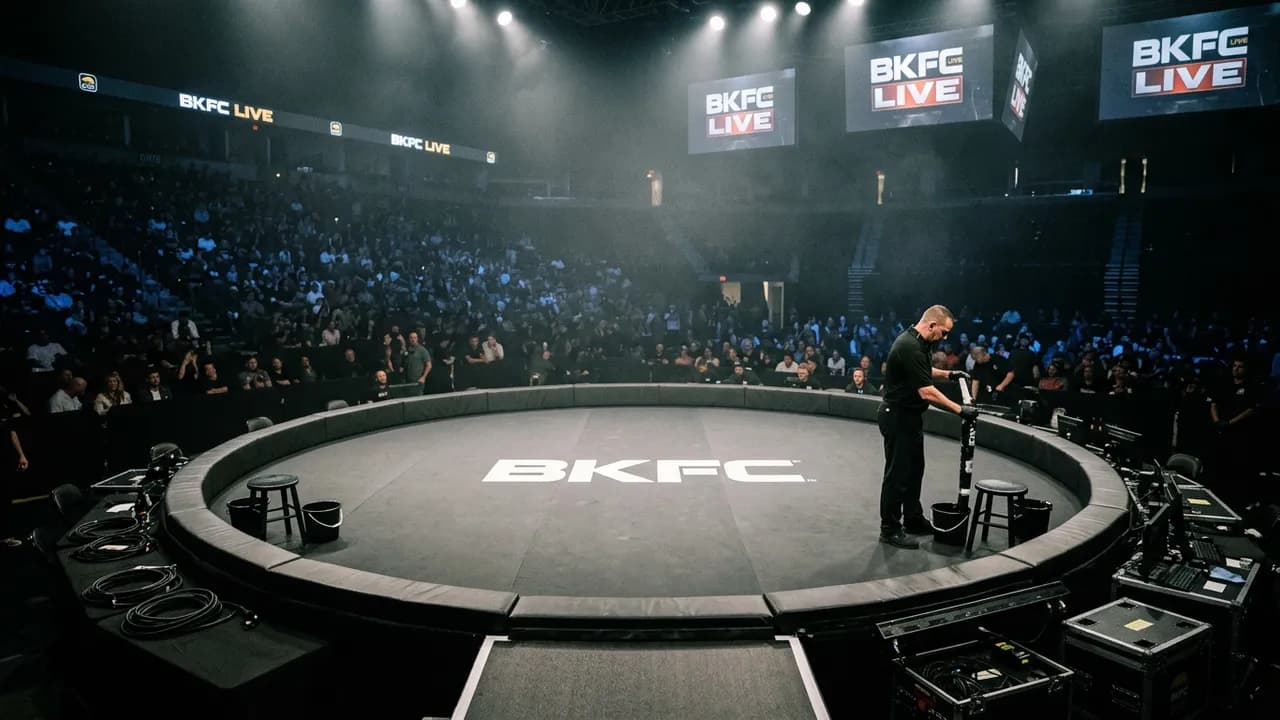
BKFC (Bare Knuckle Fighting Championship) and the UFC (Ultimate Fighting Championship) are both sanctioned, regulated combat sports promotions -- but the similarities largely end there. BKFC is bare knuckle boxing: punches only, no gloves, in a circular ring. The UFC is mixed martial arts: all striking and grappling techniques permitted, with 4-ounce gloves, inside an octagonal cage. The two promotions attract different types of fighters, produce different types of injuries, and offer dramatically different compensation structures.
What are the rule differences between BKFC and UFC?
The fundamental rules differ significantly:
| Feature | BKFC | UFC |
|---|---|---|
| Sport | Bare knuckle boxing | Mixed martial arts |
| Gloves | None (hand wraps only) | 4-ounce MMA gloves |
| Strikes | Punches only | Punches, kicks, knees, elbows |
| Grappling | Not permitted | Full grappling (takedowns, submissions) |
| Ring/cage | Circular ring ("Squared Circle") | Octagonal cage |
| Rounds | 5 rounds x 2 minutes | 3 rounds x 5 min (non-title) / 5 x 5 (title) |
| Weight classes | Multiple divisions | Multiple divisions |
| Regulation | State athletic commissions | State athletic commissions |
The most significant difference is the scope of permitted techniques. UFC fighters must prepare for strikes, takedowns, ground fighting, and submissions. BKFC fighters focus exclusively on punching -- but they must do so without the protection of gloves.
How does fighter pay compare between BKFC and UFC?
The pay gap between BKFC and UFC is significant, though BKFC's top-tier compensation has grown considerably:
UFC pay ranges:
- Debut fighters: $12,000 - $15,000 (show money)
- Mid-card fighters: $50,000 - $150,000
- Contenders: $150,000 - $500,000
- Champions: $500,000 - $1,000,000+
- Top stars: $1,000,000 - $10,000,000+
- Debut fighters: $2,000 - $5,000
- Mid-card fighters: $5,000 - $20,000
- Contenders: $20,000 - $75,000
- Champions: $75,000 - $250,000+
- Top stars: $250,000 - $500,000+
UFC fighter pay is substantially higher at every level, reflecting the promotion's massive revenue from ESPN broadcast deals, PPV sales, and global expansion. However, BKFC's pay structure has improved significantly since Conor McGregor's ownership involvement, and the gap at the lower end is narrowing.
The UFC has faced persistent criticism for its approximately 18-20% revenue share with fighters, compared to the 50%+ revenue share common in major team sports. BKFC's revenue share percentage is not publicly disclosed.
Which fighters have competed in both BKFC and UFC?
Several notable fighters have crossed between the two promotions:
- Paige VanZant -- Former UFC flyweight who transitioned to BKFC, becoming one of the promotion's biggest draws
- Chad Mendes -- Former UFC featherweight title challenger who moved to BKFC
- Eddie Alvarez -- Former UFC lightweight champion who competed in BKFC
- Jimmie Rivera -- Former UFC bantamweight contender
- Austin Trout -- Former WBA boxing champion who competed in both UFC and BKFC
- Mike Perry -- Former UFC welterweight who became one of BKFC's top draws
The crossover trend has accelerated in recent years. UFC veterans who are past their MMA prime often find competitive second careers in BKFC, where their striking skills transfer more directly than their overall MMA game.
Which is more dangerous -- BKFC or UFC?
The risk profiles are different rather than simply "more" or "less" dangerous:
BKFC risks:
- Higher rates of facial lacerations (cuts) from bare knuckle impact
- Higher rates of hand fractures
- Potentially lower cumulative brain trauma (fewer head shots due to hand injury risk)
UFC risks:
- Higher risk of joint injuries from grappling and submissions
- Higher volume of head strikes (4-ounce gloves protect the striker's hands, enabling more punches)
- Greater variety of injury mechanisms (kicks to the legs, knees in clinch, ground-and-pound)
- Longer fight duration (up to 25 minutes vs. BKFC's 10 minutes)
Both promotions are sanctioned by state athletic commissions, meaning both have mandatory pre-fight medical screening, ringside physicians, licensed referees, and post-fight medical evaluations. The safety infrastructure is comparable.
How do the fight formats differ?
BKFC format:
- Five rounds of two minutes each (championship and main events)
- One-minute rest between rounds
- Total maximum fight time: 10 minutes of action
- Standing combat only -- no ground work
- Fights tend to be fast-paced and action-heavy
UFC format:
- Three rounds of five minutes each (non-title fights)
- Five rounds of five minutes each (title and main events)
- One-minute rest between rounds
- Total maximum fight time: 15-25 minutes of action
- Includes standing, clinch, and ground phases
The shorter BKFC format produces more condensed action. There is no strategic stalling, limited wrestling-based control, and less dead time. UFC fights can include extended grappling exchanges, clinch work against the cage, and ground control -- phases that casual fans sometimes find less exciting.
How do the organizations compare in size?
The UFC dwarfs BKFC in every commercial metric:
- UFC annual revenue: Estimated $1+ billion
- BKFC annual revenue: Not publicly disclosed, estimated in the tens of millions
- UFC broadcast deal: ESPN (approximately $300 million/year)
- BKFC broadcast deal: DAZN (terms not disclosed)
- UFC events per year: 40+
- BKFC events per year: 12-20
- UFC global reach: Events in 30+ countries
- BKFC global reach: Expanding internationally
BKFC is a growing promotion, but it operates at a fraction of the UFC's scale. The Conor McGregor ownership stake has elevated BKFC's profile significantly, and the promotion is positioned for continued growth -- but parity with the UFC is not a realistic near-term expectation.
Can you go from BKFC to UFC or vice versa?
Movement between promotions happens in both directions, though UFC-to-BKFC is far more common:
UFC to BKFC: This is the established pathway. Fighters who are released from the UFC or choose not to re-sign often find competitive opportunities in BKFC. The striking-heavy format of bare knuckle boxing suits fighters with boxing backgrounds better than those who relied on grappling in MMA.
BKFC to UFC: This is rare. The UFC generally signs fighters from the amateur MMA ranks, other MMA promotions, or specific combat sports backgrounds. A fighter who has competed exclusively in bare knuckle boxing would need to demonstrate MMA-level grappling and submission defense to be competitive in the UFC.
Which should you watch -- BKFC or UFC?
This depends on what you enjoy in a fight:
Watch BKFC if you prefer:
- Pure striking action with no grappling
- Fast-paced, short fights with high finish rates
- The raw, visceral appeal of bare knuckle combat
- A growing promotion with a different energy than established MMA
Watch UFC if you prefer:
- The full range of martial arts techniques
- Longer, more strategic fights
- The deepest talent pool in combat sports
- Major production value and extensive broadcast coverage
Many fight fans watch both. The promotions serve different audiences and different moods, and the crossover of fighters between them creates natural storyline connections.
For more on BKFC specifically, see our BKFC fighter pay guide or our guide to joining BKFC. For the broader bare knuckle landscape, see our bare knuckle legality FAQ.