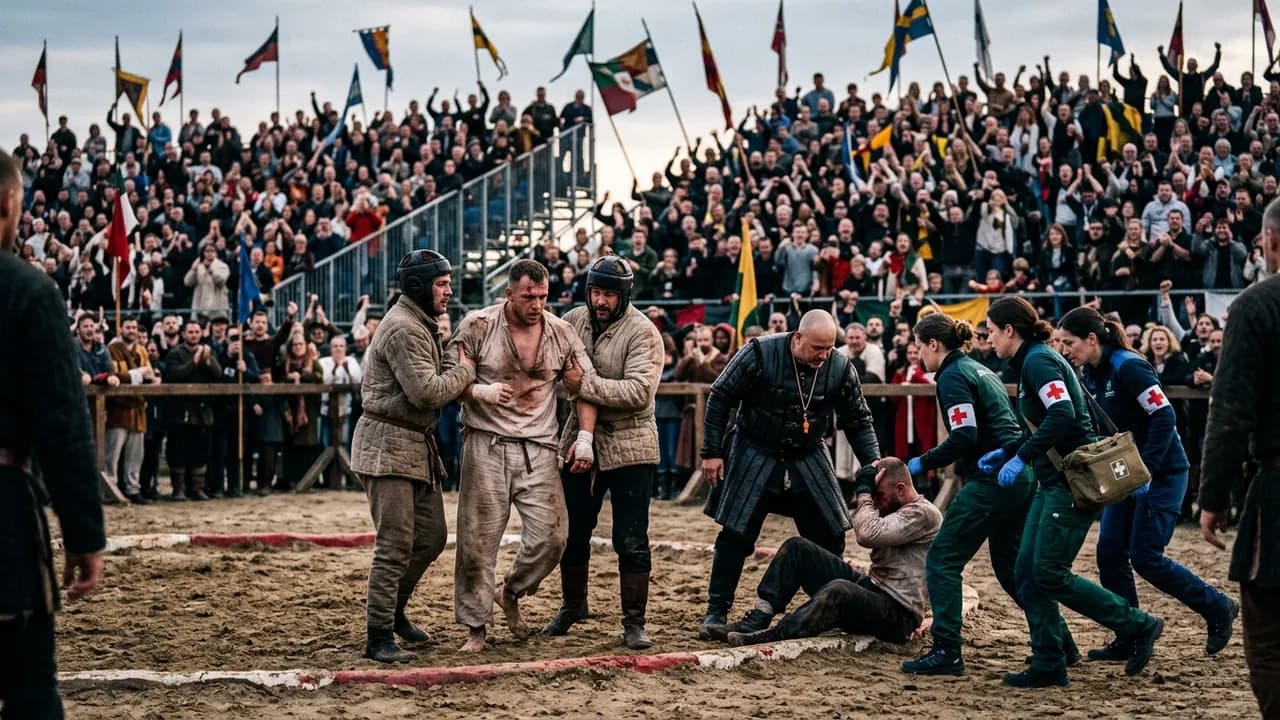
Every June, in the Piazza Santa Croce in the heart of Florence, Italy, four teams of 27 men each gather on a sand-covered field to play the most violent team sport on earth. They punch each other. They kick each other. They headbutt, elbow, choke, and wrestle each other into the ground. They do this for 50 minutes, with no substitutions, no protective equipment beyond their own bodies, and no mercy.
This is Calcio Storico Fiorentino -- "historic football" -- and it has been played in Florence since the 16th century. It is not an underground fighting event in the modern sense. It is something older, stranger, and in many ways more brutal than anything that happens in a backyard ring or a bare knuckle arena. It is a sport that predates boxing commissions, predates the Marquess of Queensberry Rules, and predates the very concept of "combat sports" as a category.
The annual tournament, held during the third week of June, is one of the most extraordinary spectacles in the world of organized violence.
The History: From Renaissance Florence to Mussolini to Today
Calcio Storico's origins trace to the Renaissance, when young Florentine aristocrats played a rough ball game in the piazzas of the city. The earliest documented match took place on February 17, 1530, during the Siege of Florence, when the city's defenders played a game in defiance of the besieging troops of Charles V. The match was an act of psychological warfare -- a message to the enemy that Florence's spirit could not be broken.
The sport was played sporadically through the following centuries before falling into dormancy. In 1930, the fascist government of Benito Mussolini revived Calcio Storico as part of a broader campaign to glorify Italian history and physical culture. The revived tournament was staged in the Piazza Santa Croce, the same location where matches had been played centuries earlier.
Since the revival, the tournament has been held annually with only occasional interruptions. The most notable disruption came in 2007, when the tournament was suspended for one year after a 50-player brawl during the previous year's final spiraled so far out of control that city officials deemed the event too dangerous to continue. Rule modifications were implemented before the tournament returned in 2008, though "rule modifications" in a sport that already permits punching and headbutting is a relative concept.
The Teams: Four Neighborhoods, Four Colors
Calcio Storico is contested between four teams, each representing a historic neighborhood (quartiere) of Florence:
Santa Croce -- Azzurri (Blues). Representing the neighborhood surrounding the Basilica of Santa Croce, the same piazza where the tournament is held. The Blues have historically been one of the most competitive teams.
Santo Spirito -- Bianchi (Whites). Representing the Oltrarno district on the south bank of the Arno River. The Whites are known for their passionate fan base and the working-class character of their neighborhood.
Santa Maria Novella -- Rossi (Reds). Representing the area around the Basilica of Santa Maria Novella, near Florence's main train station. The Reds have produced some of the tournament's most memorable players.
San Giovanni -- Verdi (Greens). Representing the neighborhood around the Baptistery of San Giovanni and the Duomo. The Greens carry the prestige of Florence's most famous landmarks.
Each team draws its 27 players from the residents of its respective neighborhood. The players are strictly amateur and unpaid -- a requirement that is enforced to preserve the sport's traditional character. In a world where virtually every form of organized combat has been commercialized, Calcio Storico's insistence on amateurism is both admirable and increasingly anachronistic.
The Format: 50 Minutes of Controlled Chaos
A Calcio Storico match lasts 50 minutes, played on a sand-covered field approximately 80 meters long and 40 meters wide. Each team fields 27 players: 4 goalkeepers (Datori Indietro), 3 fullbacks (Datori Innanzi), 5 halfbacks (Sconciatori), and 15 forwards (Corridori and Innanzi).
The objective is to score goals (cacce) by throwing the ball into the opposing team's net, which spans the entire width of the field. A goal is scored when the ball enters the net; a missed shot (the ball goes over the net) awards half a caccia to the opposing team.
03 / Up next / The Third Week of June: Tournament Structure
What makes the sport unique -- and what draws international attention -- is what happens between the goals. Fighting is not just permitted; it is fundamental to the game. Players engage in hand-to-hand combat to clear paths for the ball carrier, to neutralize dangerous opponents, and to establish physical dominance. The permitted techniques include:
- Punching (open hand and closed fist)
- Kicking
- Headbutting
- Elbowing
- Choking and wrestling
- Takedowns and ground fighting
The prohibited techniques are remarkably few: sucker punches from behind, kicks to the head of a downed player, and attacks on a player who is already being fought by two or more opponents. Everything else is fair game.
There are no substitutions. If a player is injured -- and injuries are frequent and often severe -- his team plays short for the remainder of the match. This rule creates a strategic dimension to the violence: teams may target key opposing players with the explicit goal of removing them from the game through injury.
The Third Week of June: Tournament Structure
The annual tournament follows a simple knockout format. Three matches are played during the third week of June:
Match 1 (Semi-Final): Two teams face off in the first elimination round. Match 2 (Semi-Final): The remaining two teams play the second semi-final. Match 3 (Final): The winners of the two semi-finals meet in the championship match on June 24, the Feast of San Giovanni (St. John the Baptist), the patron saint of Florence.
The pairings for the semi-finals are drawn by lot. The final on June 24 is the culmination of the tournament and is treated as one of the most important civic events in the Florentine calendar.
The winner of the final receives a Chianina cow -- a traditional prize that reflects the sport's agrarian roots. In a world of million-dollar purses and championship belts, the fact that the ultimate prize in Calcio Storico is a cow is a detail that perfectly encapsulates the sport's resistance to modernization.
The Violence: What Actually Happens on the Field
Descriptions of Calcio Storico tend to emphasize its brutality, and the emphasis is deserved. The level of violence in a typical match exceeds anything seen in sanctioned combat sports. In a BKFC bout or a Streetbeefs fight, two individuals engage in one-on-one combat under the supervision of a referee. In Calcio Storico, 54 men engage in simultaneous combat across a field, with minimal officiating and no protective equipment.
The result is chaotic, primal, and frequently dangerous. Broken noses are routine. Dislocated shoulders are common. Concussions are expected. Hospitalizations occur at nearly every tournament. The 2007 incident that led to the tournament's suspension involved a mass brawl that included spectators and resulted in multiple serious injuries.
Medical personnel are present at the field, and injured players are treated on the sideline, but the level of medical care is far below what would be required at a sanctioned combat sports event. The sport operates under its own regulatory framework, overseen by the city of Florence and the traditional institutions that govern the tournament.
The Players: Who Fights in Calcio Storico?
The players are ordinary Florentines. The amateur requirement means that no one is paid to participate, and the roster is drawn from the general population of each neighborhood. Players range from college students to construction workers to office professionals. Some have martial arts or boxing backgrounds. Many do not.
What unites the players is neighborhood pride. Playing for your quartiere in Calcio Storico is a deeply rooted Florentine tradition, and the honor of representing your neighborhood in the tournament is taken seriously. Families pass the tradition down through generations. Former players become coaches, referees, or supporters. The connection to neighborhood identity gives the violence a context that is absent from most modern fighting organizations.
The players train throughout the year, but formal training camps are a relatively recent development. Historically, teams prepared informally, relying on the physical conditioning and fighting experience that players brought from their daily lives. Modern teams have become more organized, with dedicated training sessions that combine ball skills, fighting technique, and physical conditioning.
The Spectator Experience
Attending Calcio Storico in the Piazza Santa Croce is one of the most intense spectator experiences in sports. The piazza is transformed into an arena, with temporary stands erected around the sand field. The atmosphere is electric, with each team's supporters occupying designated sections and contributing to a noise level that rivals any football stadium.
07 / Up next / Calcio Storico in the Context of Underground Fighting
The tournament is preceded by a historical pageant (Corteo Storico) featuring participants in Renaissance-era costumes marching through the streets of Florence. The pageant connects the modern tournament to its historical roots and serves as a reminder that this is not a modern invention but a revival of something ancient.
Tickets to the matches are highly sought after and often sell out well in advance. International tourists have increasingly discovered the event, adding a global dimension to what was once a purely Florentine tradition. The tourism aspect has created tension between those who view the international attention as positive exposure for the city and those who view it as an intrusion into a sacred local tradition.
Calcio Storico in the Context of Underground Fighting
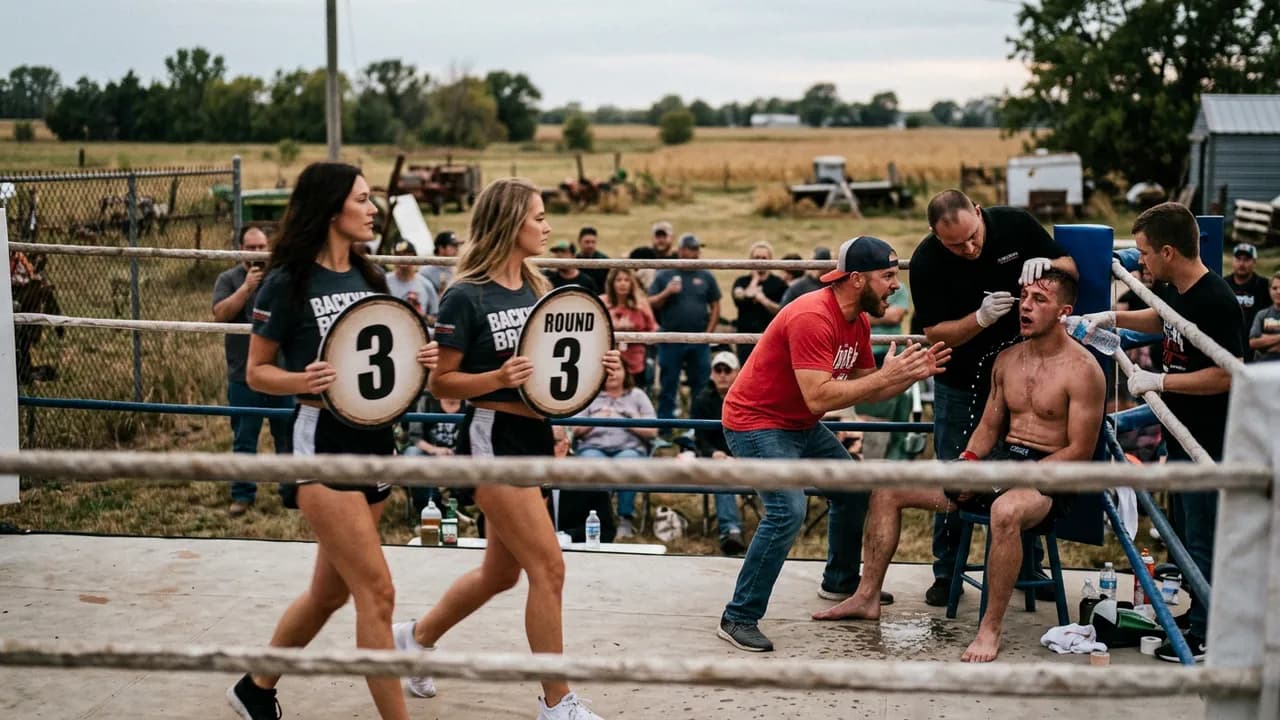
Calcio Storico does not fit neatly into the categories that define modern underground fighting. It is not a promotion. It is not a YouTube channel. It is not a backyard operation. It is a 500-year-old sport with institutional support, civic pride, and deep cultural roots that has more in common with medieval tournament combat than with anything happening in Virginia backyards or Russian sand rings.
And yet, it belongs in the conversation. Calcio Storico is organized violence between consenting adults, conducted outside the framework of modern athletic commissions and combat sports regulations. It is more dangerous than most underground fighting events. It produces more injuries. It operates under rules that would be unrecognizable to any state boxing commission.
The sport represents a different branch of the same tree that produced King of the Streets, Strelka, and every other organization that operates outside the mainstream combat sports establishment. The motivations are different -- neighborhood pride rather than personal grudges or YouTube views -- but the fundamental act is the same: human beings fighting each other because something deeper than logic compels them to.
The Future of the Tournament
Calcio Storico has survived for five centuries. It has survived wars, plagues, political upheaval, and a one-year suspension for excessive violence. It will almost certainly survive whatever the 21st century throws at it.
The tournament remains the third week of June, every year, in the Piazza Santa Croce. The teams still represent the same four neighborhoods. The prize is still a cow. And the violence is still as raw and uncompromising as it was when Florentine aristocrats played the game while their city was under siege in 1530.
In a world of pay-per-view events, social media promotions, and algorithmically optimized fight content, Calcio Storico is a reminder that organized combat existed long before the internet and will exist long after the last YouTube channel is deleted.
Watch on YouTube
Watch Calcio Storico tournament footage from across the years:
- Calcio Storico: The World's Most Brutal Sport -- Documentaries and explainer videos about the 500-year tradition
- Calcio Storico Fiorentino: Best Highlights -- Top moments from recent annual tournaments
- Calcio Storico: Complete Match Footage -- Full and extended match footage from the Piazza Santa Croce
Search YouTube for "Calcio Storico Fiorentino" to find official tournament footage, documentaries, and fan-recorded highlights from this annual Florentine tradition.
For other historic and traditional fighting events, see our coverage of Strelka's biggest events. For the modern underground fighting scene, read about Streetbeefs' biggest events.